


Investors are always on the hunt for stocks that deliver market-beating gains. Of course, finding big-time winners is much easier said than done, but investors can still deploy a basic framework that puts them on the path to reaping outsized returns.
But what are some key traits that drive market outperformance?
Let’s take a closer look at a few common traits among companies delivering outsized gains over the past year.
Robust Sales Growth
Sales growth is vital for a company’s shares to outperform, as it’s the foundation of generating profits. Strong revenue generation enables companies to achieve scaling efficiencies, deliver sustained shareholder value, and realize many other clear benefits.
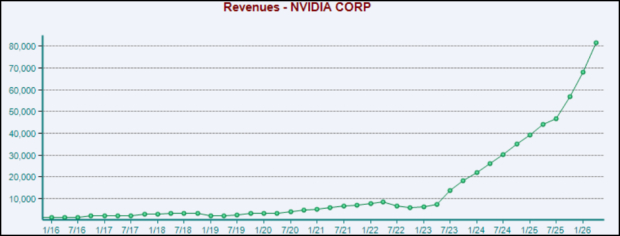
A clear-cut example of this has been NVIDIA NVDA over the last several years, whose shares have seen a historical move thanks to the AI frenzy. Below is a chart illustrating the company’s sales on a quarterly basis over the last decade.
Image Source: Zacks Investment Research
Margin Expansion
Margin expansion pleases the market, essentially signaling that a company is extracting more value from each dollar of sales. It indicates that a company is operating more efficiently, with better cost controls and other operational processes driving improved financial health.
Bottom Line
All investors look to reap outsized gains. When it comes to outperformance, robust sales growth, margin expansion, and innovation are all contributing factors.
Beyond Nvidia: AI's Second Wave Is Here
The AI revolution has already minted millionaires. But the stocks everyone knows about aren't likely to keep delivering the biggest profits. AI’s second wave is moving from infrastructure to implementation and these companies are at the forefront of this transition, positioned to become what Amazon and Google were to the internet era.
See Stocks Now >>Want the latest recommendations from Zacks Investment Research? Today, you can download 7 Best Stocks for the Next 30 Days. Click to get this free report
NVIDIA Corporation (NVDA): Free Stock Analysis Report
This article originally published on Zacks Investment Research (zacks.com).