


Cerebras Systems (CBRS) has been one of the most talked-about IPOs of 2026, but until recently, investors had limited insight into what Wall Street’s analysts really thought about the AI chipmaker. That’s because newly public companies are subject to a post-IPO “quiet period,” during which analysts affiliated with the IPO’s underwriters are restricted from publishing research reports.
With that restriction now behind it, Cerebras is finally receiving its first wave of formal Wall Street coverage. The response has been notably bullish. Several prominent brokerage firms initiated coverage on CRBS, highlighting the company’s massive wafer-scale AI chips and its potential to carve out a meaningful position in the rapidly growing AI infrastructure market.
More Top Stocks Daily: Go behind Wall Street’s hottest headlines with Barchart’s Active Investor newsletter.
The flurry of “Buy” ratings and optimistic price targets helped fuel a rebound in CRBS stock following its post-IPO pullback. After weeks of waiting, investors are now getting a clearer sense of how analysts view Cerebras’ technology, growth prospects, and ability to compete in the booming AI race.
For shareholders, Wall Street’s first verdict has been difficult to ignore.
About Cerebras Stock
Founded in 2015 and headquartered in Sunnyvale, Cerebras Systems has built a reputation for pushing the limits of AI computing. The company designs and manufactures specialized AI infrastructure, including its flagship CS-2 and CS-3 systems, used for AI training and inference at data center and supercomputer scale.
Its breakthrough technology, the Wafer-Scale Engine (WSE), transforms an entire silicon wafer into a single processor, making it the world’s largest AI chip and offering performance advantages for generative AI and other demanding workloads. Serving hyperscalers, AI labs, enterprises, and sovereign AI initiatives worldwide, Cerebras operates across the Americas, Europe, the Middle East, and Africa.
With a market value of roughly $43.2 billion, Cerebras is emerging as a notable challenger in AI computing, though it still faces formidable competition from industry leaders.
Cerebras Systems arrived on Wall Street with plenty of excitement and quickly became one of the most talked-about IPOs of 2026. When the AI chipmaker first announced its public offering, shares were expected to price between $115 and $125. Demand turned out to be far stronger than anticipated. Cerebras ultimately sold 34.5 million shares, including the underwriters’ option exercise, at $185 per share.
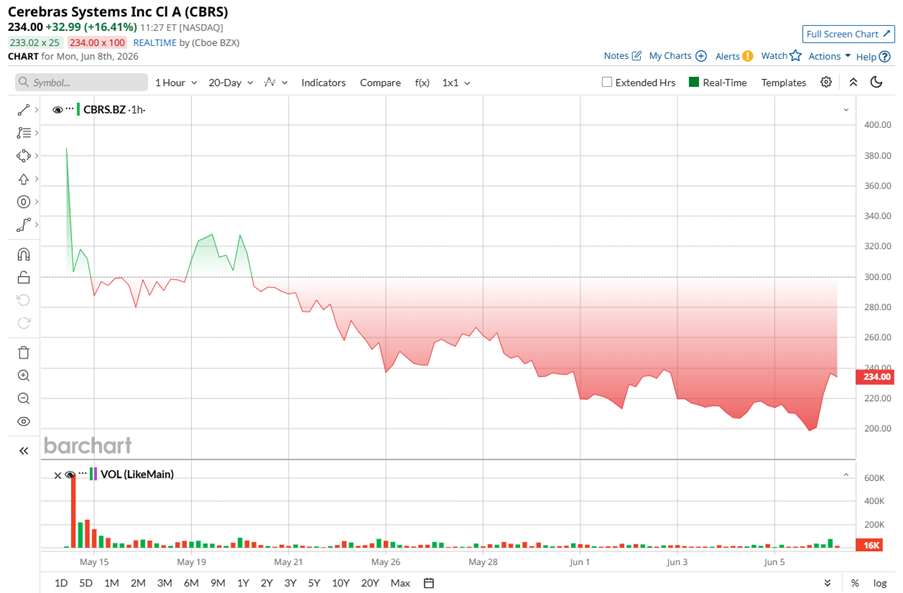
Investors wasted little time piling in. On its first day of trading on May 14, CRBS stock surged nearly 68%, finishing the session at $311.07. At one point during that debut session, shares climbed to an intraday high of $386.34, underscoring the intense excitement surrounding AI infrastructure plays.
Since then, however, the stock has come back down to earth. Shares have retreated from their first-day peak as investors reassessed valuations and enthusiasm across the AI sector. Even so, the pullback does not necessarily diminish the company's long-term prospects. Instead, it reflects a healthier balance between expectations and fundamentals.
Interestingly, sentiment appears to be improving again. In the past day, CRBS stock has been climbing impressively, supported by a wave of bullish analyst coverage. Several analysts argue that the post-IPO pullback has created an opportunity to own a fast-growing AI infrastructure company at a more reasonable valuation than investors were offered during the stock’s euphoric debut.
 www.barchart.com
 Cerebras’ Revenue Growth Matched the Excitement
Cerebras has generated plenty of attention for its wafer-scale AI chips, but the company’s latest financial results suggest there is much more to the story than cutting-edge technology. The numbers show a business that is beginning to translate innovation into meaningful commercial success.
According to its amended S-1 filing, Cerebras reported revenue of $510 million in 2025, representing a robust 76% year-over-year (YOY) growth. Even more striking was the company’s bottom-line turnaround. After posting a net loss of $481.6 million in fiscal 2024, Cerebras swung to a net income of $237.8 million in 2025. For investors, that combination of rapid growth and improving profitability is often the sweet spot, especially in an AI industry where many companies are still prioritizing expansion over earnings.
The growth story may only be getting started. As of December 2025, Cerebras reported remaining performance obligations (RPO) of $24.6 billion, providing a substantial backlog of contracted business. The company expects to recognize roughly 15% of that amount before the end of 2027, implying about $3.69 billion in potential revenue over the next two years from existing contracts alone. As new customers and agreements are added, that revenue pipeline could become even larger.
Just as important, Cerebras appears to have the financial firepower to execute its ambitions. Following adjustments for IPO proceeds, the company’s pro forma balance sheet shows a cash position of approximately $5.7 billion, giving management significant flexibility to invest in infrastructure, product development, and market expansion.
Also, the customer roster adds credibility. Alongside OpenAI, Cerebras counts G42 and MBZUAI among its clients. And, it has secured an agreement with Amazon (AMZN) to deploy Cerebras systems in AWS data centers, a partnership that reinforces the company’s standing in the AI ecosystem.
Looking ahead, the opportunity is enormous. Dell’Oro Group projects data center infrastructure spending will reach $1.7 trillion by 2030, growing at a 21% CAGR between 2025 and 2030. With its CS-3 system driving growth and a portfolio of 96 issued patents plus 50 pending applications as of March 2026, Cerebras appears well-positioned to ride the AI boom for years to come.
Analysts Launch Bullish Coverage on Cerebras Stock
After the post-IPO pullback, Wall Street is increasingly warming up to the Cerebras story. A wave of analyst initiations on Monday signaled growing confidence that the AI infrastructure company could still have significant upside ahead.
Mizuho analyst Vijay Rakesh initiated coverage with an “Outperform” rating and a $300 price target. Rakesh believes Cerebras has a unique advantage in one of the fastest-growing segments of AI – inference, the process of running trained AI models in real-world applications. Unlike traditional AI systems that rely on thousands of interconnected chips, Cerebras’ wafer-scale architecture is designed to deliver high-speed inference while reducing the networking and packaging complexity associated with competing solutions.
As AI increasingly shifts toward agentic applications, where models perform tasks autonomously, Rakesh sees Cerebras as particularly well-positioned. In his view, the company has established itself as a leader in “fast inference,” a capability that could become increasingly valuable as enterprises demand quicker AI responses.
There have been concerns that much of Cerebras’ backlog at the end of 2025 was tied to a single OpenAI cloud agreement, but the company’s growing relationship with Amazon Web Services helps diversify that narrative and strengthens its commercial credibility.
Wedbush analyst Matt Bryson launched coverage with a “Buy” rating and a $270 price target. The analyst argues that Cerebras combines a differentiated technology platform, major contracts with OpenAI and AWS, and exposure to a market that is only beginning to recognize the value of AI speed.
The most bullish so far has been Citi’s Atif Malik, who initiated with a “Buy” rating and set a price target of $340. In fact, Morgan Stanley’s Joseph Moore summarized, CBRS offers investors a “unique chance to invest in an AI processor company with a first-mover advantage against NVIDIA.” The analyst set a target of $250 with an “Overweight” rating.
Taken together, many on Wall Street believe the recent pullback may have created an attractive opportunity for investors willing to bet on the company’s long-term growth story.
On the date of publication, Sristi Suman Jayaswal did not have (either directly or indirectly) positions in any of the securities mentioned in this article. All information and data in this article is solely for informational purposes. For more information please view the Barchart Disclosure Policy here.
More news from Barchart
Following the Post-IPO Quiet Period Expiration, Here’s Why Cerebras Stock Is Moving Higher When Investors Finally Get Sick of AI Stocks, This Medical Devices ETF Could Be a Long-Term Winner Broadcom's Sell-Off Is Overdone - Based on its FCF Margins, AVGO Could Be Worth Double The $115 Million Reason ABAT Stock Is Up Today