

After years of losing the plot, Intel (INTC) seems to be gaining back its mojo. While skeptics may dismiss it as a government-led bailout of the beleaguered chip giant, Intel is slowly stacking up the “W's”. This time it is from Alphabet's Google (GOOGL) (GOOG).
According to a report on The Information, Intel has secured an order to build three million TPU chips for Google. To be manufactured in 2028, Intel's advanced packaging capabilities worked in favor of the chip major for this order.
More Top Stocks Daily: Go behind Wall Street’s hottest headlines with Barchart’s Active Investor newsletter.
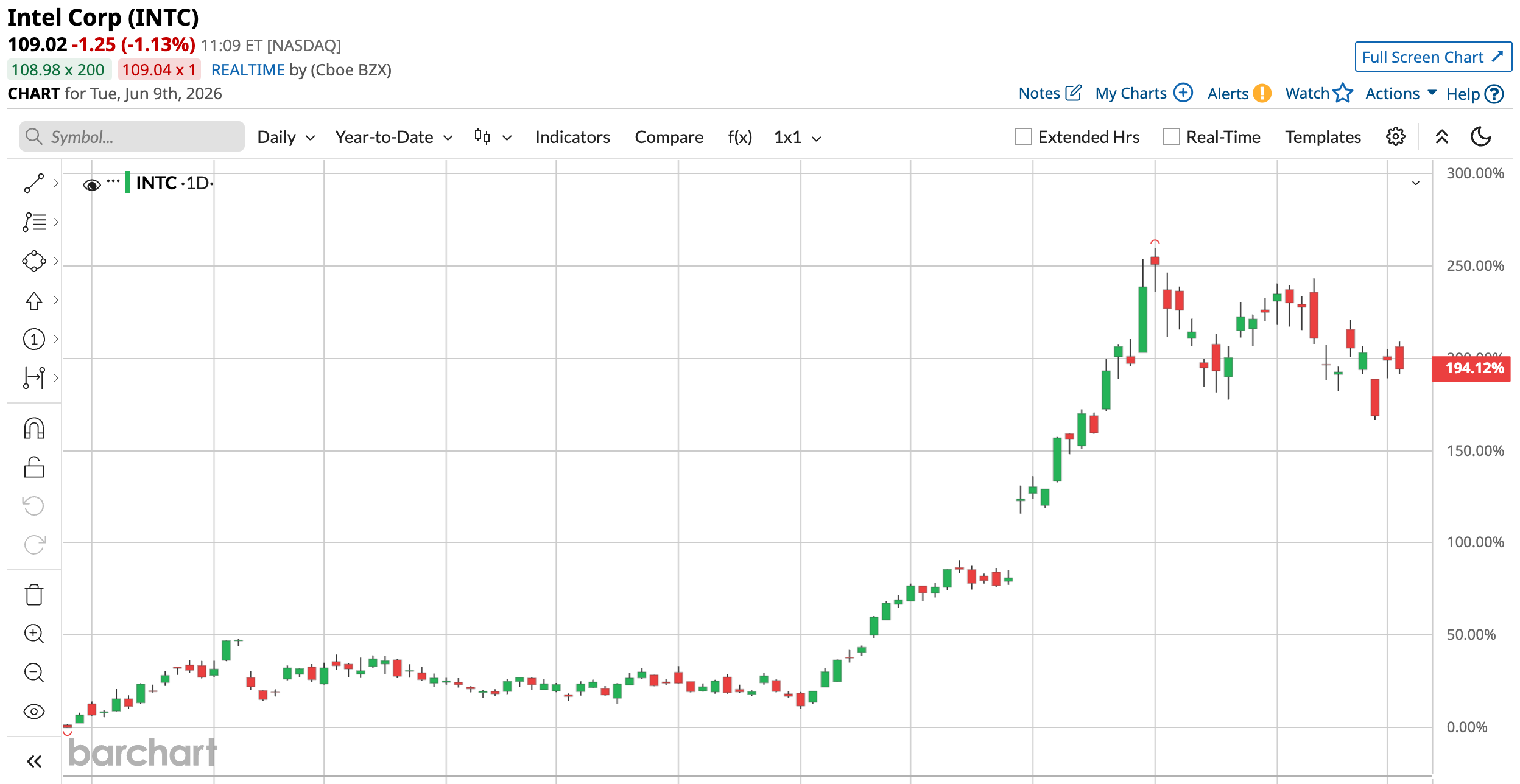
Shares reacted positively to the news, rallying by more than 11% in Monday's trading session. Notably, INTC stock is already up 191.72% year-to-date (YTD) and holds a market cap of $554 trillion dollars, a benchmark unthinkable for the company just about five years ago.
 www.barchart.com
  www.barchart.com
 Diversification Not The Sole Reason
Several market experts are citing diversification from the world's largest manufacturer of chips, TSMC (TSM), as the reason behind this move from Google. There is definitely substance to this theory, but it doesn't represent the entire picture.
The packaging angle is where the real logic sits, and it deserves more attention than it typically receives. Intel's core technology is EMIB, its Embedded Multi-die Interconnect Bridge, which is a silicon bridge embedded directly in a substrate that provides high-density die-to-die connectivity without the cost and area overhead of a full-size silicon interposer. TSMC's equivalent is CoWoS, and the problem is simple. TSMC's CoWoS capacity remains tightly constrained, and Intel's EMIB yields have reportedly reached approximately 90%.
Moreover, what makes EMIB genuinely attractive to Google is its HBM integration story. Intel's EMIB-T variant, which adds through-silicon vias to the bridge, supports scaling beyond 8 times reticle size in a 120 by 120 millimeter package configuration, enabling integration of up to 12 HBM stacks and four high-density chiplets, which is exactly the kind of memory bandwidth architecture that Google's TPU designs demand. Google's TPU v8e, scheduled for the second half of 2027, is expected to leverage Intel's EMIB technology, meaning this manufacturing order can be one of many in the future.
Beyond packaging, other technical reasons are worth considering. Google has been increasingly aggressive about owning its AI infrastructure stack, and a multi-generation dependency on a single foundry for its most critical custom silicon carries real supply chain risk at the scale Google operates. Intel CFO David Zinsner noted on the Q1 2026 earnings call that the advanced packaging business revenue potential is now expected to exceed $1 billion, with EMIB and EMIB-T customers expected as early as the second half of 2026, bringing several billion dollars in revenue, which confirms that Google's engagement is part of a broader hyperscaler validation cycle rather than a standalone deal.
There is also a cost dimension. EMIB avoids the full interposer required by CoWoS, which structurally reduces packaging costs per unit at the volumes Google is ordering.
Numbers On The Right Path
Intel delivered a strong start to 2026 with a clear double beat on both revenue and profit figures during the first quarter.
Total revenue rose 7% year-over-year (YOY) to $13.6 billion. The main drivers were the Data Center and Artificial Intelligence segments, together with the Foundry business. The Data Center and Artificial Intelligence unit grew 22% to $5.1 billion, and the Foundry segment advanced a solid 16% to $5.4 billion. Meanwhile, the Client Computing Group, which remains Intel’s biggest revenue contributor, posted only modest growth of 1% to $7.7 billion, held back by supply issues and a saturated personal computer market.
On the earnings side, non-GAAP earnings per share more than doubled to $0.29, beating consensus estimates by a healthy margin. This result extended the company’s run of consecutive earnings beats to three quarters.
Management guided for second quarter revenue in the range of $13.8 billion to $14.8 billion, with non-GAAP earnings per share expected at $0.20. Wall Street currently anticipates $14.39 billion in revenue and $0.21 per share.
Also, cash flow strengthened, as net cash from operating activities increased to $1.1 billion from $813 million in the year ago period. Intel closed the quarter with a robust cash balance of $17.7 billion, comfortably exceeding its short term debt of approximately $2 billion.
Valuation continues to represent a notable challenge for the INTC investment story. The shares trade at a premium to both industry peers and the company’s own historical norms. The forward price-to-earnings of 101.11 times, forward price-to-sales of 9.43 times, and price-to-cost flow of 44.22 times all stand well above sector medians. As a result, the stock depends heavily on consistent operational execution to validate the higher valuation the market has placed on it.
Analyst Opinion
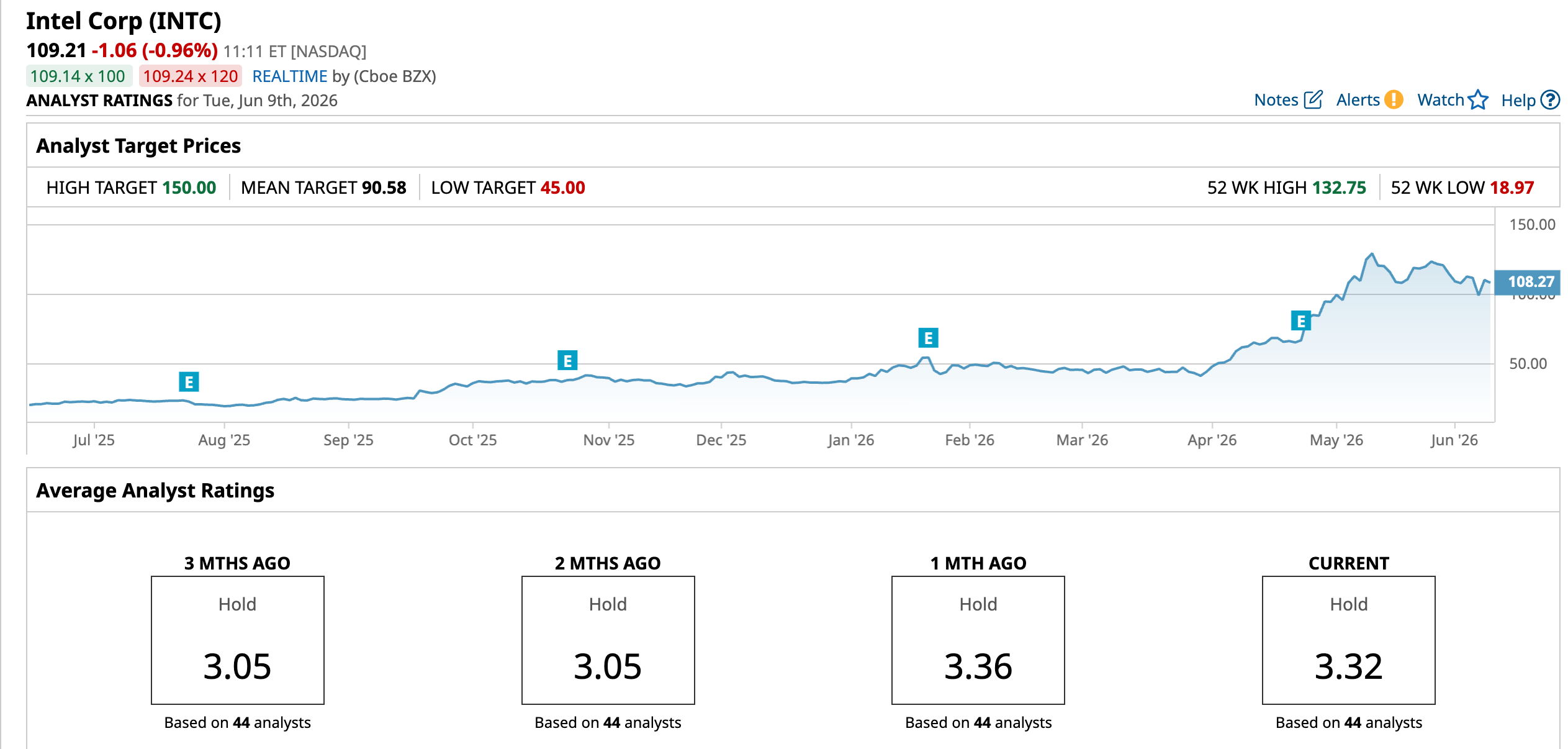
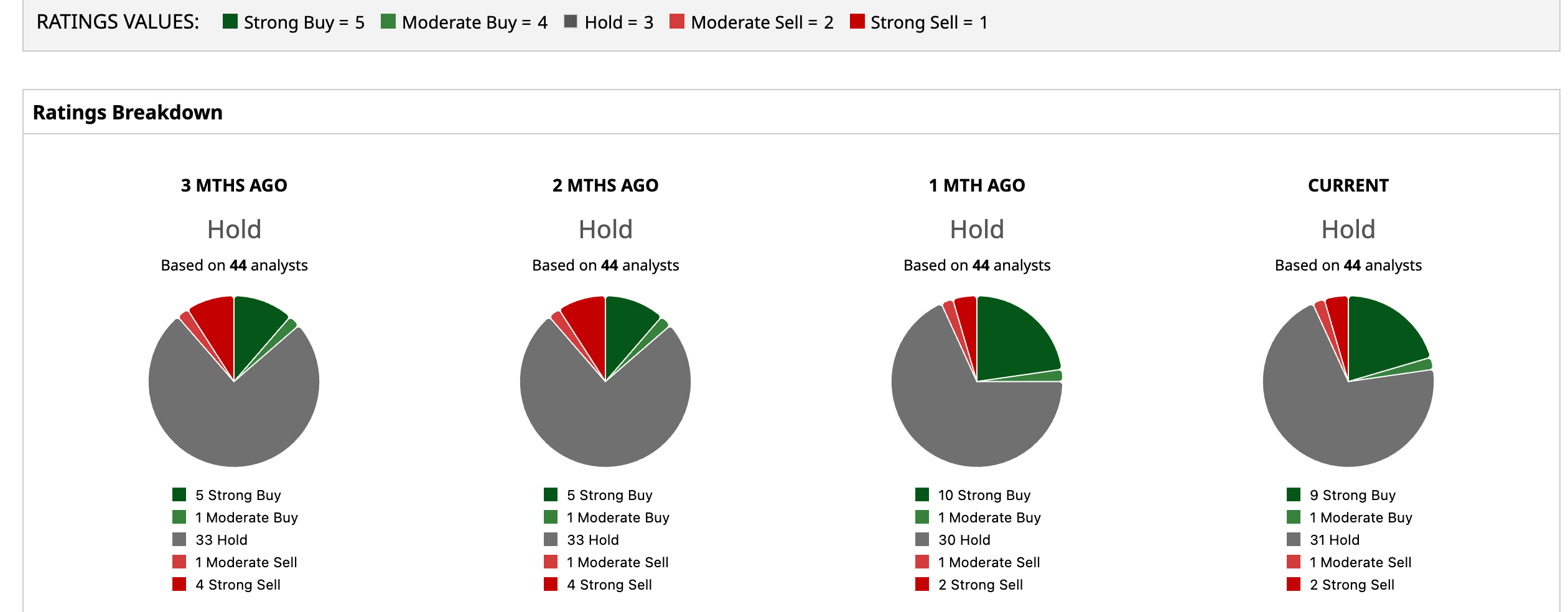
Overall, analysts have deemed a rating of “Hold” for INTC stock, with the mean target price already surpassed. However, the Street-high target price of $150 indicates potential upside of 37.35% from current levels. Out of 44 analysts covering INTC stock, nine have a “Strong Buy” rating, one has a “Moderate Buy” rating, 31 analysts have a “Hold” rating, one has a “Moderate Sell,” and two have a “Strong Sell” rating.
 www.barchart.com
  www.barchart.com
 On the date of publication, Pathikrit Bose did not have (either directly or indirectly) positions in any of the securities mentioned in this article. All information and data in this article is solely for informational purposes. For more information please view the Barchart Disclosure Policy here.
More news from Barchart
MicroStrategy Is Buying the Bitcoin Dip. Why Investors Are Turning Course and Suddenly Rewarding MSTR Stock. Billionaire Mark Cuban Says America’s Drug Pricing System Makes Patients Pay the Highest Price, ‘Make It Make Sense. It Doesn’t.’ Intel Shares Soar on Google Deal To Build TPUs. Here's What It Means for INTC Stock. This AI Fiber Play Is Backed by Amazon, Meta, and Nvidia and Has Long-Term Potential