


You’ve probably never heard of this ETF before.
You should. Knowing how to use this tool will help ensure you are a step ahead of the game the next time the stock market rolls over. When that happens, the high-flying stocks that have driven the current bull market are likely to be the downside leaders too.
More Yield, Less Trap: Sign up free to get Barchart’s daily Dividend Investor newsletter straight to your inbox.
That’s the premise behind the AGFiQ US Market Neutral Anti-Beta Fund (BTAL), an ETF that has an absolutely atrocious performance track record.
Go ahead and ignore that performance. Underneath the surface, BTAL is signaling a major shift in how institutional capital is managing risk.
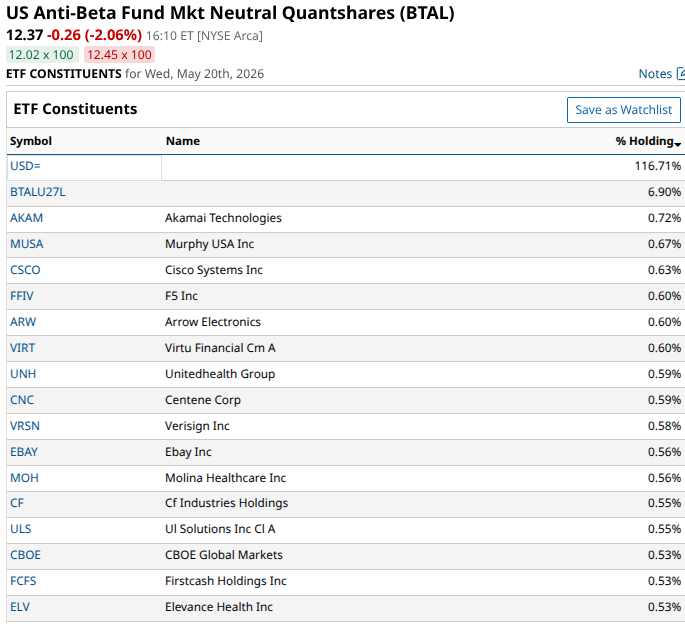
To help you understand what’s happening here, see the biggest BTAL holdings by weight below. These are long positions in lower-volatility stocks.
 www.barchart.com
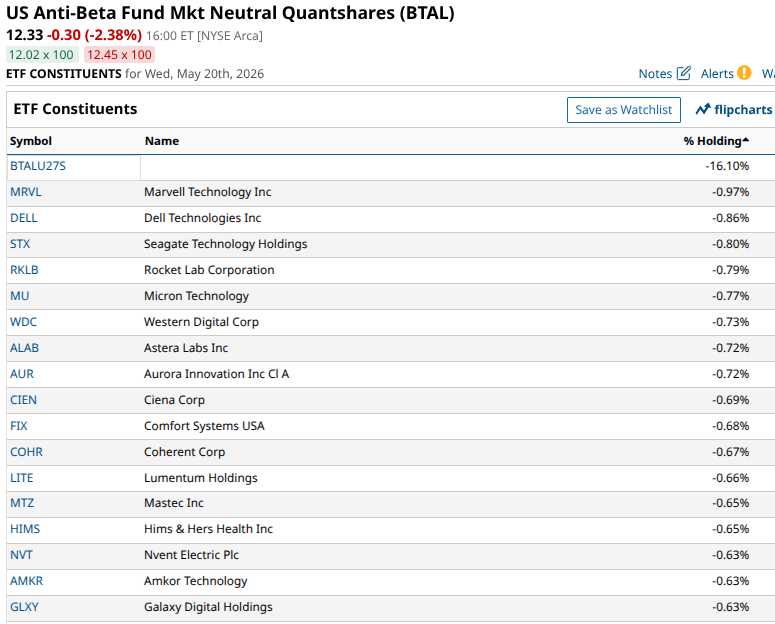
 Now, here are the smallest positions. What do you notice? They all have negative signs. Because they are short positions. And mostly tech and smaller companies. These are the stocks with higher historical volatility.
 www.barchart.com
 Let’s summarize. BTAL operates through a unique, market-neutral structure. It shorts high-beta momentum stocks and takes long positions in low-beta defensive equities.
In a typical momentum-driven market, this ETF languishes. But when the “hot” pockets of the market begin to lose their footing and institutional investors start quietly liquidating their most volatile exposures, BTAL functions as a highly sensitive leading indicator.
 www.barchart.com
 Who You Gonna Call? BTAL!
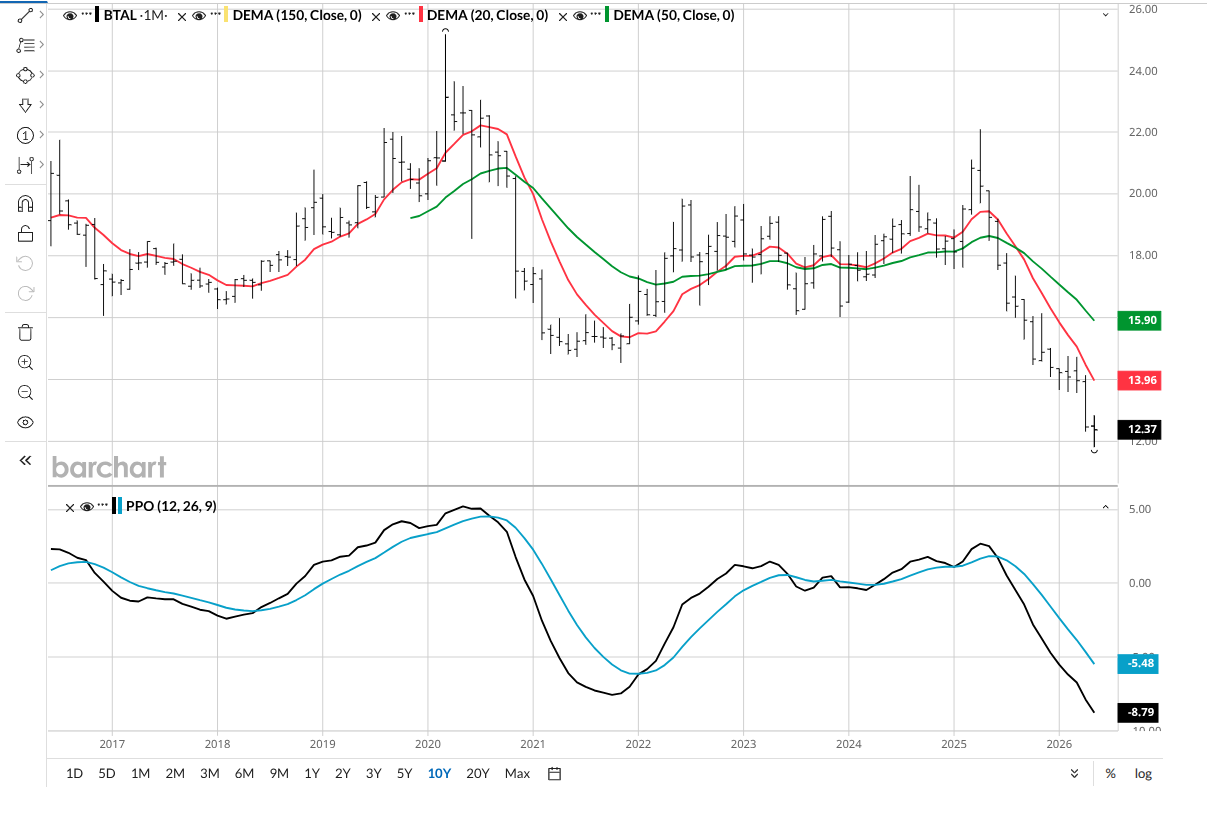
This monthly chart tells me what I already know. That betting against volatile growth stocks has been a losing effort for the past decade. But when that cycle finally turns, BTAL might as well be Ghostbusters. It’s who you gonna call!
 www.barchart.com
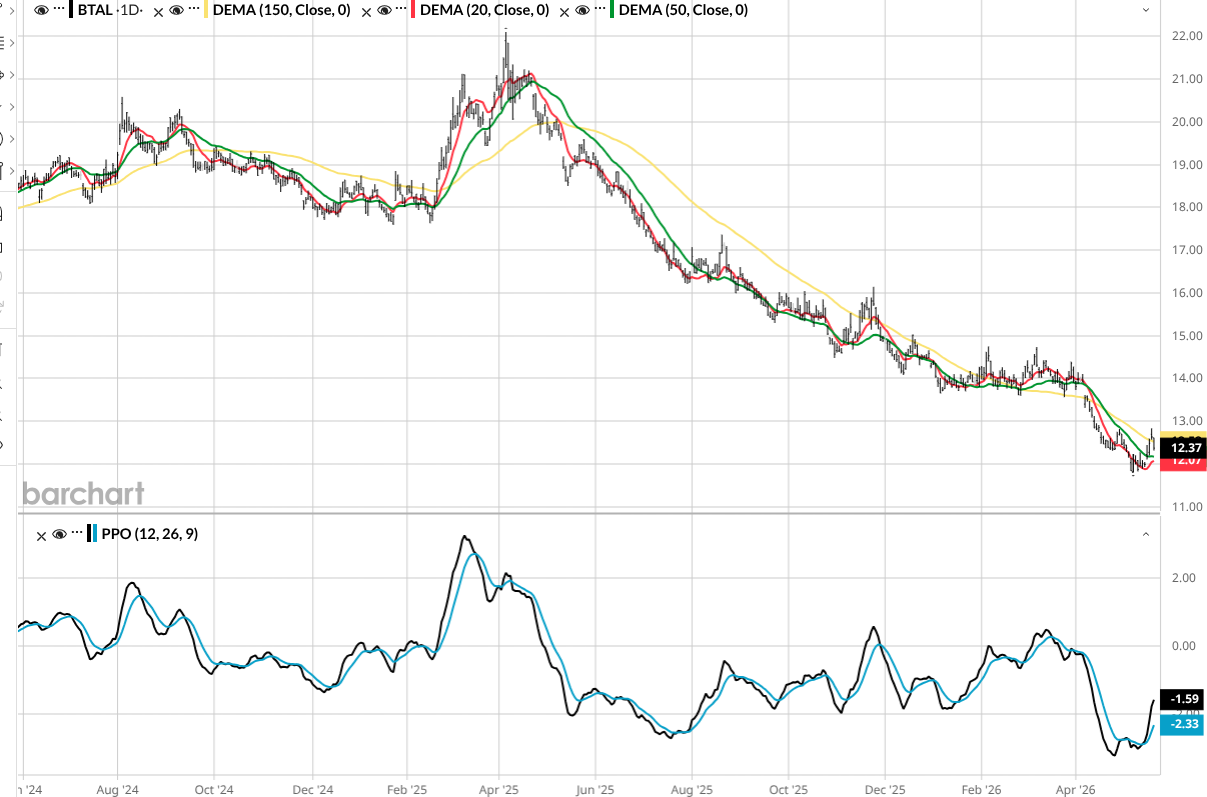
 During recent market soft spots, a telling divergence has occurred. While the broader technology complex has experienced seemingly mild, orderly pullbacks at the index level, BTAL has surged higher.
Over a recent five-day stretch where the tech-heavy Invesco QQQ ETF (QQQ) slipped just 1.2%, BTAL jumped a remarkable 3.9%. This outperformance highlights a profound dynamic under the market’s hood: institutional investors are aggressively dumping high-volatility names well beyond the mega-cap tech behemoths that dominate nightly headlines.
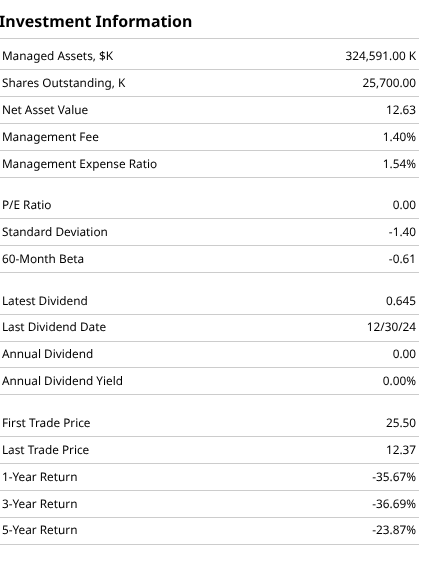 www.barchart.com
 The two important data points in this table above are the managed assets and 60-month beta. The assets tell me BTAL is not widely known. I like under-the-radar ETFs with a specific role.
And the beta is -0.6. That implies that if the S&P 500 Index ($SPX) fell 10%, BTAL is expected to rise by 6%. The opposite is also assumed.
BTAL historically operates as an efficient counterweight to broad equity exposure, often capturing a substantial portion of down-market moves in reverse. It is fundamentally a play on high-volatility stocks falling faster and harder than lower-volatility stocks.
The fact that BTAL is experiencing steady accumulation right now tells us that the average stock is facing intense distribution, even as a handful of artificial intelligence leaders keep the major averages pinned near all-time highs.
For the self-directed investor, analyzing BTAL is not about trying to time a short-term trade; it is about recognizing when market breadth has decayed to a dangerous extreme. When broad-market indices are propped up by an incredibly narrow leadership class, the margin for error disappears entirely.
The quiet, persistent strength in BTAL is a warning that underneath the superficial calm, professional money managers are actively battening down the hatches and positioning for a more systemic equity reversal. It can be a very useful tool for portfolio defense, exposing the true level of distribution that cap-weighted indices actively conceal.
Rob Isbitts created the ROAR Score, based on his 40+ years of technical analysis experience. ROAR helps DIY investors manage risk and create their own portfolios. For Rob’s written research, check out ETFYourself.com.
On the date of publication, Rob Isbitts did not have (either directly or indirectly) positions in any of the securities mentioned in this article. All information and data in this article is solely for informational purposes. For more information please view the Barchart Disclosure Policy here.
More news from Barchart
Why Billionaire George Soros Is Betting Big on Talkspace Stock When Growth Stocks Finally Collapse, You’ll Want This 1 Anti-Beta ETF in Your Portfolio Micron Stock is Up over 133% From Its Lows - But Is MU Still Undervalued? Sickly Healthcare Stocks Are Perking Up. For Contrarian Investors, Buying Now Could Be Just the Remedy to Protect Your Portfolio.