

The semiconductor industry has spent the last several years confronting a reality few expected: there simply aren't enough advanced chip manufacturing options. Taiwan Semiconductor Manufacturing Company (TSM) has become the dominant producer of leading-edge chips, powering everything from artificial intelligence accelerators to smartphones. As AI demand continues to expand, customers are increasingly looking for alternatives—not necessarily to replace TSMC, but to ensure they have a backup plan if capacity becomes constrained.
That possibility is helping fuel another remarkable rally in Intel (INTC) stock today.
More Top Stocks Daily: Go behind Wall Street’s hottest headlines with Barchart’s Active Investor newsletter.
 www.barchart.com
 Google May Be the Latest Big Name to Turn to Intel
According to a Reuters report citing information originally published by The Information, Alphabet's (GOOG) (GOOGL) Google has reportedly placed an order with Intel to manufacture more than three million tensor processing units (TPUs) beginning in 2028. Reuters noted it was unable to independently verify the report.
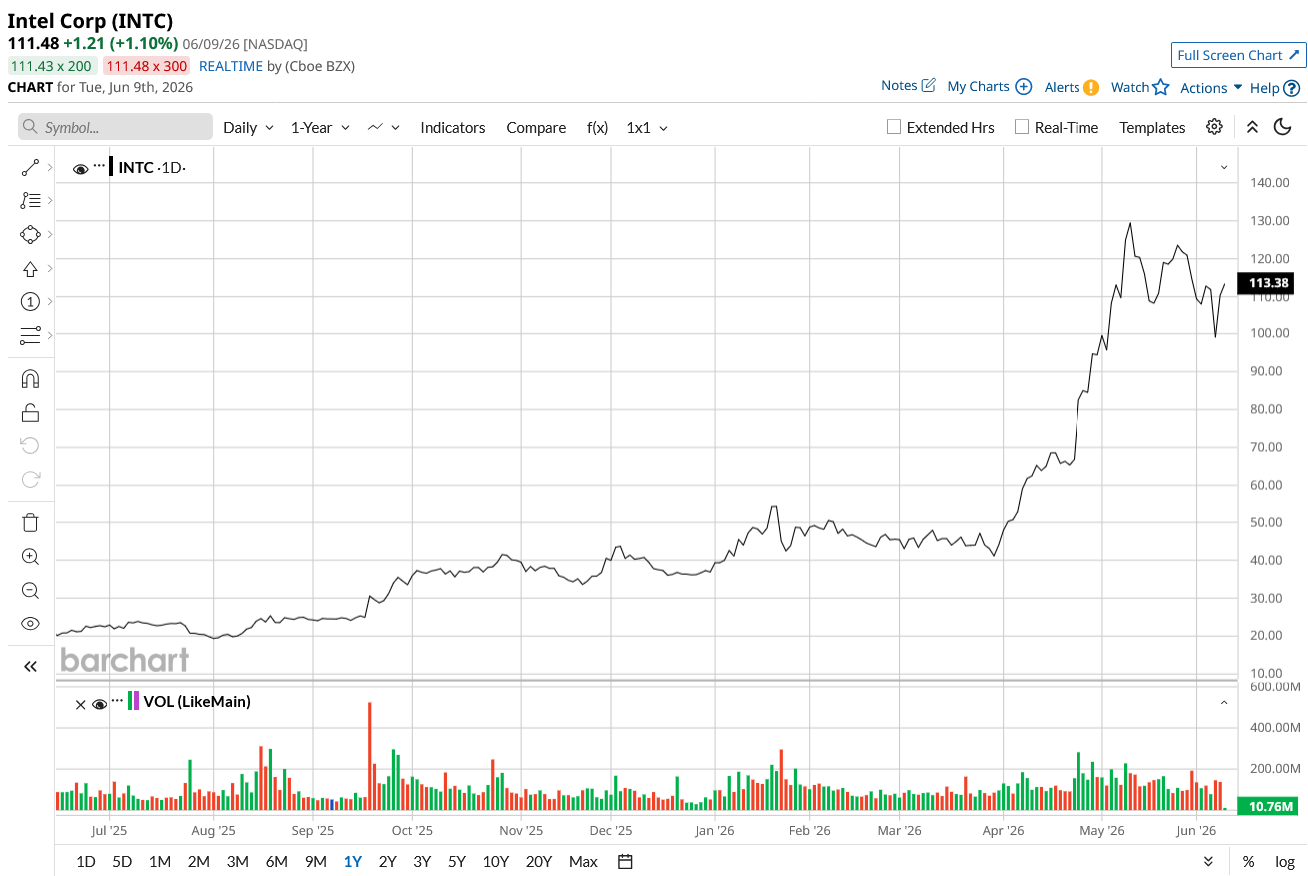
Even so, investors reacted quickly. Intel shares climbed roughly 11% in morning trading following the news. The move adds to an already stunning run that has seen the stock gain 204% year-to-date (YTD) and 448% over the past 12 months.
If the report proves accurate, Google would join a growing list of technology giants willing to give Intel Foundry a chance. More importantly, it would signal that some of the largest AI infrastructure builders are actively seeking alternatives to Taiwan Semiconductor.
Let's look at why that matters.
Nvidia's Interest Isn't New
The Reuters report also indicated that Nvidia (NVDA) is evaluating Intel as a potential manufacturing partner.
That may sound surprising given Nvidia's deep relationship with TSM, but it isn't the first time Intel has appeared on Nvidia's radar.
According to reports from late 2025, Nvidia had previously tested Intel's 18A manufacturing process for potential next-generation AI chips. Those evaluations reportedly stopped in December without advancing to production.
Yet the story didn't end there. Nvidia has already invested $5 billion in Intel, giving it a financial incentive to see Intel's foundry business succeed. While that investment alone doesn't guarantee future manufacturing contracts, it does make renewed discussions easier to understand.
In short, if Nvidia eventually awards Intel some production volume, it would represent a continuation of an existing relationship rather than a sudden change in strategy.
Intel's Customer List Continues to Grow
Google and Nvidia aren't the only names linked to Intel's foundry ambitions.
Intel has previously announced agreements involving both Microsoft (MSFT) and Amazon (AMZN), two other hyperscale technology companies building massive AI infrastructure networks.
Here's what the customer landscape currently looks like:
| Company | Relationship with Intel Foundry |
| Reportedly ordering 3+ million TPUs in 2028 | |
| Nvidia | Reportedly evaluating manufacturing options |
| Microsoft | Previously announced foundry customer |
| Amazon | Previously announced foundry customer |
The numbers tell an important story. Intel doesn't need to immediately overtake TSM to succeed. Instead, it can carve out a role as the semiconductor industry's second source—a trusted backup supplier capable of absorbing demand when customers want manufacturing diversification.
That may ultimately be a far more realistic path to success.
Key Takeaway
Intel's latest surge rests on a report that Reuters could not independently verify, so investors should treat today's excitement with appropriate caution. Rumors alone do not create foundry revenue.
That said, the broader trend is becoming harder to ignore. Google is reportedly considering Intel. Nvidia appears willing to keep the conversation going. Microsoft and Amazon have already signed on. Collectively, these companies represent some of the largest buyers of advanced semiconductors in the world.
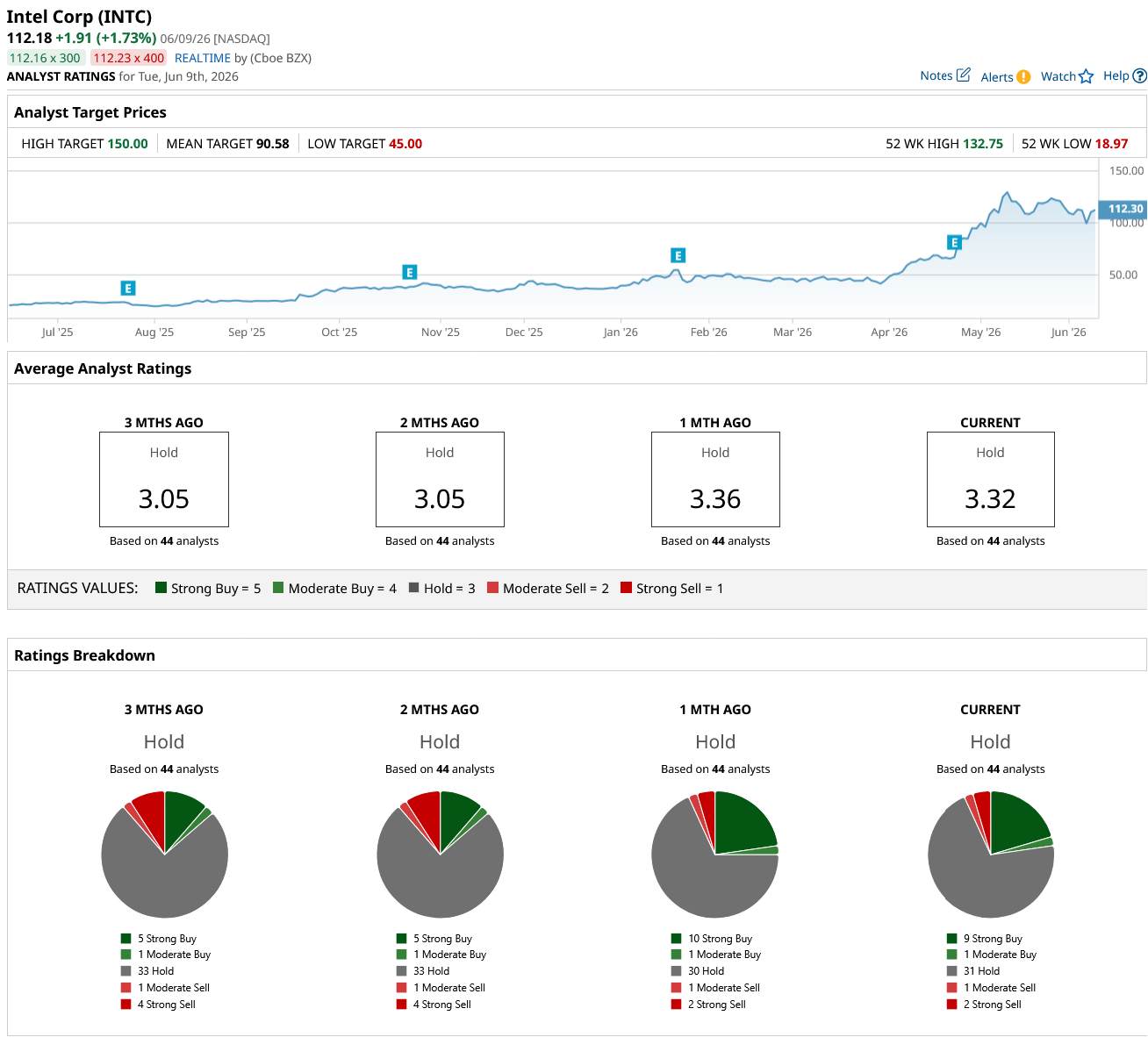
Wall Street, though, remains cautious despite the rally. According to analyst consensus data, Intel carries a "Hold" rating, and the average price target of $90.58 sits roughly 19% below the current share price near $110.
Regardless, Intel may not need to become the next TSMC to justify its turnaround story. If it can establish itself as the semiconductor industry's preferred Plan B, the opportunity could still be measured in tens of billions of dollars. For shareholders, that may be the most important development of all.
 www.barchart.com
 On the date of publication, Rich Duprey did not have (either directly or indirectly) positions in any of the securities mentioned in this article. All information and data in this article is solely for informational purposes. For more information please view the Barchart Disclosure Policy here.
More news from Barchart
McDonald’s Stock Could Be Bottoming, Creating a Contrarian Bet for Long-Term Investors Intel Becomes Plan B for the Semiconductor Industry. Here's How That's a Winning Strategy Dear KLA Stock Fans, Mark Your Calendars for June 12 Iran War Apathy Has Left Rare Earth Stocks in Critical Condition. Stay Far Away from the REMX ETF’s Dangerous Trap.