

Chip makers just reminded the market how quickly sentiment in tech can turn. The latest compression method from Google researchers, which could sharply cut the memory needed for AI tasks, helped trigger a broad selloff in big semiconductor names and pulled the Nasdaq to fresh multi-month lows.
That slide came on top of mounting worries about the Iran war, with surging oil prices, higher bond yields, and fears of a deeper economic hit. Now one major tech sector fund built around large U.S. names is down for the year. Oppenheimer recently described this as a historic phase of relative weakness for the large-cap tech ETF in nearly 50 years. They note that the pressure really began after the initial DeepSeek-driven selloff and then intensified as Iran-related war concerns grew.
More Yield, Less Trap: Sign up free to get Barchart’s daily Dividend Investor newsletter straight to your inbox.
The setup is simple but uncomfortable, with genuine earnings power from AI, chips, and cloud on one side and headline-driven weakness on the other. Does this stretch of historic underperformance mark the start of a long fade for tech leadership, or is it offering a rare chance to buy a focused sector ETF on sale while sentiment is still shaken? Let's dive in.
Overview of S&P 500 Technology Sector SPDR (XLK)
The Technology Select Sector SPDR Fund (XLK) is the classic S&P 500 tech sleeve in ETF form, built and run by State Street Investment Management to mirror the Technology Select Sector Index as closely as possible.
The fund has been around since Dec. 16, 1998, and it currently pays an annual dividend of about $0.68, for a yield of 0.48%.
It is a plain, rules-based product by design, with XLK following a passive, full replication approach. That setup means the portfolio leans heavily toward established names across semiconductors, software, hardware, communications equipment, IT services, and electronic components, rather than smaller or unproven stories.
There are 77 holdings in total, but the top 10 make up about 61.36% of the fund, so leadership at the top matters a lot. At the moment, the biggest weights sit with Nvidia (NVDA) at 15.35%, Apple (AAPL) at 13.51%, and Microsoft (MSFT) at 9.84%.
They are followed by Broadcom (AVGO) at 5.30%, Micron Technology (MU) at 3.68%, and Advanced Micro Devices (AMD) at 3.11%. Rounding out the top group are Palantir Technologies (PLTR) at 2.93%, Cisco Systems (CSCO) at 2.75%, Applied Materials (AMAT) at 2.42%, and Lam Research (LRCX) at 2.39%.
Under the hood, XLK is large and liquid, with managed assets of about $90.06 billion and a management fee of 0.08%, which keeps costs low for a sector fund of this size.
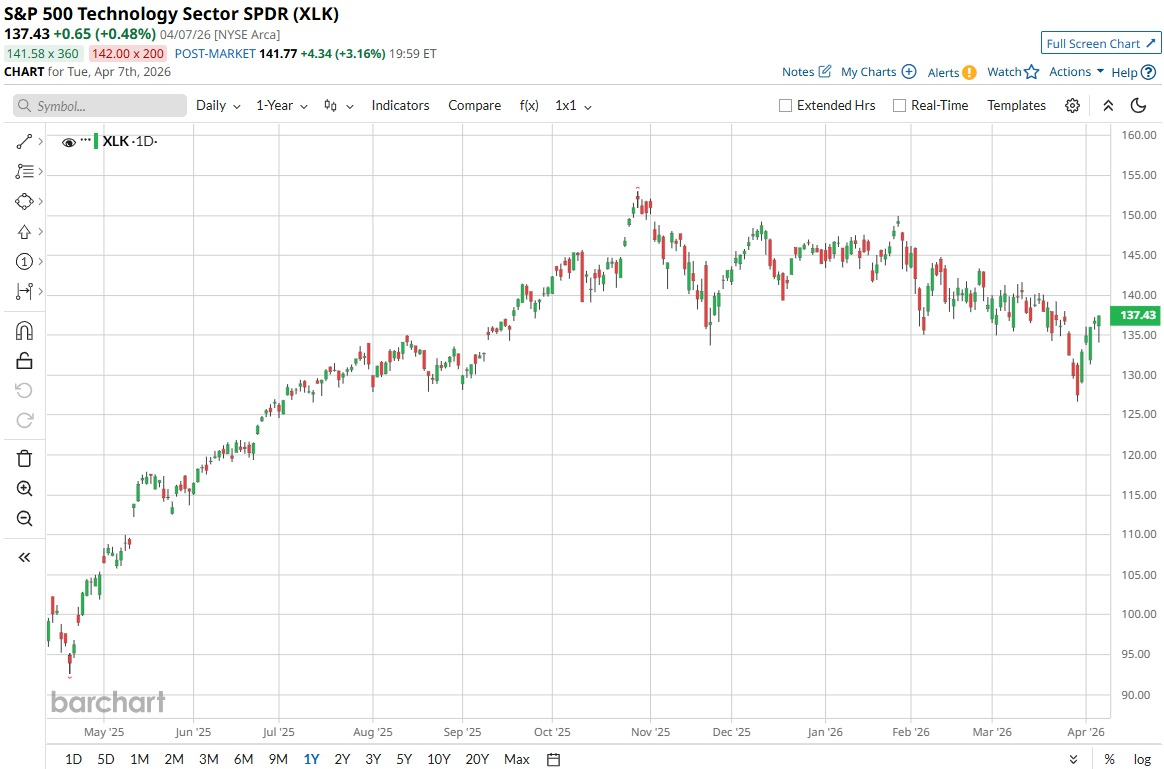
XLK’s latest figures show a price near $141.69, a year-to-date return of minus 1.58%, and a 52-week gain of 57.67%. It is very actively traded, with a recent weekly volume of 9,366,500 shares.
 www.barchart.com
 Real Demand Still Powers Tech
Global chip demand is doing a lot of the heavy lifting for big tech right now. The semiconductor revenues are forecast to move past $1 trillion for the first time in 2026. Growth for the industry is expected at 30.7% year-over-year (YOY), driven mainly by AI-focused memory and logic chips rather than a broad consumer gadget boom.
Computing and data storage are set to be the standout areas, as revenue is projected to jump 41.4% YOY and cross $500 billion. Data center servers, high-bandwidth memory, and AI-ready notebooks are soaking up capacity and supporting firmer pricing.
Chip makers are also pushing AI further out to the edge, which adds another layer of demand for core tech hardware and software. NVIDIA (the largest constituent of XLK) is rolling out new AI-centric laptop chips that will power machines from brands like Dell (DELL) and Lenovo (LNVGY). The goal is to extend AI capabilities beyond the cloud into consumer and enterprise PCs.
Further out, the software and services layer around artificial intelligence is expected to scale dramatically. The market for large language models is projected to reach $249.2 billion by 2031. That implies a compound annual growth rate of more than 30% as companies bake generative AI into customer support, analytics, and productivity tools.
Conclusion
Tech is clearly in a rough patch right now, but the setup around AI, chips, and cloud spending still points to solid long-term growth rather than a broken story. Weakness looks more like a reset after a big run than the start of a long decline. Over the next few years, prices are more likely to grind higher than collapse, even if the ride stays bumpy. So buying this dip through a focused tech fund can make sense for patient money that can handle short-term noise.
On the date of publication, Ebube Jones did not have (either directly or indirectly) positions in any of the securities mentioned in this article. All information and data in this article is solely for informational purposes. For more information please view the Barchart Disclosure Policy here.
More news from Barchart
Tech Stocks Are Experiencing Historic 50-Year Weakness. Should You Buy the Dip in This 1 ETF? Hard Disk Drive Prices Are Rising. Why That Makes Seagate Stock a Top Buy. Lockheed Martin Stock Is Up 30% in 2026 and Yields 2%. Is It a Top Buy While the Iran War Drags On? Move Over, Western Digital! Why Seagate Is the New Top Stock Pick