


Leading broker B.Riley recently upgraded shares of cloud cybersecurity firm Zscaler (ZS) to a “Buy” rating from “Neutral.” Dispelling fears about the so-called “SaaSpocalypse," the firm cited Zscaler's private cloud network, a large database of cybersecurity clients, and reliability as reasons for the upgrade.
B.Riley lowered its price target to $225 from $275 due to a correction in the valuation multiples of the wider sector. Even so, the revised price target suggests potential upside of about 29% from current levels.
More Top Stocks Daily: Go behind Wall Street’s hottest headlines with Barchart’s Active Investor newsletter.
About Zscaler Stock
Founded in 2007, Zscaler is a cloud cybersecurity company focused on zero-trust security, secure internet access, cloud-delivered enterprise security, and secure access service edge (SASE). Essentially, Zscaler is trying to replace traditional corporate network security architectures with cloud-native security.
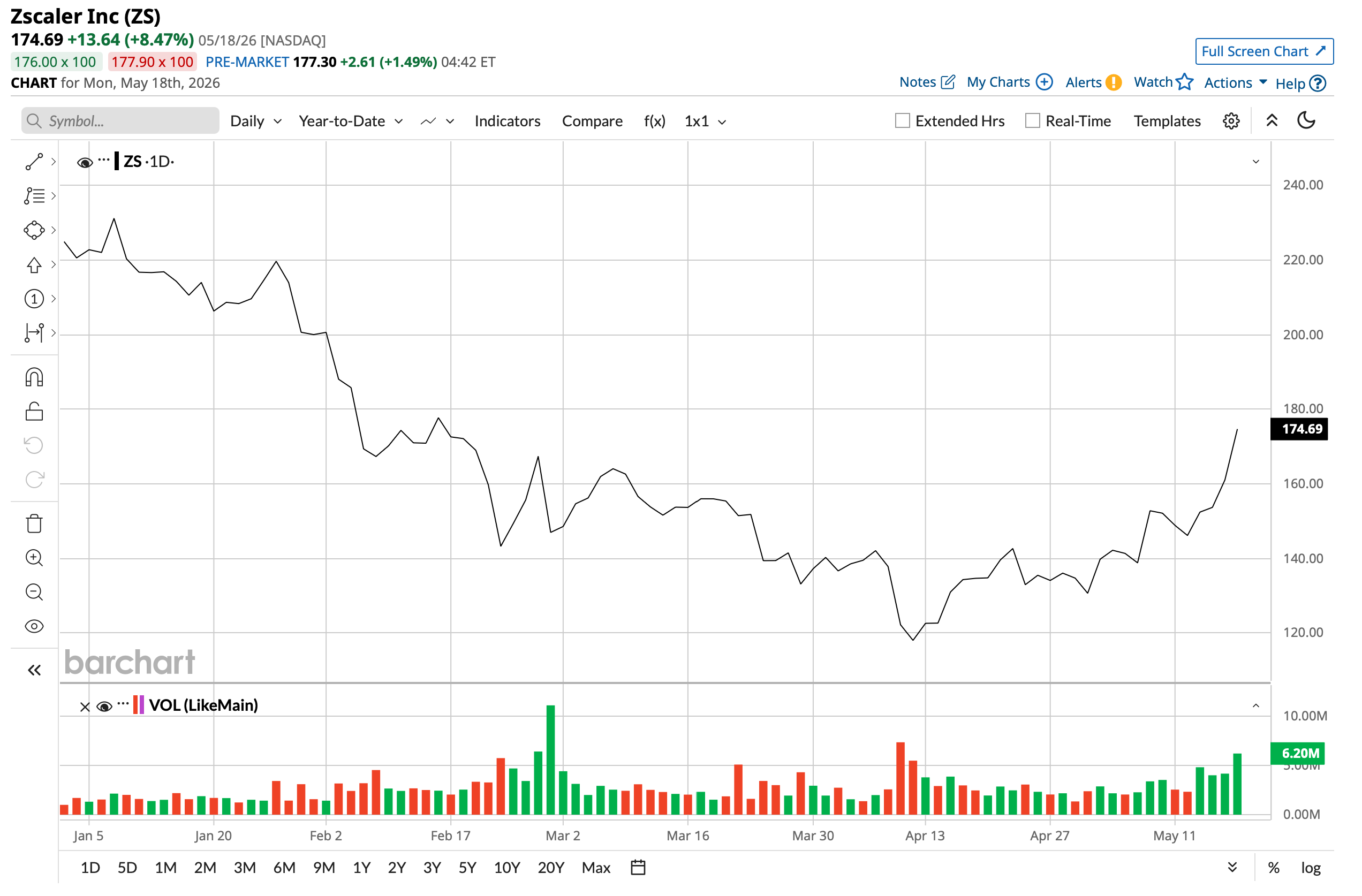
Valued at a market capitalization of $28.1 billion, ZS stock is down almost 23% on a year-to-date (YTD) basis.
So, share price weakness remains. But can the recent upgrade from B.Riley provide a much-needed flip to Zscaler's fortunes?
 www.barchart.com
 Zscaler's Robust Q2
As with many companies exposed to “SaaS will become irrelevant” fears, the financials of Zscaler remain solid. The company's second-quarter results are a prime example of this strength.
For Q2 2026, Zscaler reported a beat on both revenue and earnings. Revenue grew 26% year-over-year (YOY) to $815.8 million as the company's ARR went up by 25% in the same period to $3.4 billion. Meanwhile, non-GAAP earnings increased at an even higher rate of 29.5% to $1.01 per share, surpassing the consensus estimate of $0.89. Notably, this was the ninth consecutive quarter showing an earnings beat from the company.
Zscaler guided for Q3 revenue between $834 million and $836 million, while the Street is expecting $835.7 million in revenue. Similarly, Zscaler guided for earnings between $1 per share and $1.01 per share. The Street expects the same.
Coming to the cash flows, net cash from operating activities for the six months ended January 31, 2026, rose to $652.4 million, up from $510.8 million in the year-ago period. Overall, the company exited Q2 with a cash balance of $1.2 billion, much higher than its short-term debt levels of roughly $68 million.
However, the comfort in terms of liquidity does not extend to ZS stock's valuation. The forward price-to-earnings (P/E) ratio of 38 times and price-to-sales (P/S) ratio of 10.5 times are both above sector medians. Still, ZS stock trades at a discount to its five-year average.
Zscaler will report its Q3 results on May 26.
What Makes Zscaler Unique?
Zscaler is known for disrupting the traditional firewall product with its customizable protection products for the cloud era. Moreover, the company has now expanded its products to protect AI agents in a similar paradigm.
Specifically, Zscaler is built around a zero-trust security philosophy in which every single request, regardless of its origin, is treated as potentially hostile until it has been fully inspected. Because the platform is delivered entirely through the cloud, this rigorous inspection process does not introduce the kind of latency penalties that would typically accompany a legacy on-premises system. The scale at which this operates is striking, with the platform processing in excess of 500 billion transactions each day across a user base of more than 47 million.
Beyond the raw volume, however, lies a more consequential capability. Whenever a new threat is identified anywhere within the network, the intelligence is instantly distributed across the entire system. No internal security team operating in a silo could replicate that kind of collective threat response, and as AI tools increasingly find their way into the hands of malicious actors developing more sophisticated malware, the frequency and complexity of threats entering the landscape continues to grow.
Data security has also become an equally important dimension of the Zscaler platform, one that has already reached a $450 million annual run rate. Where a conventional firewall is oriented around keeping external threats out, Zscaler's data-security capabilities are focused on preventing sensitive information from leaving the network without authorization. In practice, this means continuously scanning for misconfigurations that could expose data to parties who have no business accessing it, as well as catching human errors before they become incidents. Should an attacker manage to breach the zero-trust perimeter, whether through insider access or an improperly configured database, the data-security layer functions as a second line of containment, limiting the damage that can be done.
Additionally, a newer but rapidly growing area of focus for Zscaler concerns the security vulnerabilities unique to AI agents and AI-powered tools. These systems introduce a distinct category of risk, including the exposure of system prompts, the inadvertent transfer of sensitive information to external parties, and the possibility of an AI ingesting manipulated inputs that lead it to generate harmful or inaccurate outputs. Through the acquisition of Red Canary in August 2025 and the subsequent purchase of SPLX in November 2025, Zscaler has assembled a comprehensive offering in the emerging market for AI agent security — a segment with an annual value projected to surpass $500 million in 2026.
On the operational side, the company has introduced a service model called Z-Flex that draws a meaningful parallel to Palantir's (PLTR) Forward Deployed Engineer approach. Z-Flex places dedicated consultants and engineers directly alongside customers, enabling them to bring new Zscaler modules online without having to re-enter a formal sales process each time. The practical effect of this is a considerably smoother path to expanding the scope of what a customer uses, whether that means layering in AI agent security or any other capability, without requiring upfront deployment commitments. For Zscaler, this translates into a more organic and frictionless upselling motion that scales naturally alongside the evolving needs of its customer base.
Zscaler is not standing still, either. In the most recent quarter, the firm unveiled AI Guard, a comprehensive suite built to test for vulnerabilities across an enterprise's entire AI footprint. The company also hired a dedicated Executive Vice President of Agentic AI Security Engineering to build defenses against autonomous AI agent threats specifically. Zscaler was selected as an early adoption partner for Microsoft's (MSFT) Entra Agent ID ecosystem as well. Finally, the firm launched Zscaler Cellular, the industry's first zero-trust solution to secure IoT and OT connectivity using only a SIM card, eliminating VPNs entirely for connected devices and routing all connections through its cloud platform.
What Do Analysts Think About Zcaler Stock?
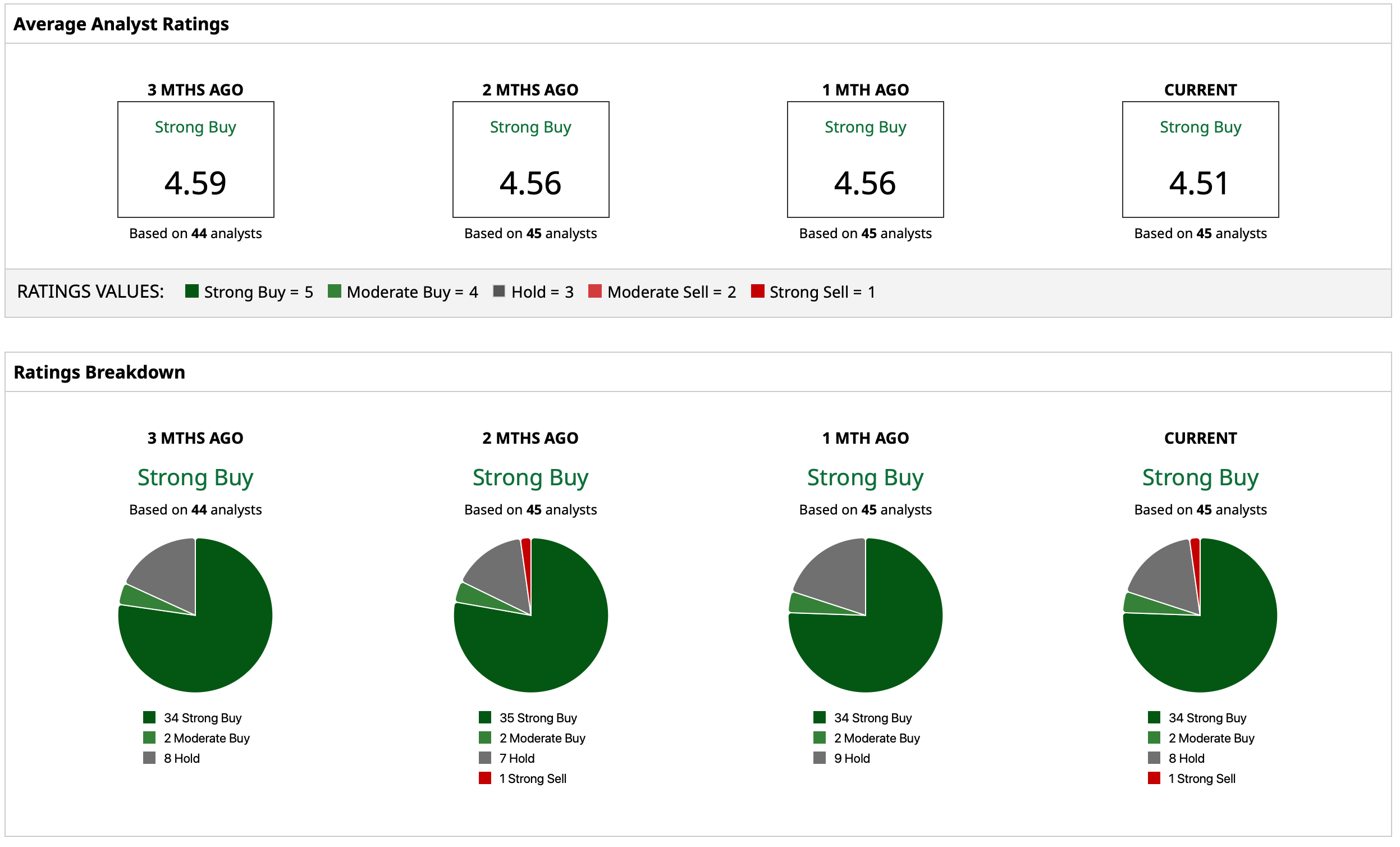
Overall, analysts have a consensus “Strong Buy” rating for Zscaler. Of the 45 analysts covering ZS stock, 34 have a “Strong Buy” rating, two have a “Moderate Buy” rating, eight have a “Hold” rating, and one has a “Strong Sell” rating. The mean price target of $223.46 indicates potential upside of about 28% from current levels.
 www.barchart.com
 On the date of publication, Pathikrit Bose did not have (either directly or indirectly) positions in any of the securities mentioned in this article. All information and data in this article is solely for informational purposes. For more information please view the Barchart Disclosure Policy here.
More news from Barchart
Greg Abel Sells Berkshire Hathaway Stake in UnitedHealth Triggering Stock Slide. Bet on UNH Here for a Turnaround. This AI Biotech Stock Landed a $10.4 Million Nvidia Investment Value Investors Should Snatch Up This Deep-Value Stock at Fresh Lows B. Riley Upgrades Zscaler Stock to ‘Buy.’ So Much for Software Apocalypse Fears.