


Whenever the U.S. stock market gets top-heavy, Wall Street’s marketing machine gets cranking. The cycle turns back to a favorite narrative: geographical diversification.
Retail investors are urged to dump their concentrated domestic shares and buy single-country ETFs to capture untapped, uncorrelated growth cycles abroad.
More Yield, Less Trap: Sign up free to get Barchart’s daily Dividend Investor newsletter straight to your inbox.
There’s no crystal ball in investing. At least there shouldn’t be, and we should run from anyone who promises they have one. But through five months of 2026, the global scoreboard displays some eye-popping performance numbers.
The question I ask myself about any ETF or market segment that is not tied to one of the benchmark indexes is am I buying true diversification, or am I just riding the coattails of the S&P 500 Index ($SPX) and Nasdaq-100 Index ($IUXX) up moves in a different package? That is, a different ticker.
So before we swap our SPDR S&P 500 ETF Trust (SPY) or Invesco QQQ Trust (QQQ) exposure for foreign tickers, we need to understand the realities driving these returns in non-U.S. stocks, particularly when we view them by country instead of in a catch-all international or global ETF.
More often than not, a single-country ETF isn’t actually a bet on a country — it’s just a highly concentrated, expensive bet on a single sector or industry in disguise. That’s because while the U.S. has a bit of everything and a ton of technology stocks, the rest of the world’s national stock markets tend to be narrow by comparison.
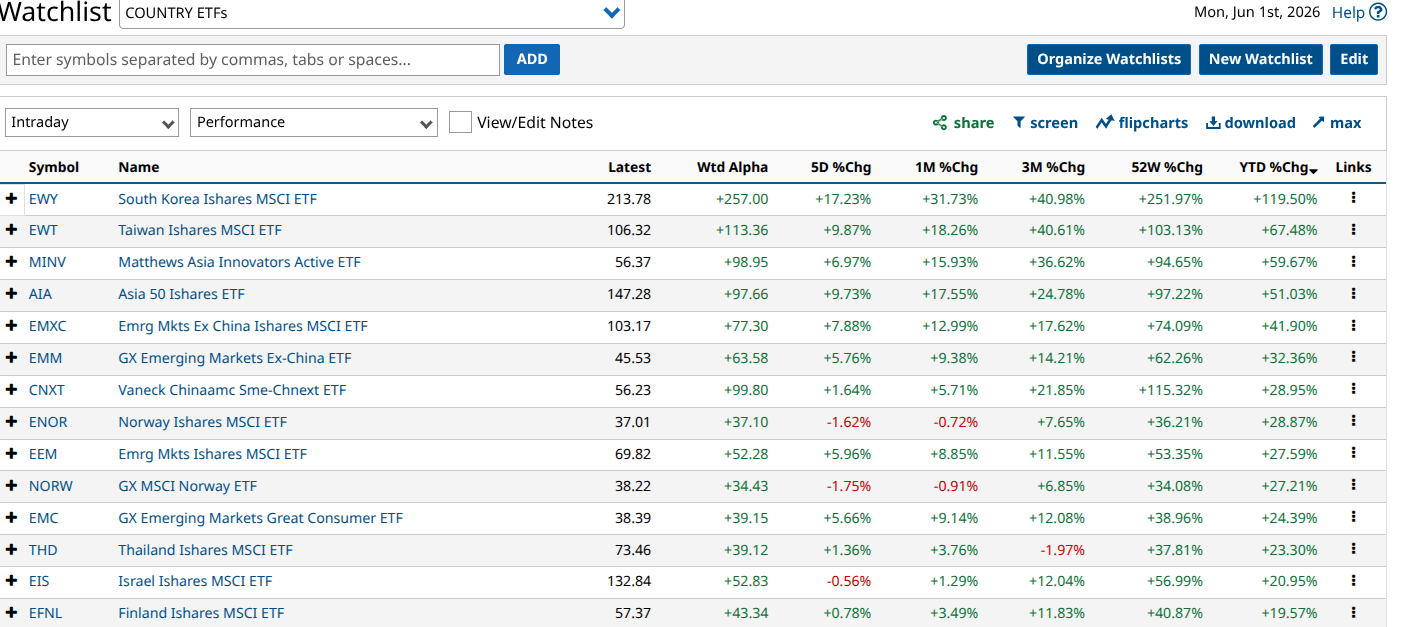
That does not mean I ignore them. But it does mean I use them as proxies for whatever their equivalent might be in the U.S. market. I track scores of single-country, regional, and specialized international ETFs. Based on year-to-date performance through last Friday, May 29, here are the leaders. I’ll discuss those and then move on to the laggards.
 www.barchart.com
 The single-country equity landscape this year is defined by two massive, tech-driven spikes and a spectacular regulatory crash.
The absolute king of global equities this year is South Korea (EWY). The index has more than doubled in 2026, driven by a violent, multi-month short squeeze and unprecedented global demand for high-bandwidth memory chips. Taiwan (EWT) is up 67%. Riding the same hardware wave, Taiwan’s equity index has surged as hyperscalers continue to stockpile advanced chip architectures.
 www.barchart.com
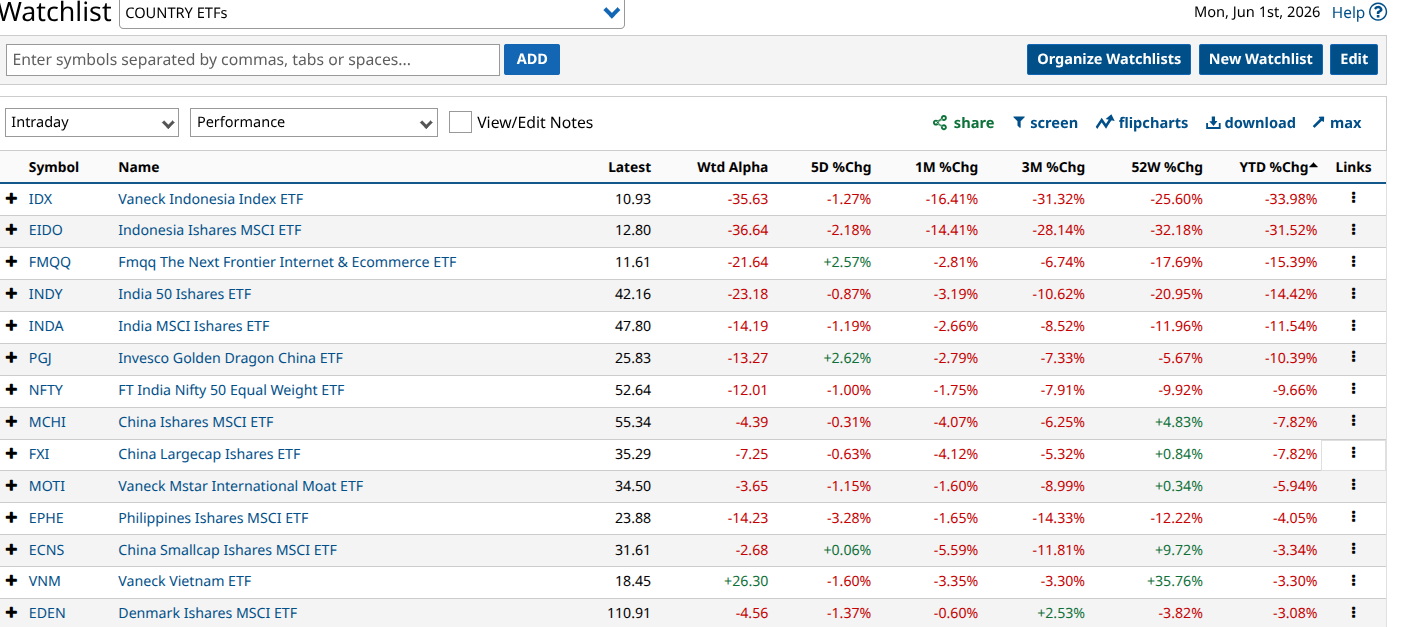
 The worst equity disaster on the planet this year belongs to Indonesia (IDX). It is off more than one-third of its 2025 year-end value. And as is the case with most country ETFs, there’s often not much difference between brands. EIDO is also devoted to Indonesian stocks, and it is a mere 2.5% better through this year’s first five months.
The country’s stock market collapsed following an official warning from index provider MSCI that the country risks a downgrade from “Emerging Market” to “Frontier Market” status due to structural transparency issues and severe shareholding concentration. Frontier markets are the smaller, earlier-stage markets.
The portfolio allocation veteran in me can’t help but think that South Korean markets were a direct beneficiary of that downgrade of its Indonesian neighbor. The sold-off assets had to go somewhere, and much of the wealth invested in Indonesia is part of a larger regional portfolio.
India (INDY) has also been a laggard. After years of trading at massive valuation premiums, its stock market has entered a sharp correction cycle as institutional liquidity rotates out of expensive emerging markets.
Are Country ETFs Better Than U.S. Sectors?
Now to that sticky question I brought up above. Look closely at the list of winners and losers. If you buy the iShares MSCI South Korea ETF (EWY) or the iShares MSCI Taiwan ETF (EWT) because you want exposure to sovereign macroeconomics, you are falling for a bit of an illusion.
Single-country ETFs are cap-weighted index models for the most part. Because foreign equity markets are rarely as deeply diversified as the United States, their domestic indexes are utterly monopolized by one or two corporate giants.
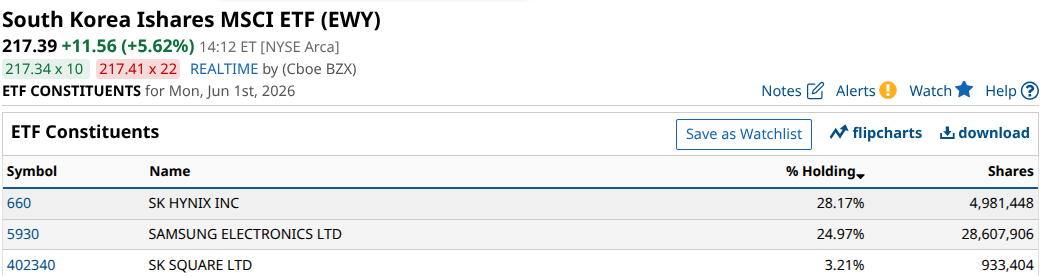
When you buy EWT, you aren’t investing in a vibrant, multi-industry East Asian economy. Taiwan Semiconductor (TSM) single-handedly dictates the overwhelming majority of that index’s daily price movement, as it takes up 20% of the ETF’s asset base. Same with buying EWY to access South Korea. It is really more of a way to buy a combined block of Samsung Electronics and SK Hynix.
 www.barchart.com
 If the goal is to make money in the chip sector, buying EWY or EWT isn’t any better or safer than simply owning a dedicated U.S. industry tracker like the VanEck Semiconductor ETF (SMH). In fact, with the country ETFs, you take on foreign currency risk and pay significantly higher net expense ratios to express a very similar underlying technology bullish thesis.
This does not mean all single-country ETFs are a hard pass. Not at all. It simply means we need to know what we own, and ask that question I ask myself each time: is this really different?
Rob Isbitts created the ROAR Score, based on his 40+ years of technical analysis experience. ROAR helps DIY investors manage risk and create their own portfolios. For Rob’s written research, check out ETFYourself.com.
On the date of publication, Rob Isbitts did not have (either directly or indirectly) positions in any of the securities mentioned in this article. All information and data in this article is solely for informational purposes. For more information please view the Barchart Disclosure Policy here.
More news from Barchart
Investors Are Fleeing to South Korean and Taiwan ETFs for Diversification. If You Do That, You’re Still Just Chasing AI Chip Stocks. VSCO Stock Alert: Victoria’s Secret Soars After Earnings The SOXX ETF Recently Hit 10,000, but There's a Semiconductor Split Lurking Under the Hood This Analyst Just Turned Bullish on CoreWeave Stock. Here’s Why