

Royal Caribbean Cruises Ltd. RCL is seeing early improvement in Mediterranean booking trends — a key part of its high-yielding European itinerary portfolio — after geopolitical disruption pressured demand late in the first quarter. The softness was tied partly to higher airfares, reduced airline capacity and flight disruptions, rather than a weaker underlying appetite for cruise vacations.
The company entered 2026 with exceptionally strong European demand, and that strength was built into its initial outlook. Booking momentum later moderated for Mediterranean sailings, especially for the second and third quarters, when those itineraries represent a larger share of deployment. Airfare to Europe also spiked sharply before easing, adding friction for North American travelers considering summer Mediterranean cruises.
Recent trends suggest the worst of that pressure has passed. RCL said Mediterranean bookings have rebounded in recent weeks, although the near-term benefit may be limited because very little inventory remains for the second and third quarters. As a result, improved demand can support close-in pricing but may not fully restore the stronger trajectory expected earlier in the year.
The impact is reflected in RCL’s 2026 guidance. Full-year net yield growth is now expected to be 1.5% to 2.5%, with Mediterranean and West Coast Mexico disruption weighing most on the second and third quarters. Second-quarter net yields are projected to increase only about 0.2% in constant currency, with geopolitical events and dry dock timing creating a nearly 200-basis-point headwind. A similar impact is expected in the third quarter.
Still, the issue appears more temporary than structural. Europe is expected to perform well in 2026, just below the elevated expectations set earlier in the year. RCL also does not see the disruption affecting 2027 booking behavior, while demand across the broader portfolio remains healthy. The Caribbean, which represents the largest share of deployment, continues to show resilience despite elevated industry capacity.
Overall, RCL appears to have moved past the sharpest phase of Mediterranean booking weakness, but limited remaining summer inventory may restrict the pace of near-term yield recovery. Strong Caribbean demand, record Wave Season trends, healthy onboard spending and a diversified portfolio support the broader outlook, while Mediterranean pricing remains a key swing factor for the second and third quarters.
How RCL Stacks Up to Competitors
While RCL’s pressure is centered on Mediterranean sailings, Carnival Corporation & plc CCL and Norwegian Cruise Line Holdings Ltd. NCLH framed the disruption more broadly across their European deployments.
Carnival provides a steadier comparison of European demand. The company indicated that cancellation trends were not significant, even as Eastern Mediterranean sailings carried a different risk profile from Western Mediterranean and Northern Europe. CCL also stated that Northern Europe was progressing well and that it had made booking progress even on Eastern Mediterranean sailings versus a few weeks earlier. Its strategy of pulling forward occupancy during Wave Season helped it enter the disruption with booking headroom, reducing the near-term pressure from geopolitical uncertainty.
Norwegian Cruise is facing a more difficult European setup. It entered 2026 behind its targeted booking curve, leaving it with more inventory to fill when geopolitical disruption added pressure. NCLH’s second-quarter European sailings represented about 26% of deployment, while third-quarter exposure is expected to be about 38%. The company cited elevated cancellations across Europe and noted that, given its weaker starting booking-curve position and the late timing, it would be hard to recover quickly.
Against this backdrop, RCL sits between a better-positioned CCL and a more pressured NCLH. RCL’s Mediterranean bookings moderated after an exceptionally strong start to the year, but the weakness appears narrower and more temporary than NCLH’s broader European pressure, where external disruption compounded company-specific booking-curve and commercial execution issues. CCL, meanwhile, appears more resilient, supported by pulled-forward occupancy and limited cancellation pressure. For RCL, the recovery in Mediterranean bookings supports confidence, but limited remaining second- and third-quarter inventory may restrict how much of that rebound translates into near-term yield upside.
RCL’s Price Performance, Valuation & Estimates
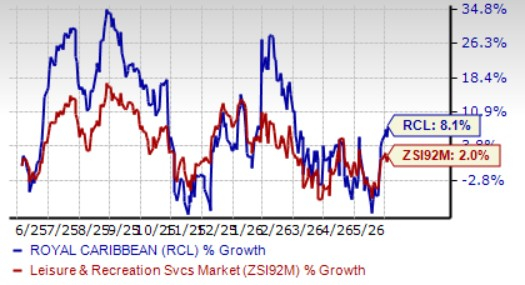
Shares of Royal Caribbean have gained 8.1% in the past year compared with the industry’s 2% growth.
RCL Stock’s One-Year Price Performance
Image Source: Zacks Investment Research
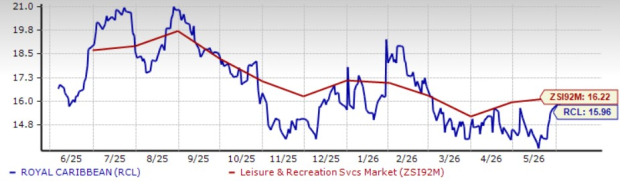
From a valuation standpoint, RCL trades at a forward price-to-earnings ratio of 15.96, below the industry’s average of 16.22.
RCL’s P/E Ratio (Forward 12-Month) vs. Industry
Image Source: Zacks Investment Research
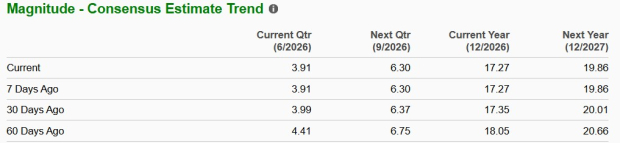
The Zacks Consensus Estimate for RCL’s 2026 earnings implies a year-over-year uptick of 10.4%. The EPS estimates for 2026 have declined in the past 60 days.
EPS Trend of RCL Stock
Image Source: Zacks Investment Research
RCL’s Zacks Rank
RCL stock currently carries a Zacks Rank #4 (Sell).
You can see the complete list of today’s Zacks #1 Rank (Strong Buy) stocks here.
Radical New Technology Could Hand Investors Huge Gains
Quantum Computing is the next technological revolution, and it could be even more advanced than AI.
While some believed the technology was years away, it is already present and moving fast. Large hyperscalers, such as Microsoft, Google, Amazon, Oracle, and even Meta and Tesla, are scrambling to integrate quantum computing into their infrastructure.
Senior Stock Strategist Kevin Cook reveals 7 carefully selected stocks poised to dominate the quantum computing landscape in his report, Beyond AI: The Quantum Leap in Computing Power .
Kevin was among the early experts who recognized NVIDIA's enormous potential back in 2016. Now, he has keyed in on what could be "the next big thing" in quantum computing supremacy. Today, you have a rare chance to position your portfolio at the forefront of this opportunity.
See Top Quantum Stocks Now >>Want the latest recommendations from Zacks Investment Research? Today, you can download 7 Best Stocks for the Next 30 Days. Click to get this free report
Carnival Corporation (CCL): Free Stock Analysis Report
Royal Caribbean Cruises Ltd. (RCL): Free Stock Analysis Report
Norwegian Cruise Line Holdings Ltd. (NCLH): Free Stock Analysis Report
This article originally published on Zacks Investment Research (zacks.com).