

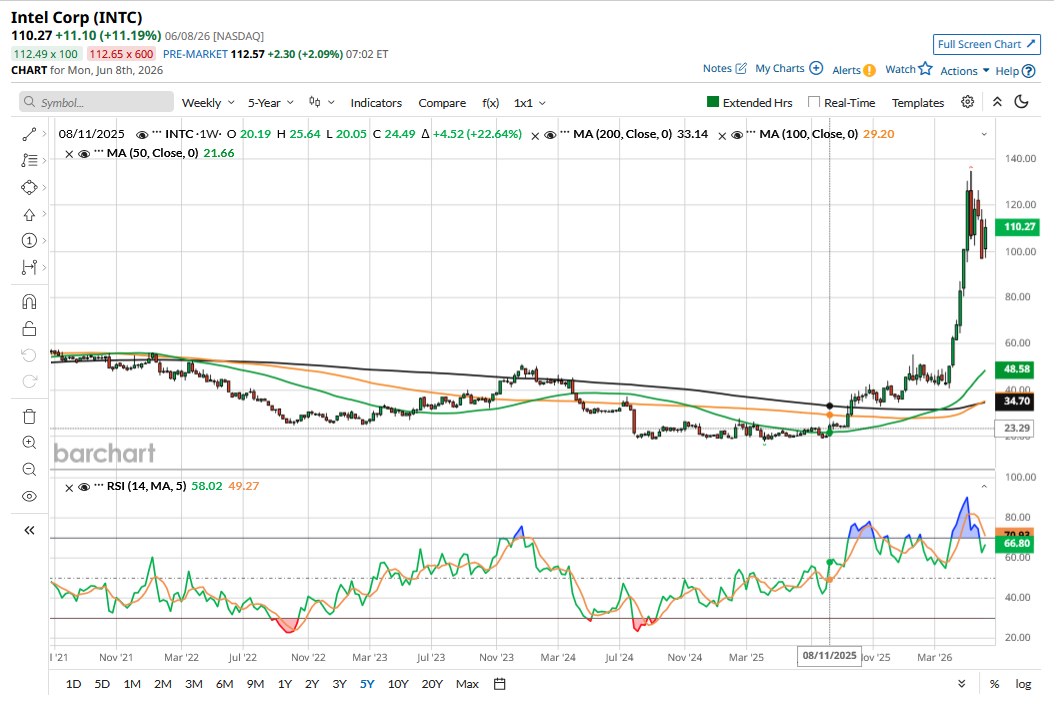
As I have said multiple times, the term "corporate turnaround" is much abused. However, Intel (INTC) could be a textbook example of a turnaround stock. INTC is up almost sixfold from its 2025 lows, and what was once dead money turned into a FOMO stock.
Intel’s turnaround has been in the works for quite some time now. In 2021, company veteran Pat Gelsinger took over as the CEO and embarked upon “transforming” Intel under the IDM 2.0 strategy. The strategy focused on making Intel a major foundry player, which would manufacture chips for third parties. At the same time, the company doubled down on innovation. It also ventured into the artificial intelligence (AI) chip market amid the euphoria.
More Yield, Less Trap: Sign up free to get Barchart’s daily Dividend Investor newsletter straight to your inbox.
 www.barchart.com
Intel’s Turnaround Has Been in the Works for Over Five Years
The strategy sounded good on paper, and Intel spent billions building foundries. However, there were two issues with the strategy. First, it wasn’t able to sign up any major third-party customers for its foundries even as the massive capex left its balance sheet saddled with loads of debt. Second, the pivot towards AI chips failed to bring in the desired results, and the revenue numbers for its Gaudi chips fell short of expectations.
At a time when companies in the semiconductor ecosystem, ranging from designers like Nvidia (NVDA) and foundries like Taiwan Semiconductor Manufacturing Company (TSM), were booming, Intel's stock price continued to plunge. In 2024, it had to suspend its dividend and was also kicked out of the Dow Jones Industrial Average Index ($DOWI) to make way for what else but Nvidia.
Intel Got a Boost From the U.S. Government’s Backing
Amid a plunging stock price, Intel booted Gelsinger in late 2024 and appointed Lip-Bu Tan as its new CEO in March 2025. Tan talked about building a “new Intel” and said that the company would “learn from past mistakes.” However, INTC stock continued to plummet and hit a multi-year low in April 2025.
Things, however, started to turn around soon, and Intel received the backing of the U.S. government, which converted its grants to equity and took a 10% stake in the company in the process. Soon enough, SoftBank (SFTBY) and Nvidia also announced investments in the chip giant.
These investments helped bring in the much-needed cash to Intel’s coffers, which were drying up due to the massive foundry investments. However, it still needed foundry customers. Things have been moving on that front as well, and the company has signed up Microsoft (MSFT) as a customer and reached a preliminary agreement with Apple (AAPL). Intel has also joined Elon Musk’s ambitious "Terafab" project to develop and manufacture advanced AI chips for Tesla (TSLA), SpaceX, and xAI. The partnership was a watershed moment for Intel and a strong validation of its foundry capabilities.
Reports suggest that Alphabet (GOOG) (GOOGL) has placed an order for over 3 million of its tensor processing units (TPUs) from Intel, while Nvidia is running early trials on its 18A production process. Intel is also getting a boost from agentic AI, which requires more CPUs of the kind that it produces.
As I have noted previously, onshoring chip production is a structural story given the growing importance of chips amid the AI pivot. Intel stands out in that regard with its foundries situated in the Western world. Given the continued tensions between China and Taiwan, it's no surprise that U.S. companies are seeking to diversify their chip sourcing from the latter to stateside.
Intel Won't Resume Dividends Anytime Soon
To sum it up, Intel’s turnaround has been a resounding success so far, and the price action is a testament to it. Usually, companies consider restoring their dividends when the business conditions improve. However, I believe that in Intel’s case, the dividend reinstatement would take a bit longer. First, the revenues from its foundry customers would take time to trickle into its earnings and cash flows, and it won’t be an overnight bonanza.
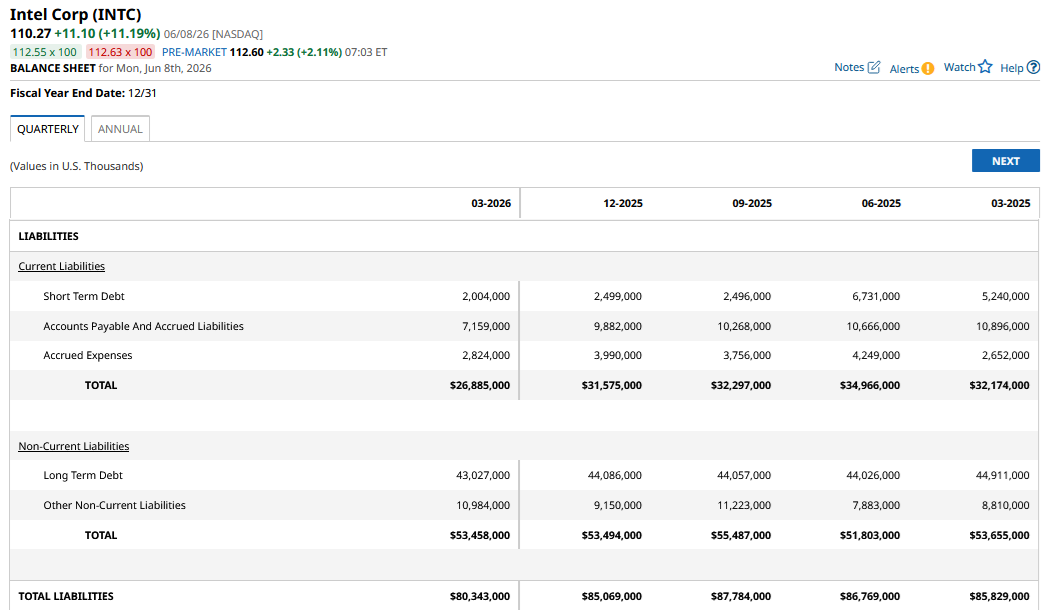
Second, the company is still investing, and while it previously expected capex to come down in 2026, it now expects it to be similar to last year. Finally, Intel has a long-term debt pile of over $43 billion on its balance sheet, and lowering that burden might be the company’s priority before it starts paying dividends again.
 www.barchart.com
All said, shareholders won’t complain about Intel not paying dividends for now, as the stock has delivered stellar returns over the last year, rising to record highs and breaching its previous all-time highs that it hit in August 2000. Ironically, that was the time when the tech bubble was peaking, and similar concerns are being raised about AI by some observers.
On the date of publication, Mohit Oberoi had a position in: NVDA , TSLA , GOOG , MSFT . All information and data in this article is solely for informational purposes. For more information please view the Barchart Disclosure Policy here.
More news from Barchart
Intel Stock Has Risen Sixfold from Its 2025 Lows, but Don’t Expect a Dividend Yet Nuvalent Stock Hits All-Time High Following GSK's Buyout Offer RIVN Stock Alert: What to Know as Rivian Begins Deliveries of R2 EV Apple Kicks Off WWDC. How to Play AAPL Stock Here.