

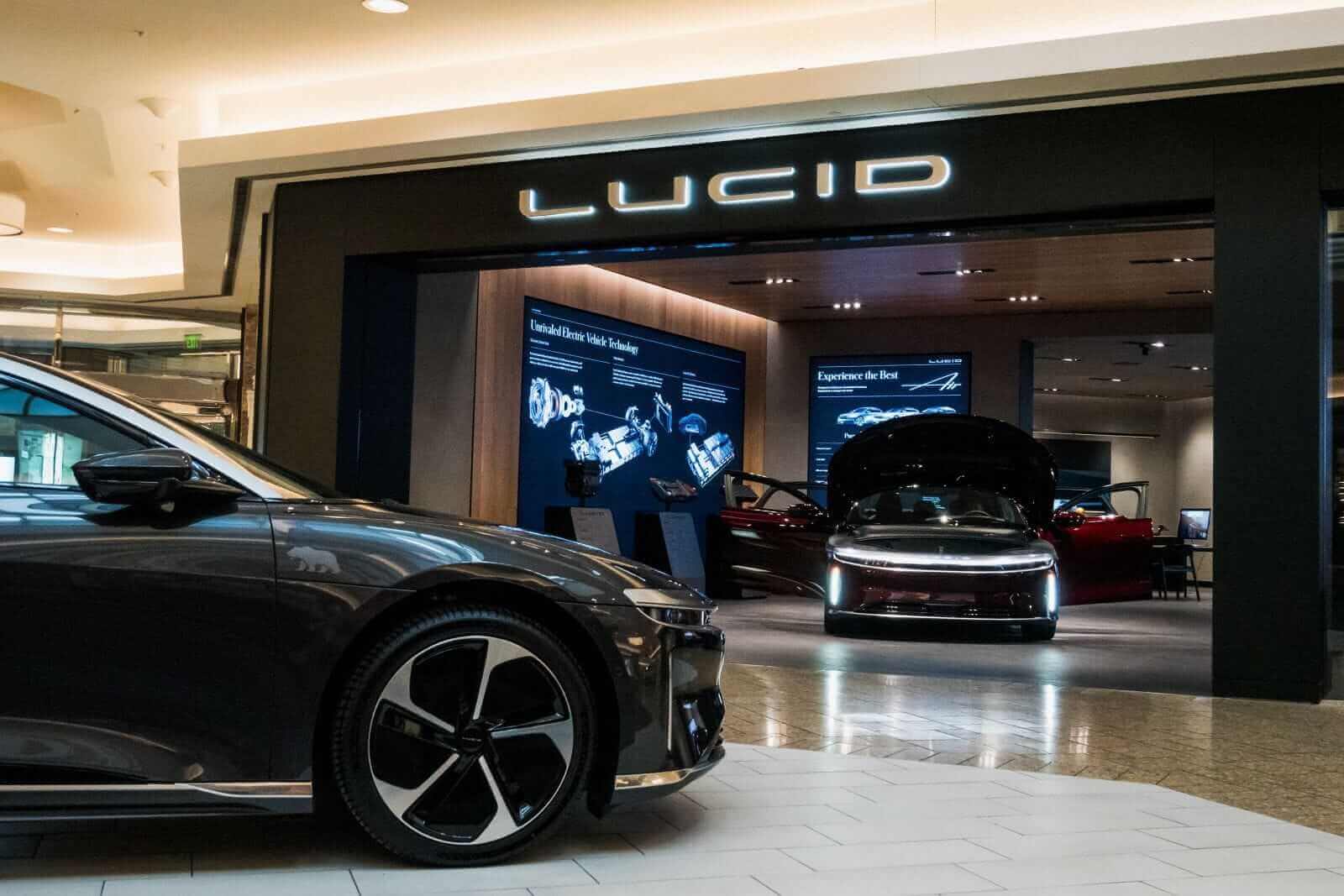
The electric vehicle (EV) industry has been going through turmoil, and barring market leader Tesla (TSLA), no other player has been able to make money in the U.S. market. Legacy automakers, which announced ambitious vehicle electrification plans, have lately been licking their wounds and booking massive losses.
The quantum of losses the Detroit Big 3 have announced is gigantic. Ford (F) announced a $19.5 billion write-down in its EV business in December 2025. General Motors (GM), which had once declared that it wouldn't sell gasoline cars after 2035, has written down $7.6 billion. Stellantis (STLA), meanwhile, leads the pack with a charge of $26.5 billion.
More Top Stocks Daily: Go behind Wall Street’s hottest headlines with Barchart’s Active Investor newsletter.
Startup EV players also continue to struggle, to say the least, and are saddled with continued losses and cash burn. Legacy automakers have the luxury of profitable internal combustion engine (ICE) operations, which offset the EV losses and leave them with billions of dollars in free cash to splurge on dividends and buybacks.
EV Companies Need Frequent Capital Infusion
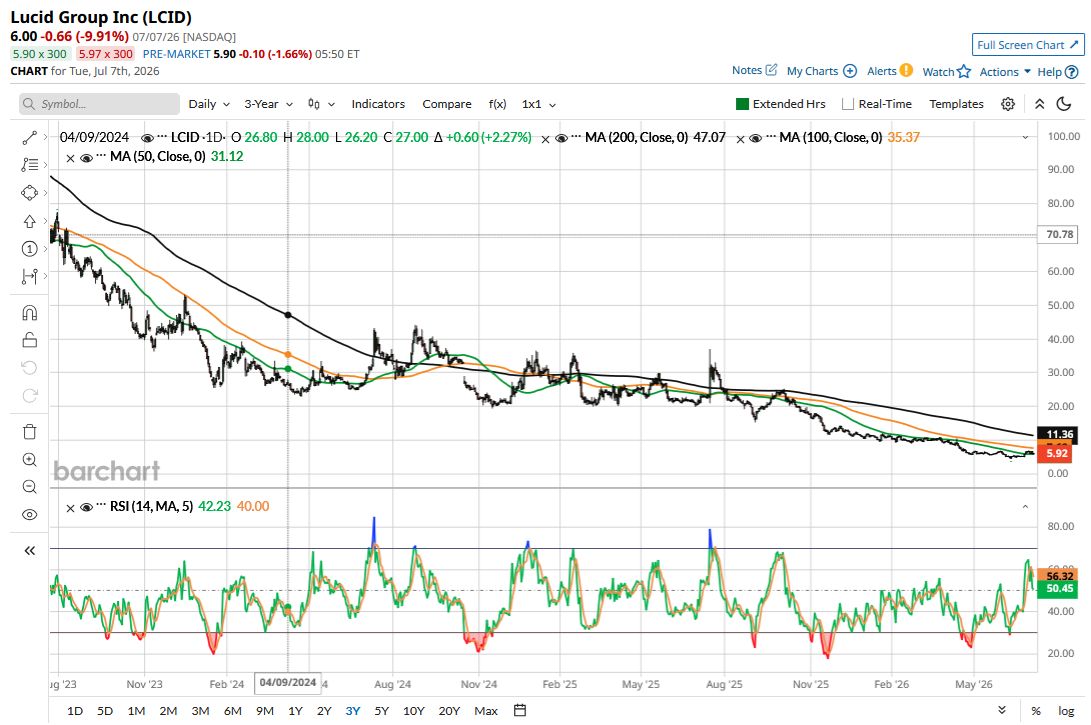
Startup EV players have had to resort to frequent capital raises to make up for the perennial cash burn. Earlier this week, Rivian (RIVN) announced a $1.5 billion capital raise. The stock expectedly fell after the announcement. Lucid Group (LCID) has raised capital even more frequently. It is backed by Saudi Arabia’s Public Investment Fund (PIF), which first invested $1 billion into the company in 2018.
Incidentally, that was the year when Tesla CEO Elon Musk made his infamous remark about “taking Tesla private.” Musk, who became the world’s first trillionaire following SpaceX’s (SPCX) listing, claimed that the PIF approached him to take the company private and that he was banking on them while asserting “funding secured” for the transaction.
 www.barchart.com
 PIF Has Poured Billions of Dollars into Lucid Motors
Meanwhile, the PIF also participated in the private investment in public equity (PIPE) transaction during Lucid's 2021 merger, buying the shares at $15 apiece. It was an aberration from the general convention then as PIPE transactions happened at $10 a share, which was the IPO price of the special purpose acquisition companies (SPACs)—remember those shell companies that “helped” many startups go public? Many of which have since either gone bankrupt or have slipped into oblivion.
The key reason Lucid hasn’t met the same fate as, say, Nikola, is the rock-solid backing from the PIF. Apart from investing directly into the cash-guzzling EV startup by participating in every stock sale since the 2021 listing, it has also opened a delayed draw term loan credit facility for Lucid Motors. Last year, the PIF virtually provided a backstop in Lucid’s convertible bond sale by entering into a privately negotiated prepaid forward transaction.
The Saudi-Lucid partnership is a win-win. Lucid built the Kingdom’s first car manufacturing facility and is now building the second one, which, unlike the first one, would actually build cars instead of only assembling them. By partnering with Lucid, the kingdom expects to diversify from oil. That said, Saudi Arabia has also partnered with Foxconn (FITGF)—best known for making Apple (AAPL) iPhones—to launch its first EV car brand named Ceer.
While Saudi money has surely helped keep Lucid Motors afloat, it also has a portfolio of quality vehicles unlike many other EV startups, which at best had a me-too product or worse, an unviable product proposition. In a market dominated by Tesla, you need a quality product to compete, and to its credit, Lucid hasn’t disappointed on that front, as reflected in many accolades its cars have received.
The Biggest Problem for Lucid Is to Increase Sales
Having a quality product and the ability to raise capital are prerequisites to survive in the EV industry. However, eventually Lucid would need to turn into a sustainable enterprise, as with all its deep pockets, the PIF might not keep bailing out the company forever.
The biggest problem for Lucid is that its sales haven’t taken off. We are not talking about the over a quarter million cars that Lucid’s merger presentation said it would sell this year, but the company even missed the modest delivery estimate in Q2. Incidentally, the company guided for production between 25,000 and 27,000 units this year, which is about a tenth of what it said in its 2021 presentation, and it has even suspended that guidance under its new CEO, Silvio Napoli.
Despite having a promising product, Lucid Motors’ sales have failed to take off materially. While the tepid sales of the Air sedan could be partially blamed on apathy towards sedans in general, even the sales of the Gravity SUV haven’t really been all that impressive.
Lucid is next working on a midsize platform, which would be priced below $50,000. However, the competition in that space might only intensify with several companies looking to launch affordable models. This includes the R2 platform from Rivian and the sub-$30,000 vehicle that Ford has promised.
The way I see it, Lucid Motors is betting on a new product with the midsize platform and has a new C-suite in place. It is operating in an industry that is battling massive overcapacity and tepid demand, leading to a price war. It does not help that the EV industry does not have many friends in the White House, unlike the previous Joe Biden administration, which devised EV-friendly policies that President Donald Trump has done away with. While there is a chance that the new management team can turn around the business and make the U.S. EV industry a two-horse race with Tesla, as previous CEO Peter Rawlinson once said, or perhaps the PIF ends up taking the company private, there are just too many uncertainties and pain points with LCID stock here.
Overall, I believe the time is now running out for Lucid, and I capitalized on the recent rally in the stock to exit my position, as there are ample other opportunities in the market that are much less speculative than LCID.
On the date of publication, Mohit Oberoi had a position in: RIVN , GM , F , TSLA . All information and data in this article is solely for informational purposes. For more information please view the Barchart Disclosure Policy here.
More news from Barchart
Citi Just Placed Micron on an Upside Catalyst Watch. What This Means for MU Stock. Lucid Motors’ Woes Run Much Deeper. Saudi Money Alone Won’t Solve Them. Strategy Just Broke Its Biggest Bitcoin Rule. What It Means for MSTR Stock. Micron Just Landed a Major Ford Deal. This Could Be a Game Changer for MU Stock.