

Space Exploration Technologies (SPCX), better known as SpaceX, is a vertically integrated aerospace, connectivity, and artificial intelligence company founded in 2002 by Elon Musk and headquartered in Starbase, Texas. The company operates across three segments: Space, which designs and launches reusable rockets including Falcon 9, Falcon Heavy, and the next-generation Starship system; Connectivity, which powers the Starlink satellite broadband network serving 10.3 million subscribers across 164 countries; and AI, encompassing the Grok large language model (LLM), X social media platform, and the Colossus AI data center complex, all absorbed through SpaceX's landmark acquisition of xAI in February 2026.
SpaceX Stock Remains Volatile
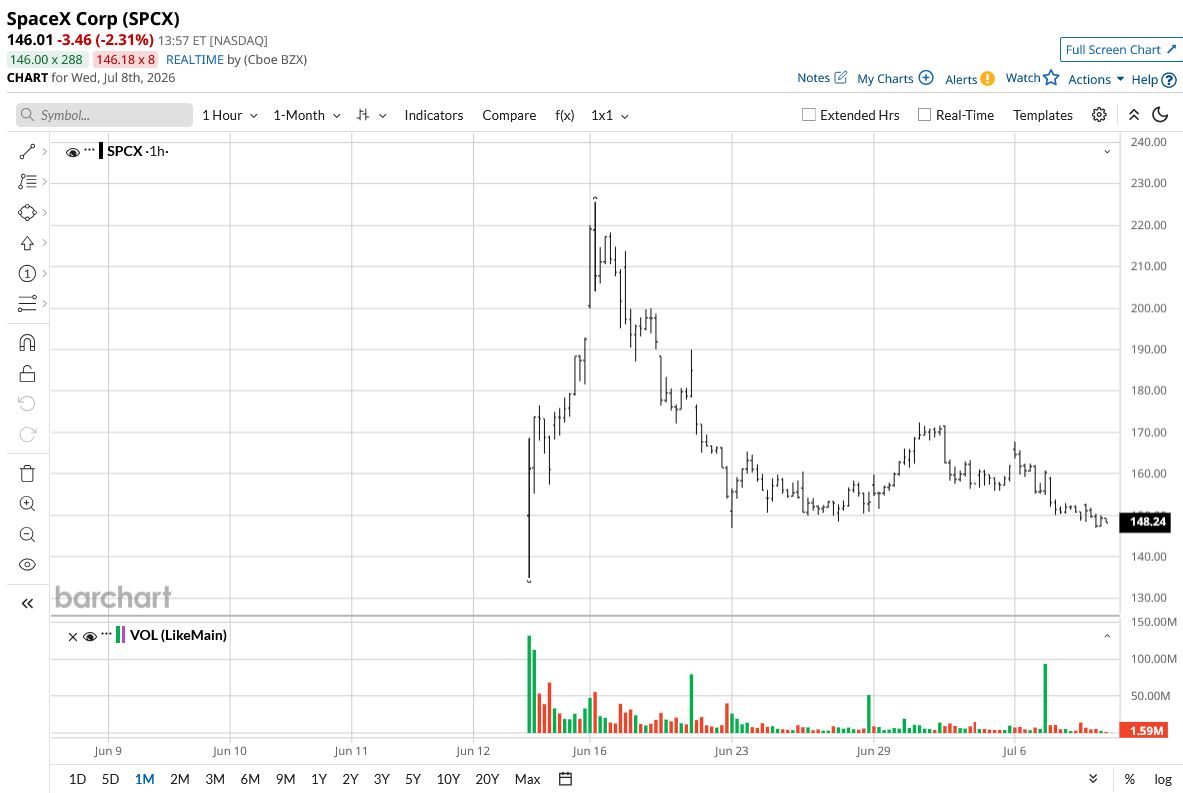
SPCX stock made its Nasdaq ($NASX) debut on June 12, 2026, the largest IPO in history at a valuation of $1.77 trillion, priced at $135 per share and closing its first trading day at $161, a 19% gain. The stock reached an all-time high of $225.64 on June 16 before retreating sharply, trading around $149 as of July 7, 2026, representing a roughly 34% pullback from the peak.
More Top Stocks Daily: Go behind Wall Street’s hottest headlines with Barchart’s Active Investor newsletter.
SpaceX joined the Nasdaq-100 ($IUXX) on July 7, 2026, triggering an estimated $4.3 billion in passive inflows from index trackers. Compared to the Nasdaq Composite, which has broadly advanced on AI infrastructure enthusiasm in 2026, SPCX has significantly underperformed since its debut, weighed down by valuation concerns, a thin 5% public float driving acute volatility, and investor unease over deepening AI-segment losses offsetting Starlink's robust profitability.
 www.barchart.com
 SpaceX Earnings Report
SpaceX's Q1 2026 financials, disclosed as part of its IPO prospectus for the quarter ended March 31, 2026, revealed consolidated revenue of $4.694 billion, an operating loss of $1.943 billion, and adjusted EBITDA of $1.127 billion. Since SpaceX was pre-IPO at the time of reporting, no formal Wall Street consensus estimate existed. Revenue grew 15% year-over-year (YoY), with the Connectivity segment generating $3.257 billion, driven by Starlink, delivering $1.188 billion in operating income and $2.087 billion in adjusted EBITDA, the only profitable business unit.
The net loss for Q1 2026 widened to $4.28 billion, with the company's accumulated deficit now at $41.3 billion. The AI segment posted revenue of $818 million alongside an operating loss of $2.469 billion and an adjusted EBITDA loss of $609 million, reflecting the capital intensity of scaling xAI's Grok model and Colossus supercomputer infrastructure. SpaceX held $15.9 billion in cash and equivalents at the end of Q1 2026, against $29.1 billion in long-term debt.
Looking ahead, management has set audacious long-term targets, with Musk publicly targeting $1 trillion in revenue by 2030. Growth strategies include expanding Starlink Mobile, monetizing its consumer AI platform, and deploying orbital AI compute satellites at scale, with deployment expected as early as 2028. The company's 13th Starship test flight is targeted for late July 2026, a pivotal milestone for next-generation satellite deployment and the broader commercial space ambition.
SpaceXAI Receives “F” on AI Safety Index
SpaceX took a significant reputational hit in the latest AI Safety Index published by the Future of Life Institute, with its AI division, SpaceXAI, receiving an “F” grade, the lowest possible score, dropping from fourth place to seventh among nine AI companies evaluated. SpaceXAI was among three companies, alongside DeepSeek and Mistral, that made no notable progress since the previous Index published in December 2025.
The poor showing stands in stark contrast to the Index's top performers: Anthropic led with a “C+,” followed by OpenAI and Google (GOOG) (GOOGL) DeepMind with “C’s.” The grades span six categories, including Risk Assessment, Safety Frameworks, Existential Safety, and Governance.
The result adds a fresh layer of scrutiny to SpaceX's AI ambitions at a critical moment, as the company scales xAI's Grok model and Colossus supercomputing infrastructure while simultaneously navigating a high-profile post-IPO trading environment.
Should You Get SPCX Stock?
SpaceXAI's “F” rating on the AI Safety Index is an unwelcome headline for a freshly public company still establishing credibility with institutional investors, adding governance risk to an already complex investment thesis laden with deep AI losses and a stretched valuation.
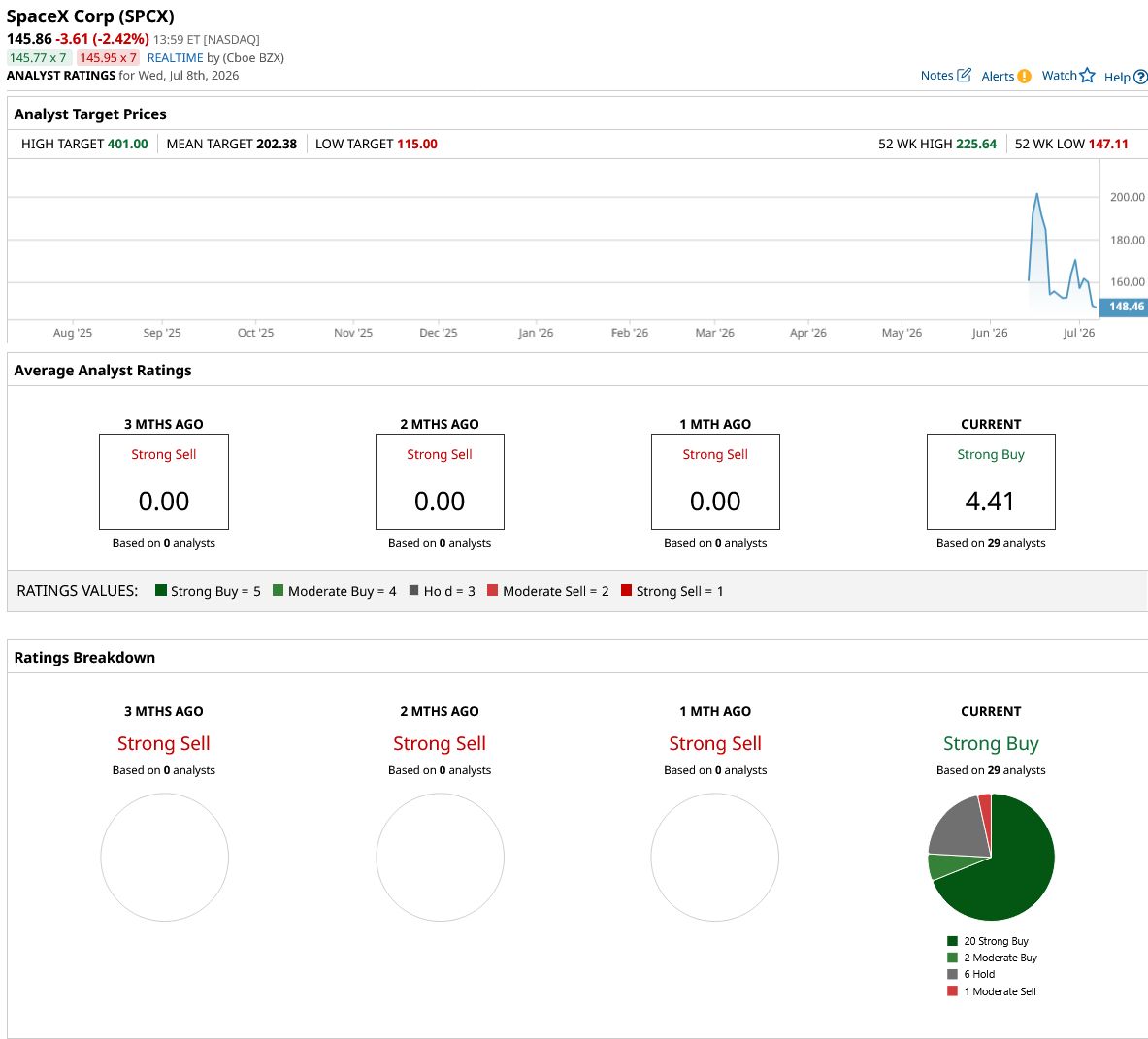
Yet Wall Street remains bullish, with a consensus "Strong Buy" rating across 29 analyst ratings, comprising 20 Strong Buy, two “Moderate Buy,” six “Hold,” and one “Moderate Sell.” The mean price target of $202.38 implies a substantial 35% upside from current levels, suggesting analysts see long-term value in Starlink's profitable growth engine and SpaceX's orbital AI ambitions despite near-term turbulence.
 www.barchart.com
 On the date of publication, Ruchi Gupta did not have (either directly or indirectly) positions in any of the securities mentioned in this article. All information and data in this article is solely for informational purposes. For more information please view the Barchart Disclosure Policy here.
More news from Barchart
These 3 Niche ETFs Might Just Buck A Bear Trend From Rockets to Red Flags: Here Is How to Play SPCX Stock After AI Safety Controversy Dell Stock Has A-Plus Fundamentals as Cash Flow Surges 313% Jeff Bezos Says ‘We Don’t Have a Revenue Problem’ in America — Bottom Half Paying Just 3% of Taxes Means ‘We Can Find 3%’