


SpaceX (SPCX) just joined the Nasdaq-100. But apparently, the inclusion wasn’t enough to revive the hype.
The stock has fallen 34% from its high of $225.64, and many say the piping-hot excitement for Elon Musk’s newest public company is waning.
Can’t Get Enough Options?: Join the list for Barchart’s daily unusual options report, delivered free.
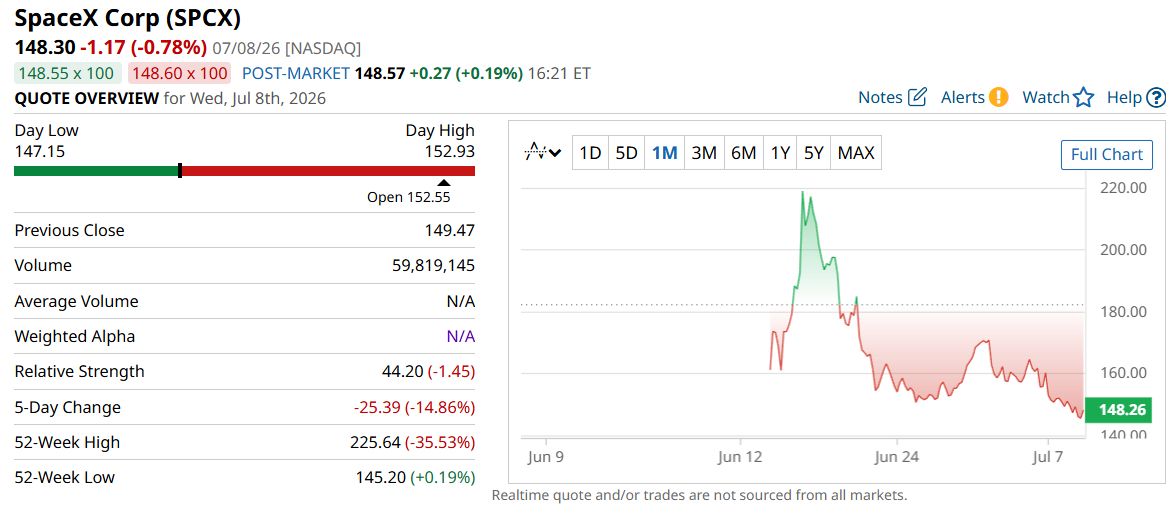
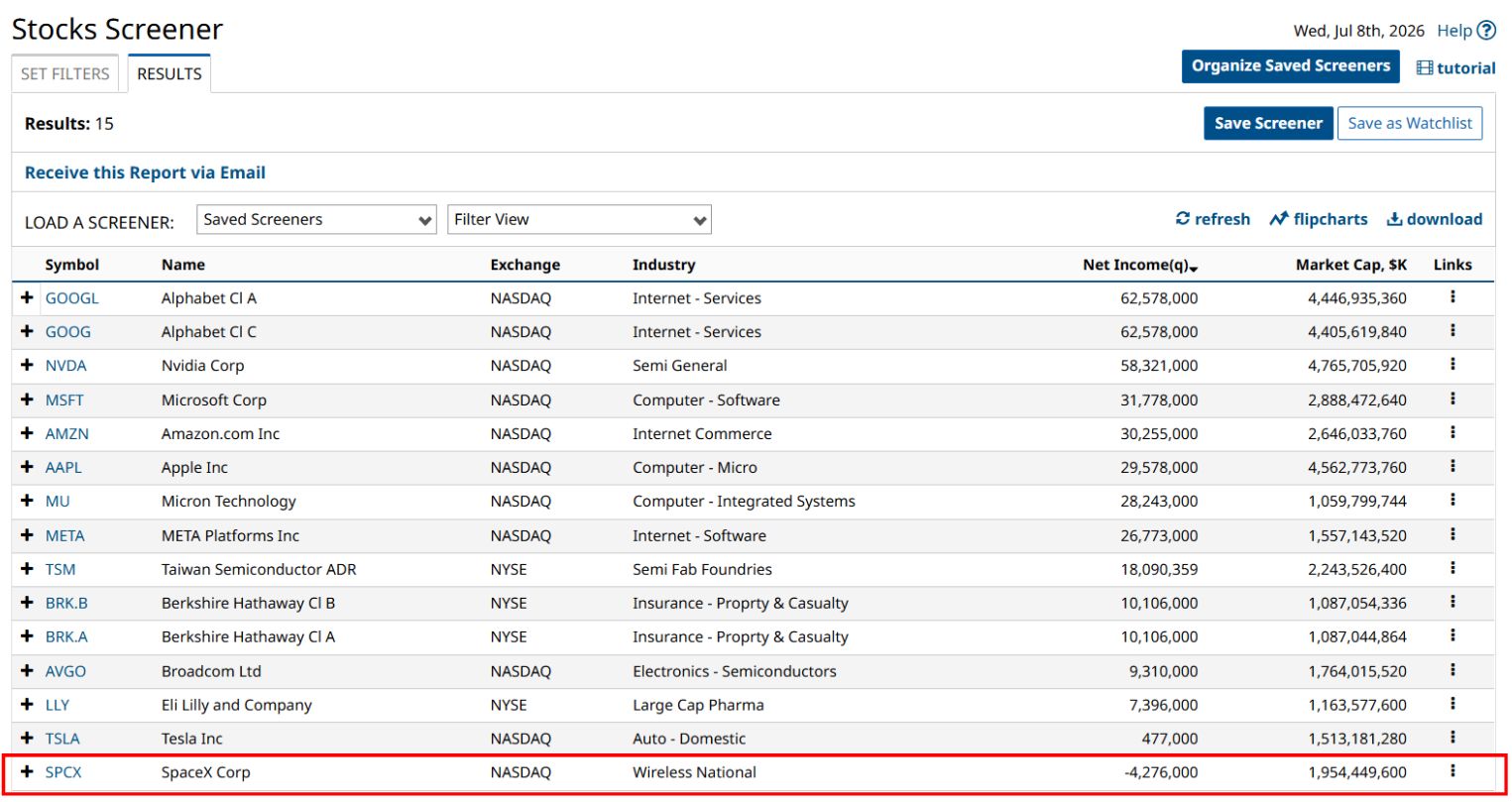
At this point, investors are shifting their focus from that initial excitement to the company’s fundamentals and valuations. And with a market cap just under $2 trillion, SpaceX is officially the most expensive company in the world that has nothing to show for it on the bottom line - ironically right next to Tesla in the second-to-last position of the recent quarterly income ranking.
So, if you’re one of the people who believe SpaceX is overhyped, how do you actually turn that outlook into a trade?
Well, one of the simplest ways is with a bear call spread.
Get paid during market downturns using the bear call
Bear call spreads are used when you expect a stock to remain below a specific price level. The strategy involves selling a call option at a lower strike price for which the seller receives a premium, and buying a call option at a higher strike price for which the investor pays a premium. These are all done on the same underlying asset with the same expiration dates.
The difference results in a net credit, which is why it’s also called a call credit spread.
If the underlying stock stays below the lower short strike by expiration, you get to keep the entire net credit without further obligation. If the stock ends between the short and long strikes, the trade ends at a partial profit or loss, depending on how close it is to the relevant strike prices.
However, if the stock trades above your long strike at expiration, your trade ends with a maximum loss equal to the distance between the strike prices (the spread width) minus the net credit you received.
For this reason, bear call spreads typically start out of the money, i.e., with the short strike price already higher than the stock trading price.
What is volatility, and why is it your friend when selling options?
Before we proceed with finding bear call spreads on SpaceX, I need to cover volatility.
Volatility is a measure of the magnitude of a stock’s price movements over a given period. Option traders typically look at implied volatility, which reflects future expected price movements.
Volatility is a key concept when selling options because it directly affects option premiums. Higher volatility means higher premiums, which means more income potential when using strategies like bear calls.
However, volatility cuts both ways. With higher expectations for large price swings, there is also a greater chance that your bear call will expire in the money. That’s the tradeoff when you’re selling high-volatility options - more income equals more risk.
But there is a way to mitigate that: sell options when volatility is high but falling. And that’s something you typically expect when the world's biggest IPO winds down.
Is volatility really low?
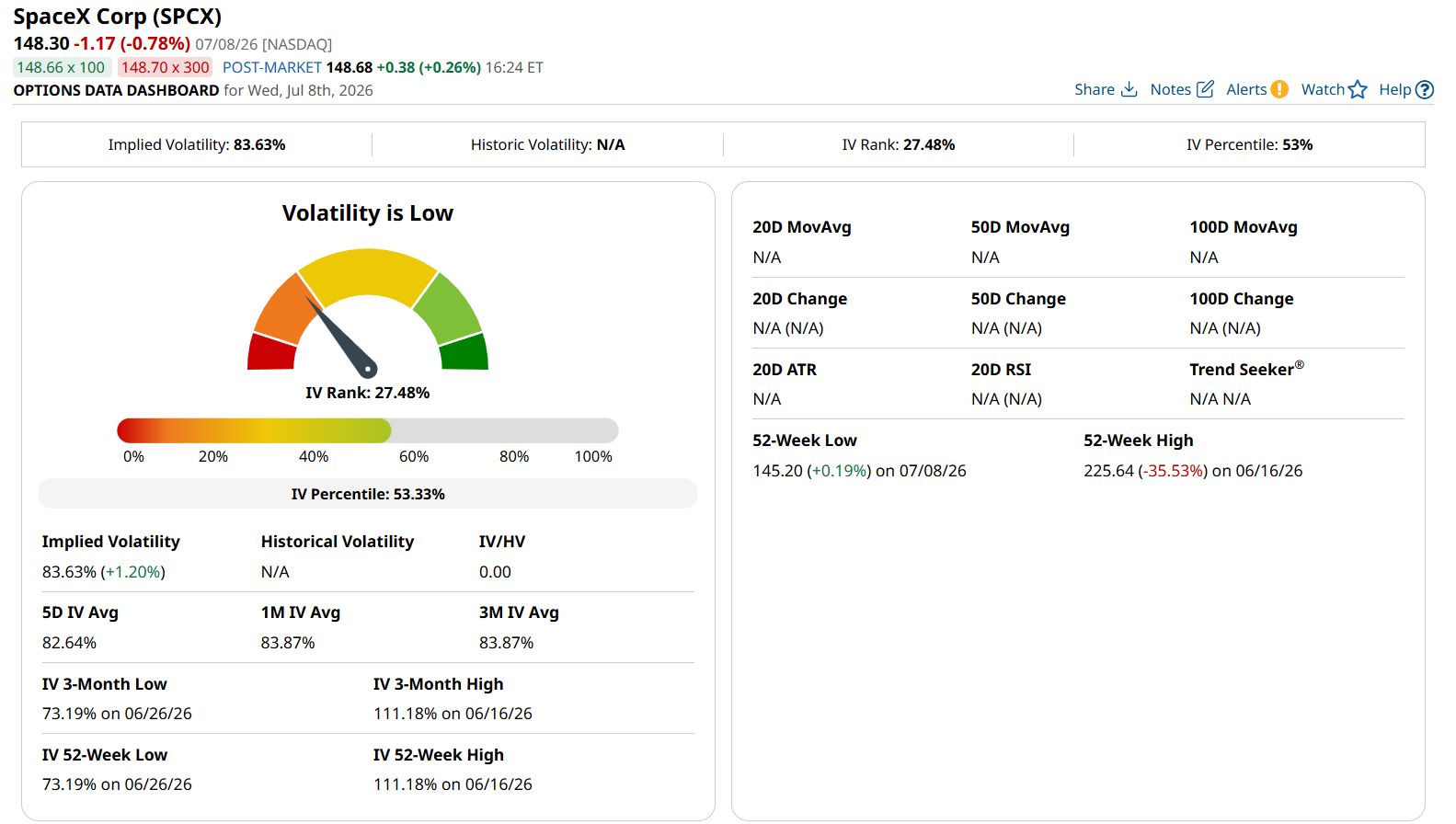
But looking at the Options Data Dashboard, we can see that SpaceX's volatility is currently LOW.
But that’s not actually the case.
Right now, it’s low only because volatility has been falling since the IPO and the all-time high. There’s no 12-month data to pull from to accurately gauge IV rank, either. It’s a new stock, so whatever the lowest IV value is at the moment will register as the floor. But in actuality, it can still go lower.
This is exactly why it's important to look beyond a single volatility metric. Tools make it easy to digest information, but special circumstances, such as massive IPOs, may affect bottom-line readings. As an option seller, you need to learn to take in and process metrics yourself. And once you do, then you can find opportunities hiding in the options chain.
So, if you believe the initial hype is fading, valuations are stretched, and the stock is more likely to trade sideways or drift lower than make another explosive move higher, a bear call spread on SpaceX starts to make a lot more sense.
So let’s look at potential trades.
Finding bear call trades
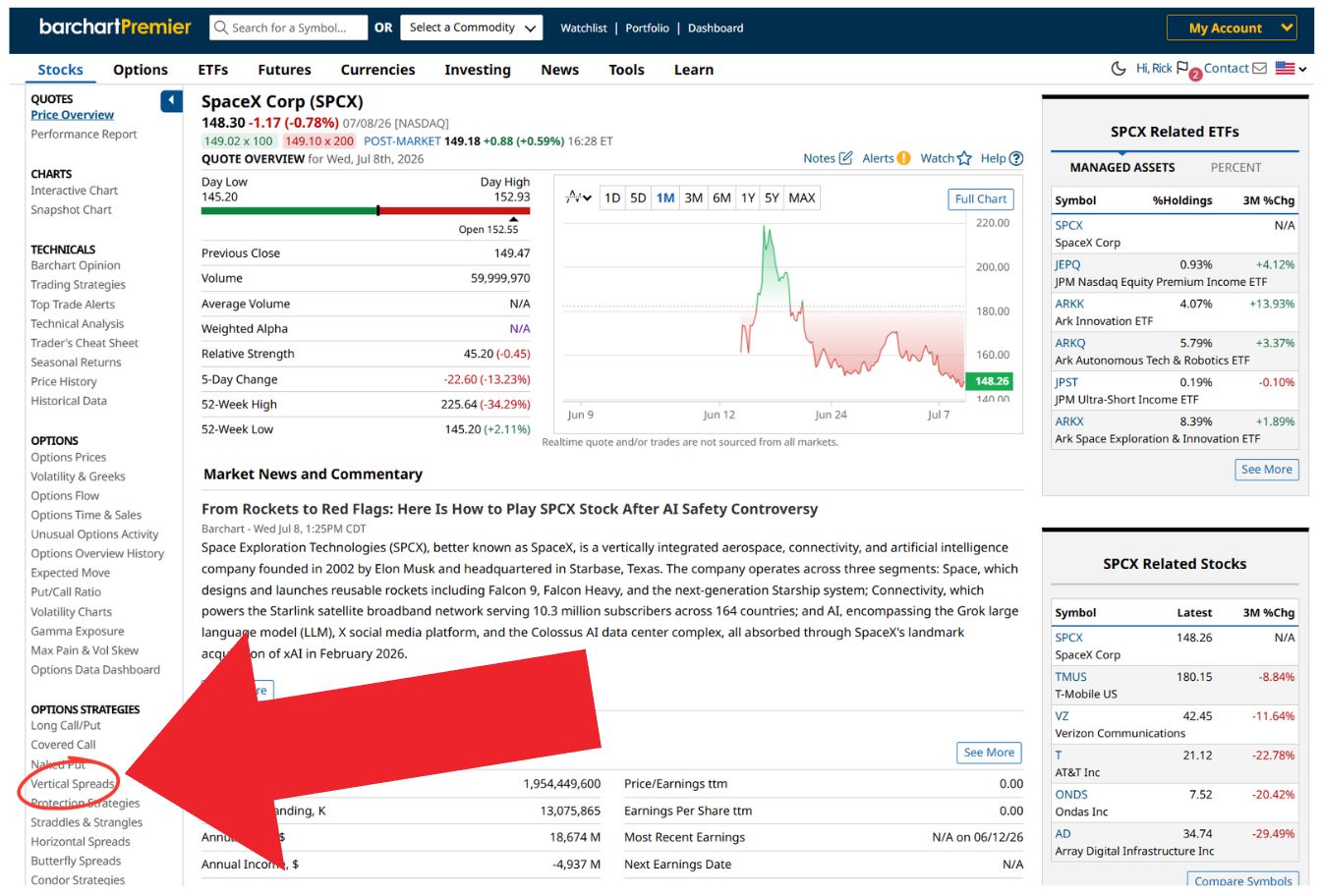
To find suitable spreads to sell, click Vertical Spreads under Option Strategies, then click the Bear Call tab.
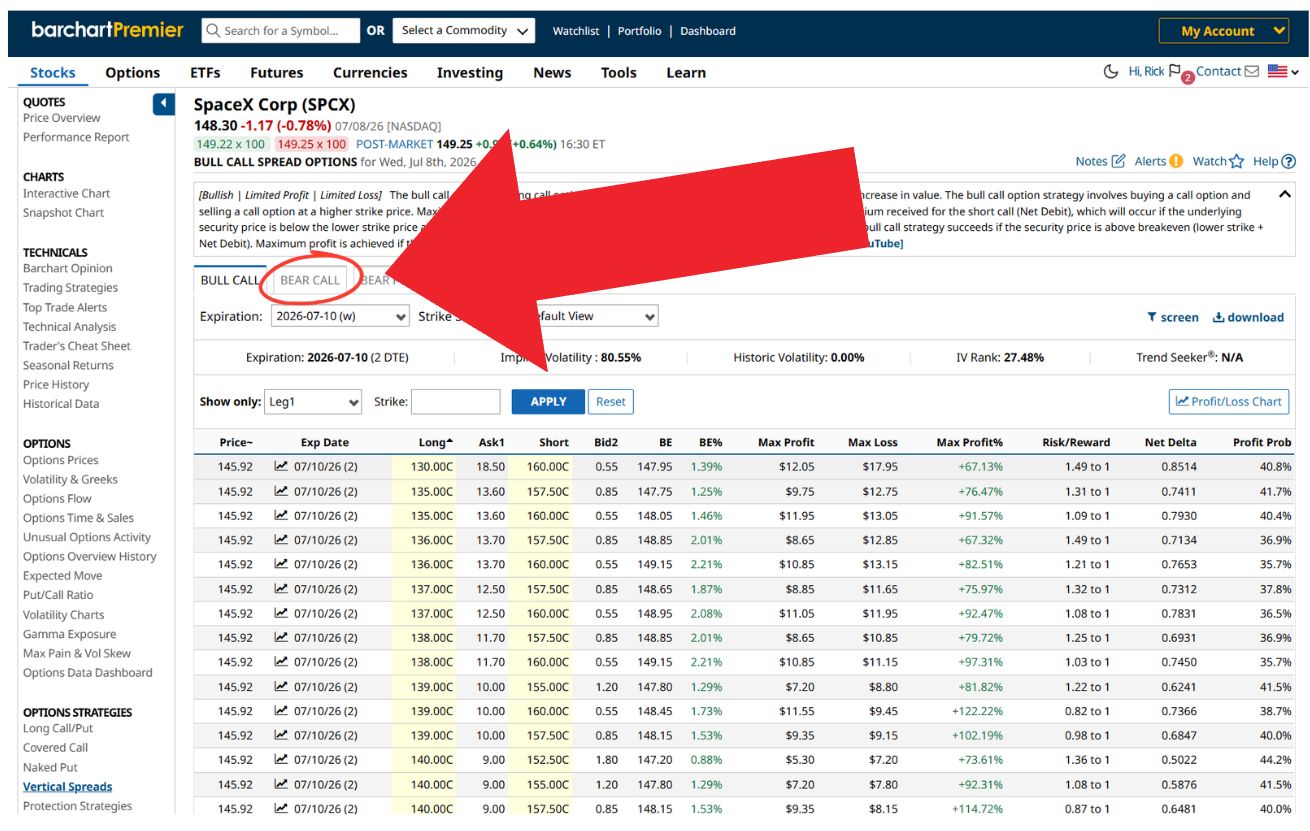
Once there, you’ll be brought to a results screen. First, change the expiration date to between 30 and 45 days. That’s usually the sweet spot for selling options, as it provides ample time value and allows more time for the trade to work in your favor.
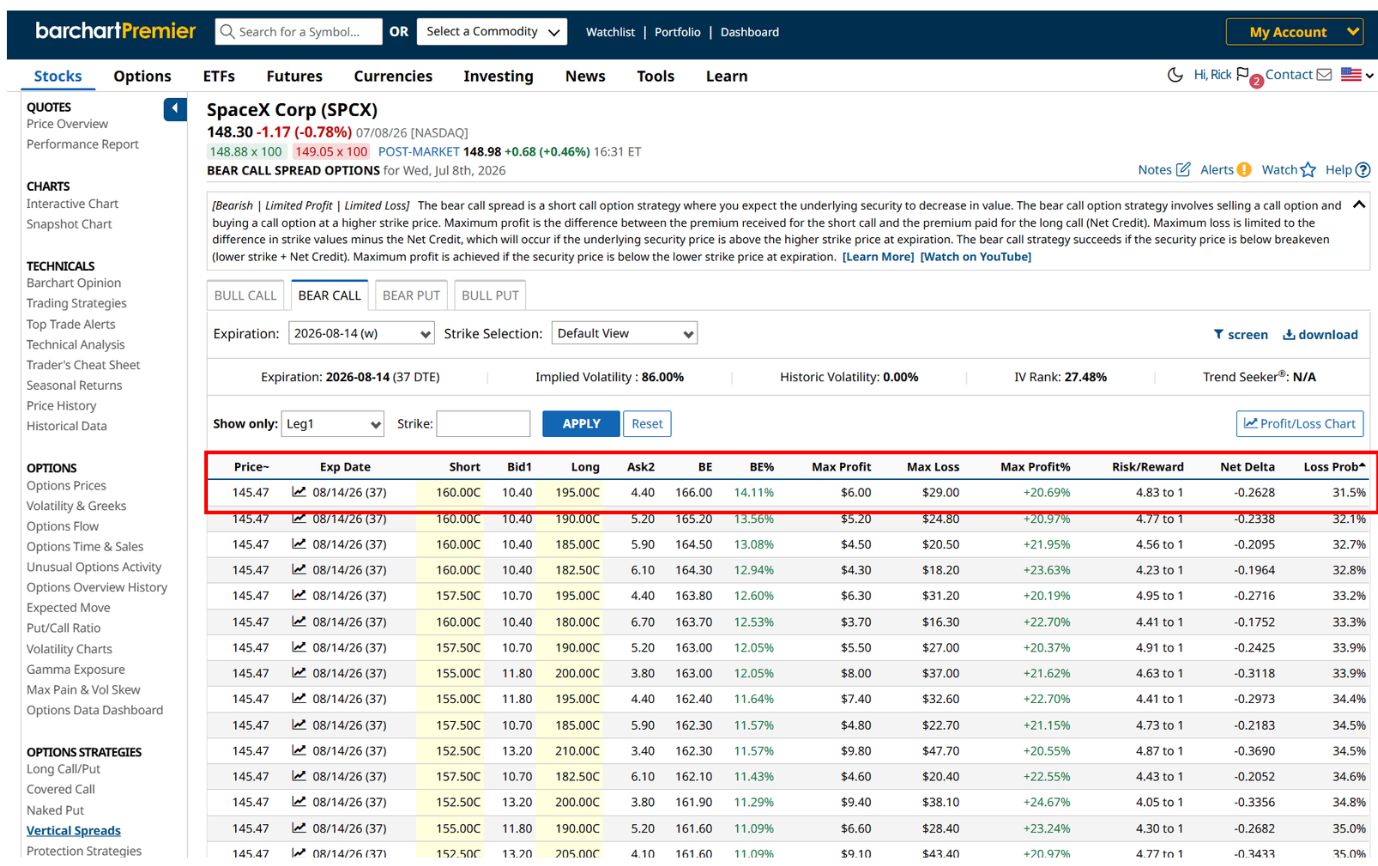
So, let’s switch to August 14, 2026, 37 days away from now, and look at the top trade with the lowest probability of loss.
Breaking down the trade
According to the screener, you can sell a 160-195 bear call spread on SpaceX. The trade starts with a $6.00 credit per share or $600 total for the entire spread. The trade ends on August 14 and has a relatively low 31.5% chance of ending at a loss.
As long as SpaceX trades below $160 at expiration, you’ll keep the $600 net credit and be free from further obligation.
On the other hand, the maximum loss is $29.00 per share, or $2,900 per spread, and that will happen if SpaceX trades at or above $195 at expiration.
Now, I think this is a good, reasonable example trade. But of course, that doesn't mean you should take the top result every time. The default Barchart Option Screener provides a balanced selection of trades, making it easy to find opportunities that align with your risk tolerance and trading style.
Just remember that no option strategy is guaranteed to win. Position sizing, risk management, and sticking to high-quality setups matter far more than chasing the biggest premium.
Conclusion
Bear call spreads are among the simplest ways to profit from a stock you believe will remain below a certain price. But you don’t just sell them on stocks that you don’t like. Otherwise, I’d be selling them non-stop on Tesla and SpaceX.
The key here is to find the right market conditions: high but falling volatility, a bearish outlook, and a favorable trade. So always remember to use tools like Barchart’s Option Screener to find the best possible option trades for your market outlook.
On the date of publication, Rick Orford did not have (either directly or indirectly) positions in any of the securities mentioned in this article. All information and data in this article is solely for informational purposes. For more information please view the Barchart Disclosure Policy here.
More news from Barchart
SpaceX Stock Dropped 34% From Its High. This Trade Pays You to Bet It Stays There. Stop Wasting Time. Here's the Workflow to Find Trades Before Everyone Else. 1 Smart Way to Keep 95% of Your Capital Without Giving Up Long-Term Growth 1 Smart Way to Keep 95% of Your Capital Without Giving Up Long-Term Growth