

For years, Jensen Huang's Nvidia Corporation (NVDA) has been the biggest winner of the artificial intelligence (AI) revolution, turning into Wall Street's favorite AI stock as insatiable demand for its chips fueled one blockbuster quarter after another. But after an extraordinary run, cracks are beginning to emerge in the market's seemingly unstoppable AI optimism.
While Nvidia’s fundamentals hardly indicate weakness, investors are increasingly wary of soaring AI infrastructure spending, intensifying competition from custom AI chips, lofty expectations, and the growing risk that the AI boom may have run too far, too fast. And those concerns gained fresh momentum after Taiwan's central bank governor, Yang Chin-long, warned that while the AI boom is supported by genuine economic growth, aggressive borrowing by technology companies to finance AI investments could inflate an unsustainable bubble if left unchecked.
More Yield, Less Trap: Sign up free to get Barchart’s daily Dividend Investor newsletter straight to your inbox.
For Nvidia, the comments underscore both the strength and the potential risks surrounding AI demand. Taiwan sits at the heart of the company's AI supply chain through manufacturing partner Taiwan Semiconductor Manufacturing Company (TSM), while CEO Jensen Huang has doubled down on the island this year by expanding partnerships with local suppliers and unveiling plans for an AI supercomputer project in Taiwan. So, as Taiwan sounds the alarm over an overheating AI boom, should Nvidia investors be paying closer attention as well?
About Nvidia Stock
For much of the past five years, Nvidia has become almost synonymous with the artificial intelligence boom. Whether it's ChatGPT, autonomous vehicles, AI-powered cloud services, or cutting-edge scientific research, chances are Nvidia's chips are working behind the scenes. As businesses worldwide continue pouring billions of dollars into AI infrastructure, the chipmaker has emerged as the biggest beneficiary of the spending frenzy.
That dominance didn't happen overnight. Founded in 1993 as a graphics chip designer for the gaming industry, Nvidia has successfully transformed itself into the world's leading AI computing company. Its portfolio of advanced accelerators, including the Hopper-based H100, the next-generation Blackwell platform, and the upcoming Rubin architecture, has become the gold standard for training and deploying large language models, giving the company a commanding lead in one of the fastest-growing technology markets.
The payoff has been extraordinary. Nvidia's market capitalization has climbed to nearly $5 trillion, making it the world's most valuable publicly traded company at the time of writing. Over the past decade alone, the stock has generated a staggering return of more than 14,105%, turning early believers into multi-millionaires and establishing itself as one of the greatest wealth creators in market history.
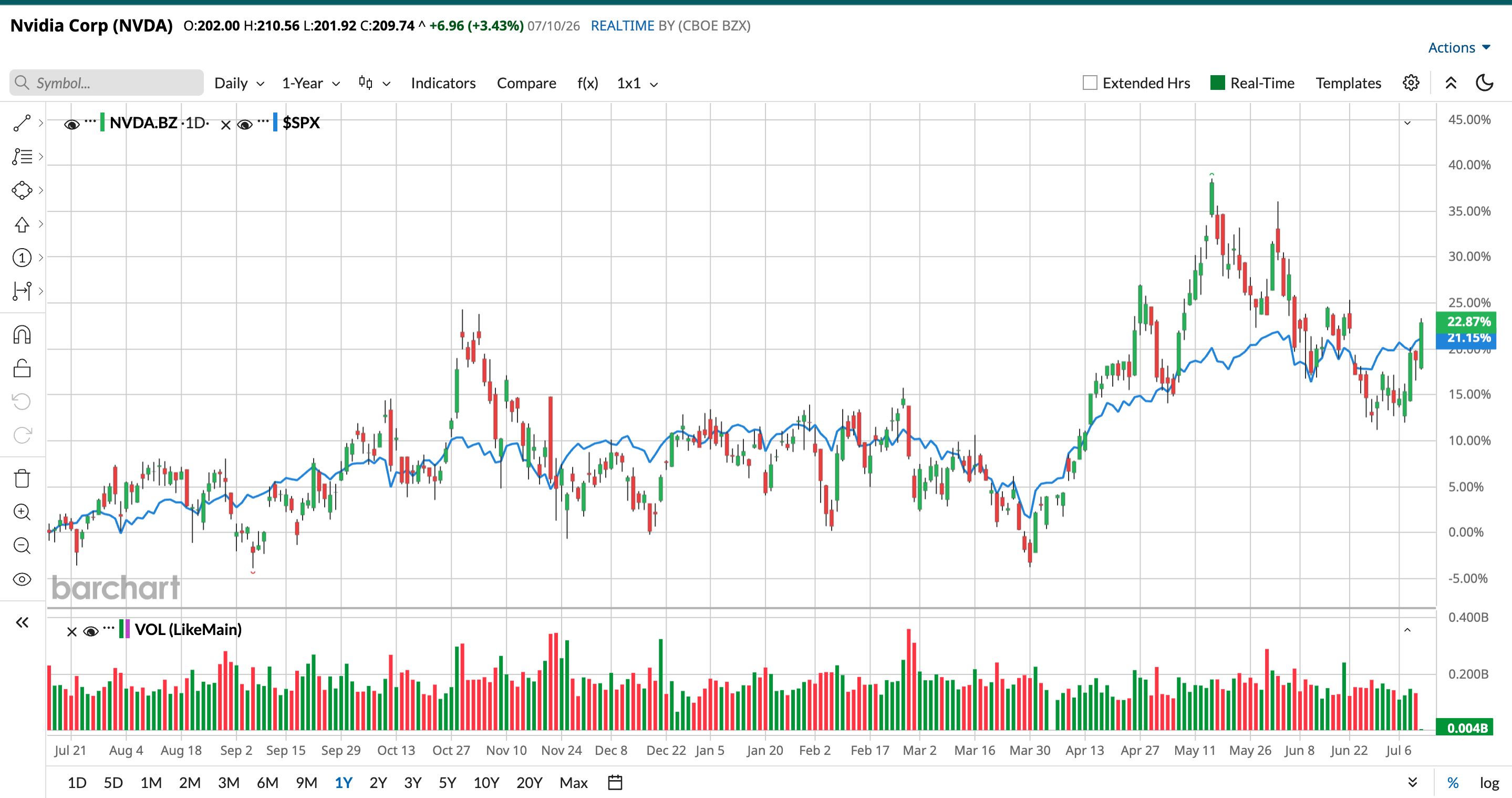
Yet, even market leaders are not immune to changing investor sentiment. As Wall Street begins to question whether AI-related spending can continue at its current breakneck pace, Nvidia's once-unstoppable rally has started to cool. The stock has gained a respectable 27.9% over the past year and 12.5% year-to-date (YTD), but those returns have been overshadowed by a handful of memory chip and emerging AI names that have recently stolen the spotlight.
Investors have also become increasingly cautious after Nvidia surged to an all-time high of $236.54 on May 14. Since then, the shares have retreated 11.2% as traders locked in profits and concerns mounted over rich valuations, rising competition from custom AI chips, and growing debate over whether the industry's massive AI spending cycle is sustainable in the long run.
 www.barchart.com
 Nvidia’s Q1 Earnings Snapshot
Despite growing concerns that AI spending could eventually lose momentum, Nvidia's most recent quarterly results painted a very different picture. Instead of slowing demand, the company continues to benefit from an unprecedented wave of investment in AI infrastructure, with cloud providers, enterprises, and governments showing little sign of easing their spending.
For the first quarter of fiscal 2027, Nvidia delivered another blockbuster performance. Revenue reached an all-time high of $81.6 billion, soaring 85% from the same period last year and comfortably surpassing Wall Street's expectations of $78.84 billion. The company's bottom line was equally impressive, with adjusted earnings climbing 140% year-over-year (YOY) to $1.87 per share, once again beating analysts' consensus estimate of $1.77. The results underscored Nvidia's ability to consistently exceed even the market's elevated expectations.
Also, the quarter marked an important shift in the way in which Nvidia presents its business. Reflecting the company's transformation from a graphics chip manufacturer into a full-fledged AI computing platform, management introduced a simplified reporting structure built around two key segments: Data Center and Edge Computing.
The numbers highlight the increasing dominance of the AI infrastructure for the company. The Data Center business generated $75.2 billion in quarterly revenue, more than 92% of Nvidia's total sales, and expanded 92% from a year earlier. The surge was fueled by relentless demand for AI accelerators as customers continued building next-generation data centers to support generative AI workloads.
While the spotlight remains firmly on Data Center, Nvidia's newer Edge Computing platform is steadily carving out a larger role in the business. Quarterly revenue from the segment rose 29% YOY to $6.4 billion, supported by growing adoption of AI-powered technologies across gaming devices, personal computers, industrial robotics, networking infrastructure, autonomous machines, and automotive applications.
Beyond its exceptional growth, Nvidia demonstrated that it has maintained remarkable pricing power. The company posted a GAAP gross margin of 74.9%, matching the previous quarter and improving sharply from the prior year, a sign that robust demand continues to outweigh supply and competitive pressures. Nvidia's confidence in its financial strength was also evident in its capital allocation strategy.
During the quarter, the company returned about $20 billion to shareholders through a combination of stock repurchases and cash dividends, highlighting management's willingness to reward investors while continuing to invest heavily in future growth. Looking forward, management expects fiscal second-quarter revenue of approximately $91 billion, well ahead of analysts' projections of about $86.11 billion.
Notably, that forecast assumes no contribution from Data Center compute sales in China, suggesting that demand across the rest of the world remains powerful enough to offset geopolitical headwinds. Combined with projected gross margins of roughly 75%, Nvidia's guidance indicates that the AI investment cycle is still in full swing, despite growing debate over whether the boom can be sustained.
What Analysts Think About Nvidia Stock
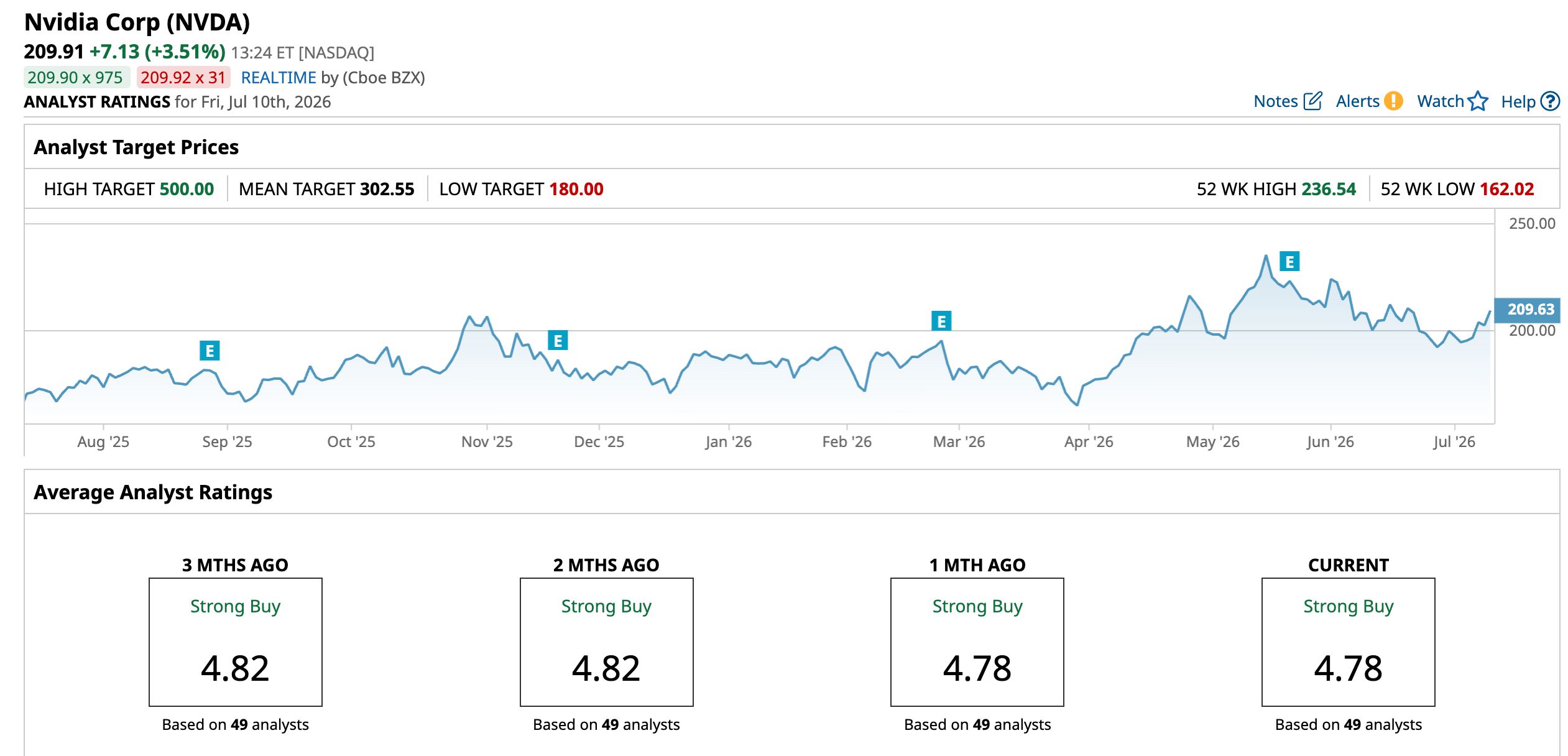
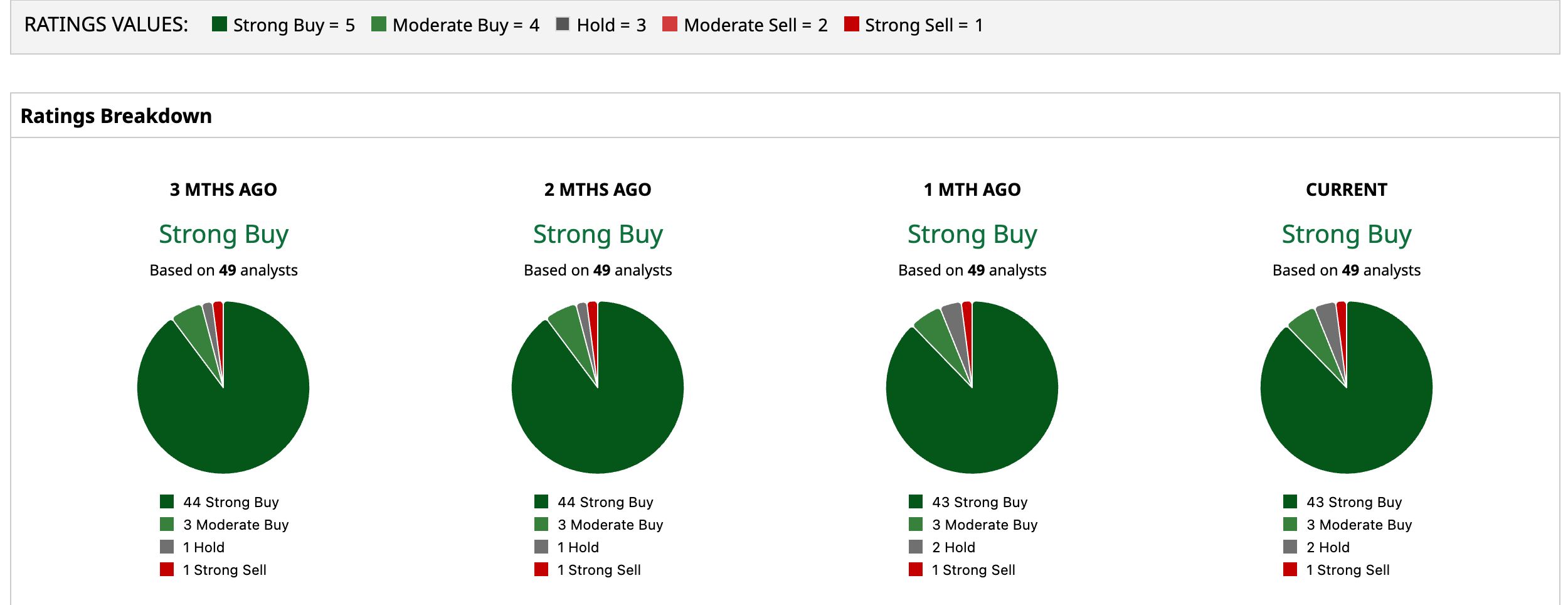
Even with all the noise about red flags surrounding the AI boom, Wall Street remains firmly in Nvidia's corner. The stock continues to command a consensus "Strong Buy" rating, with 43 of the 49 analysts covering the company recommending a "Strong Buy." Three analysts rate it a "Moderate Buy," two maintain "Hold" ratings, while just one has issued a "Strong Sell."
The average price target of $302.55 implies 44.1% upside from current levels. Even more bullish, the Street-high target of $500 suggests Nvidia shares could soar as much as 138.2%, highlighting analysts' confidence that the AI leader's growth story is far from over.
 www.barchart.com
  www.barchart.com
 On the date of publication, Anushka Mukherji did not have (either directly or indirectly) positions in any of the securities mentioned in this article. All information and data in this article is solely for informational purposes. For more information please view the Barchart Disclosure Policy here.
More news from Barchart
Taiwan Just Waved a Red Flag for Nvidia Stock Wall Street Says Investors Are Missing Cloudflare’s Biggest AI Opportunity Navitas Semiconductor Stock Is on the Ropes. It Faces a New Patent Infringement Lawsuit. Grok’s Ongoing Market Share Decline Raises Questions About SpaceX’s AI Strategy Post-IPO