

(NFLX) reports second-quarter earnings on July 16, three days before the World Cup final.
That is awkward timing. The biggest sporting event on the planet is taking viewers away from almost every other form of entertainment, and Netflix does not own the rights. Engagement will likely drop. It would be strange if it did. But I think investors are in danger of drawing the wrong conclusion from that.
More Top Stocks Daily: Go behind Wall Street’s hottest headlines with Barchart’s Active Investor newsletter.
Watching less (NFLX) during the World Cup is not the same as cancelling (NFLX). It is not the same as weaker pricing. It is not the same as lower advertising revenue. And it certainly is not proof that the business has lost its relevance. The World Cup began on June 11, so it only affected the final 20 days of (NFLX)’s second quarter. Most of the knockout rounds, including the final, fall into the current quarter. That means the July 16 numbers will only provide a partial picture.
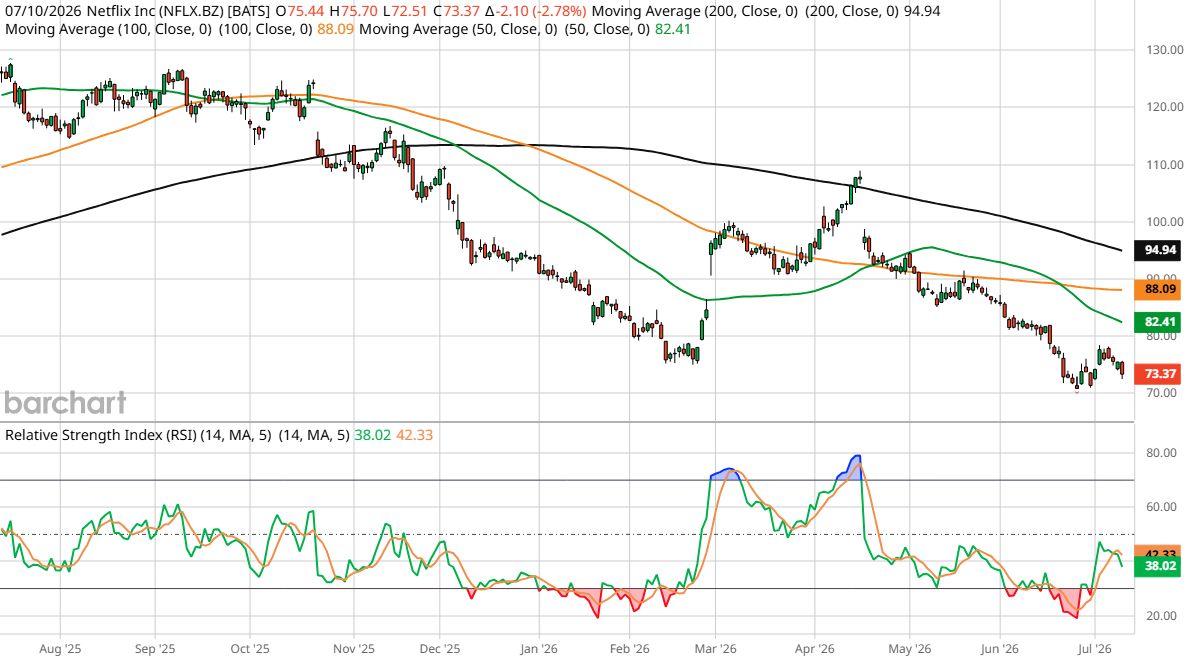
Management’s comments will matter more. (NFLX) shares have fallen sharply since April. At around 23 times trailing earnings, the stock is not obviously cheap, but investors are treating the company more critically. The next stage of the story must come from better monetization, not just from adding millions of subscribers each quarter. That is what I will be watching.
Viewing Hours Can Be Misleading
Investors like simple numbers. Subscriber growth worked for years because (NFLX) was expanding into new households and new countries. The faster subscribers grew, the stronger the story looked. That measure becomes less useful as the business matures.
(NFLX) is currently boosting rates, establishing an ad business and selectively going into live programming. A consumer who stays on the platform, watches fewer hours, and pays a higher fee may generate more value because they also contribute to advertising revenue, compared to a heavy viewer on a lower plan. So, I would be cautious about interpreting lower engagement as a major concern in itself.
The first-quarter results didn’t indicate (NFLX) was suddenly in trouble. Revenue increased 16.2% to $12.25 billion. Operating income climbed 18% to nearly $4 billion, and the operating margin was 32.3%. Management also reiterated its full-year sales outlook of $50.7 billion to $51.7 billion and its operating margin target of 31.5%. Those are good stats.
The concern is that second-quarter margin guidance was weaker. (NFLX) expects a margin of 32.6%, down from 34.1% a year earlier. Management blamed heavier content amortization and said margin expansion should return during the second half. That explanation now has to hold up. (NFLX) does not need to deliver a spectacular quarter. It does need to show that it is not spending more money just to keep viewers from leaving. A revenue beat with weaker margins would not settle that concern.
Advertising Matters More Than Football
The advertising business is becoming the most important part of the Netflix investment case. More than 60% of first-quarter sign-ups in markets offering the advertising plan chose that option. (NFLX) now works with more than 4,000 advertisers, and management expects advertising revenue to reach roughly $3 billion this year, about double the 2025 level.
That is where the opportunity sits. Netflix has spent years building one of the largest paid entertainment audiences in the world. Advertising gives it another way to earn money from that audience, particularly from customers who do not want to pay for the premium plans.
It can lower the entry price, reduce cancellations, and still generate revenue from viewing. But there is a catch. Moving customers from a full-price subscription to a cheaper advertising plan is not automatically a win. The advertising revenue has to more than compensate for the lower subscription price and the additional cost of running the advertising platform. That is why the July report matters. I want to hear that advertising remains on track, advertiser demand is broadening, and the lower-priced plan is improving the economics of the business rather than just changing where the revenue comes from.
If that is happening, a few weeks of weaker viewing during the World Cup will not bother me. Live programming is part of the same discussion.
(NFLX)’s coverage of the World Baseball Classic in Japan attracted 31.4 million viewers and produced the company’s biggest-ever sign-up day in the country. Japan then became (NFLX)’s largest contributor to first-quarter membership growth. That is what live content is supposed to do. It should bring people onto the platform, provide advertisers something valuable, and keep existing customers from cancelling. Netflix does not need to buy every sports package available. In fact, that would worry me.
Traditional media companies have spent years overpaying for rights in the belief that audience size alone would solve their problems. (NFLX) should not make the same mistake. Live programming makes sense when the economics work. It becomes dangerous when management starts chasing viewing hours at any cost. (NFLX) has already secured rights to the FIFA Women’s World Cup in 2027 and 2031. That could be valuable. It could also become expensive. The key factor will be discipline.
What Would Make Me More Positive
I am not going to judge (NFLX) by whether people watched football instead of a drama series for a few weeks. I will judge it by what happens to the business underneath that viewing shift. If advertising revenue remains on track to double, price increases hold and management maintains its full-year margin target, the recent engagement concerns will look overdone. If cancellations rise, advertising demand weakens and margins come under pressure; at the same time, that is different. That would suggest (NFLX) is not just losing temporary attention. It may be losing some of its pricing power and customer loyalty. That is the risk.
At 23 times trailing earnings, (NFLX) still has to deliver. The stock is not cheap enough to ignore weakening fundamentals. But the market may be measuring the company with an old scorecard. The subscriber story is maturing. The next phase is about how much revenue and cash (NFLX) can generate from each household without overspending to keep them entertained.
The World Cup will end on July 19. If (NFLX)’s pricing, advertising growth, and margins remain intact after it does, investors may discover they confused a temporary loss of attention with a permanent loss of value.
On the date of publication, Jim Osman did not have (either directly or indirectly) positions in any of the securities mentioned in this article. All information and data in this article is solely for informational purposes. For more information please view the Barchart Disclosure Policy here.
More news from Barchart
Netflix Is Losing Viewers To The World Cup. That May Be The Wrong Measure Of The Business. Taiwan Just Waved a Red Flag for Nvidia Stock Wall Street Says Investors Are Missing Cloudflare’s Biggest AI Opportunity Navitas Semiconductor Stock Is on the Ropes. It Faces a New Patent Infringement Lawsuit.