

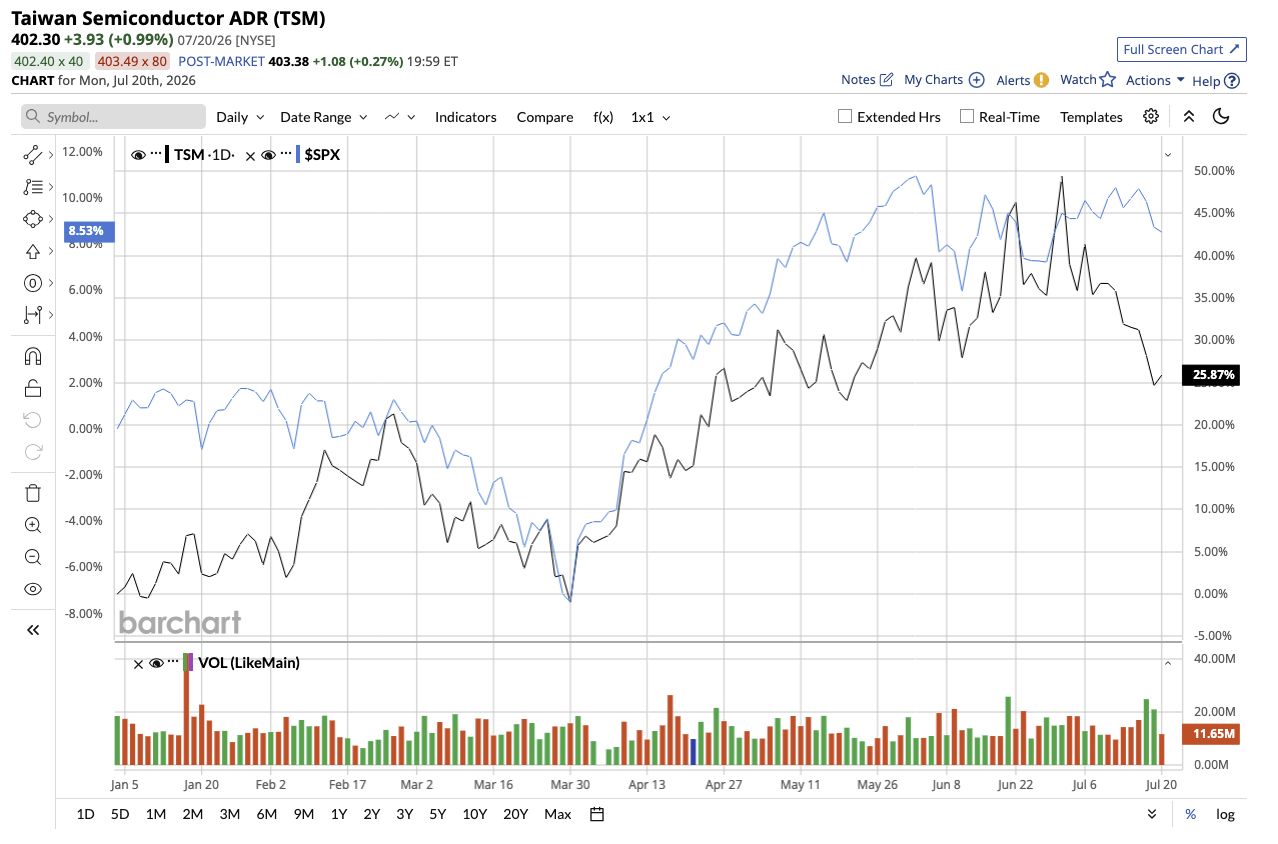
Artificial intelligence (AI) stocks have been on a roller-coaster ride this year. While bulls see AI as a multi-decade tech revolution, bears warn that spending on AI infrastructure has become excessive, which could eventually collapse earnings. Rather than being cautious amid these growing investor concerns, Taiwan Semiconductor (TSM), or TSMC, raised its 2026 capital expenditure budget to between $60 billion and $64 billion in its most recent second-quarter earnings call. TSM stock has climbed 39% year-to-date (YTD), outperforming the overall market's 10% gain so far this year.
It’s hard to imagine a company committing that kind of capital while believing AI demand will decline. Why is TSMC spending so much money even as AI bubble fears grow? Let's take a closer look.
More Top Stocks Daily: Go behind Wall Street’s hottest headlines with Barchart’s Active Investor newsletter.
 www.barchart.com
 A $64 Billion Investment That Might Worry Investors
TSMC’s recent Q2 earnings revealed that demand for advanced chips is not slowing. Total revenue increased 34% year-over-year (YOY) to $40.2 billion, owing to strength in advanced technologies used in AI accelerators, cloud computing, and high-performance computing (HPC) applications. Together, advanced technologies of 7 nanometers and below accounted for an impressive 77% of total wafer revenue.
Segment-wise, HPC accounted for 66% of total revenue and increased 20% sequentially. The performances of other segments like smartphone, IoT, automotive, and digital consumer electronics were mixed. Notably, HPC compensated for weakness in traditional consumer electronics. Despite spending $15.7 billion in capital expenditures in Q2, TSMC saw impressive growth of 77.4% in diluted EPS.
However, the most important announcement that surprised investors was the increase in capital spending. TSMC raised its capital expenditure budget to between $60 billion and $64 billion for 2026. The company plans to spend 70% to 80% of this on advanced process technologies. Additionally, 10% will support specialty technologies, while 10% to 20% “will be spent for advanced packaging, testing, mask making, and others,” per CFO Wendell Huang.
Management explained that higher investments have historically resulted in stronger long-term growth opportunities. The statement makes sense. Companies tend to reduce expenditures when there is weaker demand, but there is strong proof of growing demand as TSMC manufactures advanced chips designed by some of the largest tech companies. Its customers include Nvidia (NVDA), Apple (AAPL), AMD (AMD), Broadcom (AVGO), Qualcomm (QCOM), Amazon (AMZN), Microsoft (MSFT), Alphabet (GOOGL), and Meta Platforms (META). These companies are rapidly expanding their AI infrastructure. Hence, TSMC stands to benefit from that collective growth.
Profitability Faces Near-Term Pressure, But for a Bullish Reason
Much of today’s AI investment revolves around GPUs. However, the emergence of agentic AI is creating a revival in CPU demand inside AI data centers, which even Intel’s (INTC) management has emphasized. As TSMC manufactures chips for a wide variety of processors, it is well-positioned to win no matter which computing platform gains market share.
TSMC assured that its heavy investments are supported by growing demand. But the company also acknowledged that margins will face temporary pressure because of the same. While Q2 gross margin reached 67.7%, Q3 gross margin is expected to decline to around 66%, with guidance ranging between 65% and 67% due to the rapid production ramp of 2nm technology.
While the lower margin is a short-term concern, investors should note that this isn’t due to weak demand or pricing. Instead, it reflects the enormous investment needed to bring the company’s newest and most cutting-edge technologies to market, which will support complex AI workloads over the next few years. Management emphasized the same, stating that compared with N2, A14 is expected to deliver 10% to 15% higher performance at the same power, or 25% to 30% lower power consumption at the same speed, along with nearly 20% higher chip density.
TSMC expects Q3 revenue to increase by 37% YOY at the midpoint to land between $44.6 billion and $45.8 billion. Moreover, full-year revenue could grow slightly above 40% YOY. The revenue forecast is further proof that TSMC continues to see extraordinary customer demand across AI infrastructure markets. Analysts also see earnings increasing by 52% in fiscal 2026, with another 28% increase expected in fiscal 2027.
One of the main reasons TSMC can afford such an ambitious investment program is its disciplined cost management and fortress balance sheet. At the end of the quarter, it held $110 billion in cash and marketable securities.
What Does Wall Street Think of TSM Stock?
Every earnings season raises more questions about excessive AI spending as semiconductor firms raise their capex budgets. TSMC's capex budget has raised the same concerns. However, the company also raised its revenue growth target for this year. While temporary margin pressure and rising inventory are making short-term investors skeptical, management believes these are just consequences of bringing new manufacturing technologies online fast enough to satisfy customer demand. TSMC’s confidence suggests its next chapter will be considerably stronger than the current one. Long-term investors who can ignore the short-term noise might benefit from holding on to TSM stock.
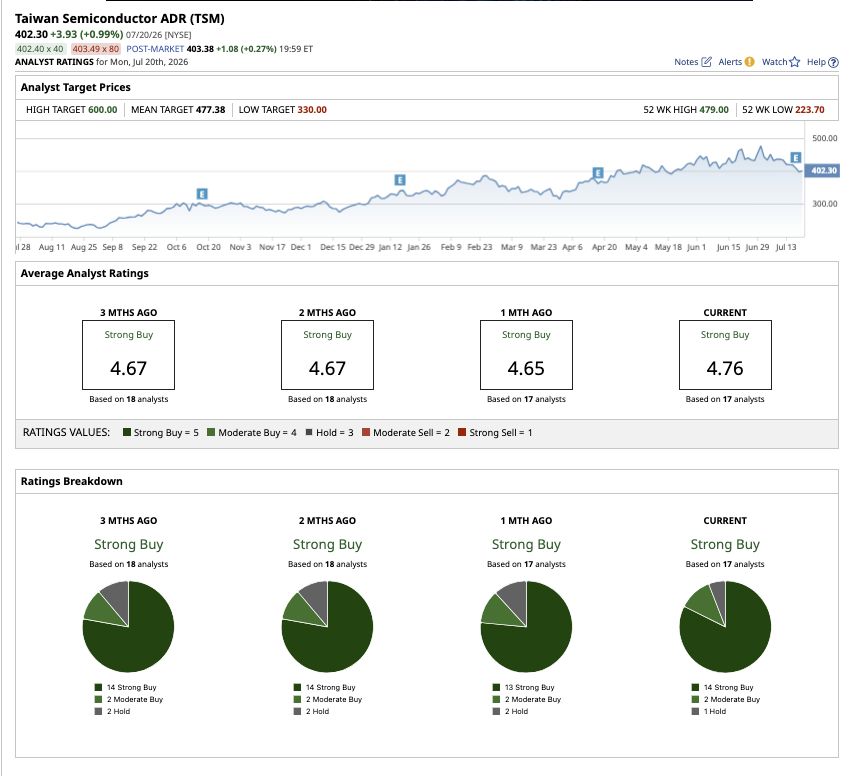
On Wall Street, TSM stock holds a consensus “Strong Buy” rating. Out of 17 analysts with coverage, 14 have a “Strong Buy,” two have a “Moderate Buy" rating, and one offers a “Hold" rating. The average price target of $497.77 implies potential upside of 18% from current levels. Following the strong quarter, Barclays assigned a new high price target of $650 for TSM stock, which suggests potential upside of 54% over the next 12 months.
 www.barchart.com
 On the date of publication, Sushree Mohanty did not have (either directly or indirectly) positions in any of the securities mentioned in this article. All information and data in this article is solely for informational purposes. For more information please view the Barchart Disclosure Policy here.
More news from Barchart
Record Orders, Soft Revenue: What Super Micro Isn’t Saying About Its $60 Billion Quarter General Motors’ CFO Says GM Stock Is a Bargain. Here's Why He's Right. Microsoft Is Deepening Ties with AI Giant Mistral. What That Actually Means for MSFT Stock Investors. TSMC Stock: A $64 Billion Bet Even as AI Bubble Fears Grow