


Memory chip stocks have endured a sharp reversal in recent weeks as investors questioned whether the enormous sums being invested in artificial intelligence infrastructure can continue at the same pace. The selloff has swept through leading memory and data-storage companies, dragging the Roundhill Memory ETF (DRAM) sharply below its recent highs and testing confidence in one of the market’s most crowded AI trades.
Still, investors have responded to the weakness by buying rather than heading for the exits. The Roundhill Memory ETF reportedly attracted approximately $10 billion in fresh capital during its recent drawdown, an extraordinary show of conviction. The move suggests that many investors viewed the selloff as an opportunity to gain exposure to the memory sector at lower prices.
More Top Stocks Daily: Go behind Wall Street’s hottest headlines with Barchart’s Active Investor newsletter.
So, the key question now is whether DRAM investors are correctly anticipating another leg higher—or simply buying into a trade whose best gains have already passed. Let’s take a closer look.
About the Roundhill Memory ETF
The Roundhill Memory ETF is an actively managed thematic ETF that provides targeted exposure to global companies involved in producing memory and data-storage technologies, including DRAM, NAND flash, and high-bandwidth memory. The fund is designed to benefit from rising memory demand driven by artificial intelligence infrastructure, data centers, cloud computing, consumer electronics, and other data-intensive applications. Roundhill describes DRAM as the first U.S.-listed ETF focused specifically on memory semiconductor stocks.
DRAM’s portfolio is highly concentrated in the three companies that dominate the global memory market. Micron Technology (MU) is the largest holding at 26.91%, followed by Samsung Electronics (SMSN.L.IX) at 25.88% and SK Hynix (SKHY) at 22.18%. Together, these three stocks account for approximately 76% of the ETF’s portfolio. Meanwhile, DRAM holds Samsung, SK Hynix, and Micron through swap positions. Other notable holdings include SanDisk (SNDK), Kioxia Holdings (KXIAY), Western Digital (WDC), Seagate Technology (STX), and GigaDevice Semiconductor.
Launched on April 2, the ETF trades on the Cboe BZX Exchange and has an annual expense ratio of 0.65%. It currently holds $25.05 billion in assets under management.
DRAM has soared more than 92% since launching at around $30 per share in early April. It reached an all-time high of $81.34 on June 22.
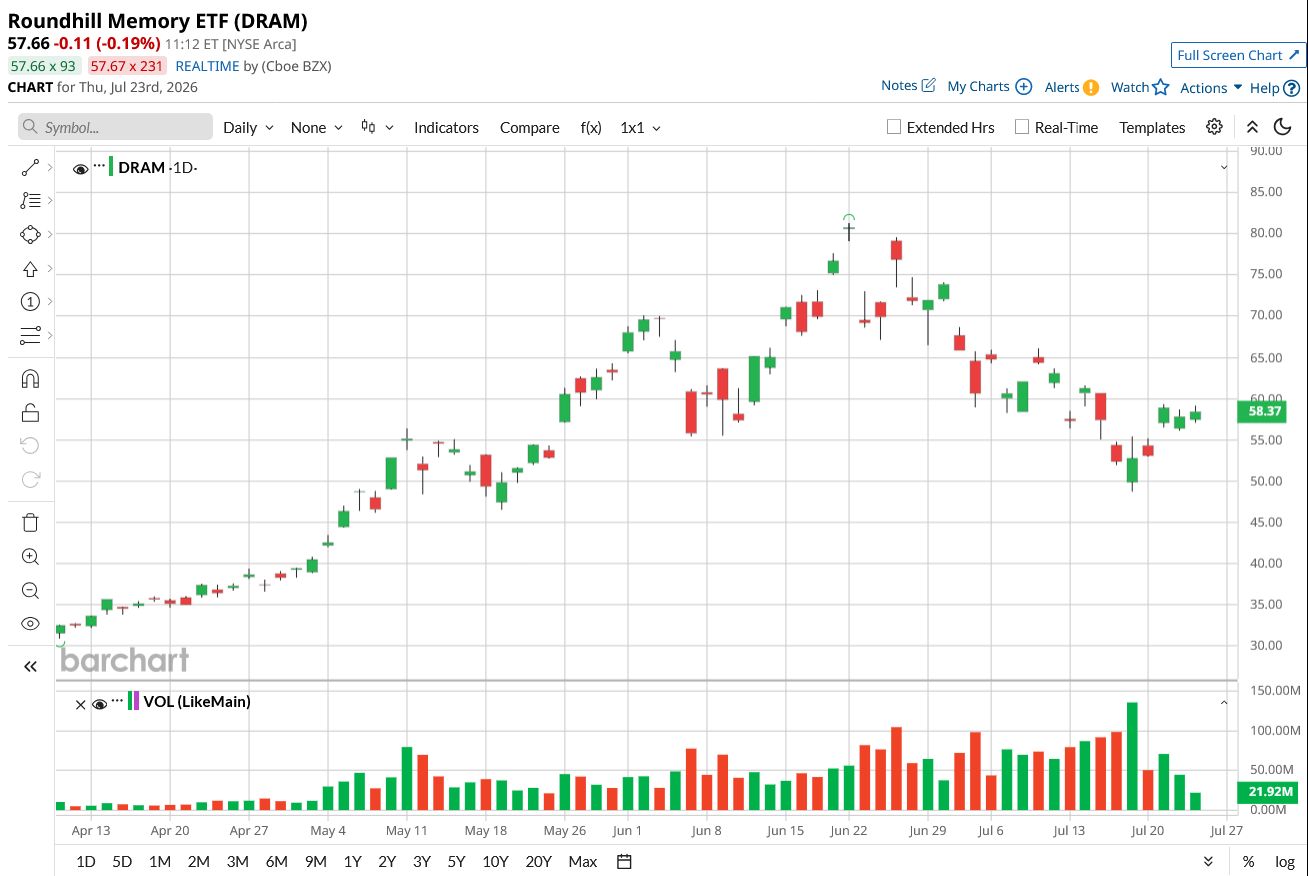 www.barchart.com
 DRAM ETF Falls Into a Bear Market, but Inflows Keep Surging
Memory chipmakers and other AI-related stocks came under heavy pressure in recent weeks amid growing investor concerns that the AI boom has become overextended. As the three holdings responsible for roughly 75% of the Roundhill Memory ETF’s performance took a hit, DRAM also slumped. It has fallen about 29% from its all-time high, marking a move into a technical bear market. Still, this hasn’t appeared to spook investors, who have continued buying the ETF with both hands.
According to ETFDb, DRAM attracted about $9.4 billion in net inflows during its retreat from its peak. Despite losing nearly 30% of its value, the fund held $25.05 billion in assets under management as of Wednesday, only slightly below its late-June peak of $25.9 billion. This means that inflows have almost entirely offset the fund’s market losses.
Even more interestingly, the fund attracted more than $1.65 billion in net inflows last week. That’s despite memory companies suffering their worst week in years. With that, such strong dip-buying signals robust investor conviction in the semiconductor memory sector.
And now comes the most logical question: Are dip buyers right to bet on another leg higher for memory chipmakers, or is the cycle over? Let’s find out.
Memory Chip Fundamentals Keep Strengthening Despite the Selloff
As I’ve said multiple times in my previous articles, it’s critical to separate the facts from the noise, particularly when it comes to memory chipmakers and the memory cycle as a whole. By doing so, we can see that some things that initially appear to be major negatives are actually not as bad as feared—or may even be positives.
The recent selloff in memory chipmakers initially began as a healthy round of profit-taking following a near-parabolic rally. However, the selloff was later amplified by several factors, ranging from liquidations in South Korea and overcapacity concerns sparked by Meta Platforms’ (META) plan to sell computing capacity to escalating tensions in the Middle East and fears of growing competition from China. It pushed many chipmakers into bear-market territory, leaving investors wondering whether another leg higher is possible or the party is over.
As I argued in one of my recent articles, much of this year’s chip rally has been supported by improving fundamentals. With that, to determine whether chipmakers still have room to run, I think it’s important to turn our attention to the broader fundamental picture. And you might be surprised, but it has actually become even stronger since the chip selloff began in late June. Ironically, some of the factors that contributed to the selloff—or were meant to sour investor mood—only strengthened my bull case.
First, there’s the China factor, which weighed on chipmakers from two directions. Last Friday, Moonshot AI unveiled Kimi K3, which offers frontier-level intelligence at a fraction of the cost of proprietary Western models, prompting investors to draw parallels with last year’s “DeepSeek moment.” However, the model contains 2.8 trillion parameters, all of which must still be stored in memory, meaning the need for high-bandwidth memory hasn’t gone anywhere. Separately, investors were worried that DRAM maker CXMT and NAND flash maker YMTC would aggressively expand capacity and pressure pricing, but Citi analysts said in a recent note that those fears are unlikely to materialize this year or next.
Since I’ve raised the pricing question, it is also worth addressing a recent warning from SK Hynix executive Chey Tae-won, who reportedly said last week that current memory prices are unsustainable over the longer term. In fact, this is nothing new, as we already know that major memory chipmakers have been expanding capacity to meet booming demand. When supply catches up with demand, prices tend to fall. However, the bulk of major new production capacity will not come online until late 2027 and 2028. This means memory chipmakers should retain unprecedented pricing power for the foreseeable future, enabling them to expand margins and deliver explosive profit growth. I explored this in greater detail in my latest article on Micron.
Finally, sharp selloffs in South Korean memory chipmakers have repeatedly dragged down U.S. chip and AI infrastructure stocks over the past few weeks. And here, I want to highlight one important point. Leveraged exchange-traded funds tracking SK Hynix and Samsung Electronics have become highly popular in South Korea, but when the two stocks began to fall, these funds amplified the volatility. That means most of this “technical pressure”—not any deterioration in fundamentals—spilled over to their U.S. peers.
Conclusion
Putting it all together, I believe the recent selloff in memory chipmakers was overdone and that investors who bought the dip in the DRAM ETF are right to bet on another leg higher.
Still, memory chipmakers need a catalyst to begin a new upward move—and fortunately, Big Tech earnings season could provide exactly that. Confirmation that the largest U.S. tech companies continue spending heavily to build the infrastructure needed to power AI would undoubtedly be excellent news for memory chipmakers and other AI hardware suppliers. And we just got the first one, as Google parent Alphabet (GOOG) (GOOGL) yesterday raised its full-year capital expenditure guidance by $15 billion to a new range of $195 billion to $205 billion, surpassing Wall Street’s estimates. U.S. memory chipmaker Micron Technology reacted positively in pre-market trading, climbing over 3%. Alphabet was the first of the major technology companies to report quarterly results, with Meta Platforms, Microsoft (MSFT), and Amazon (AMZN) set to follow next week. The four so-called AI hyperscalers said in April that they planned to spend as much as $725 billion this year to advance their AI ambitions. If Alphabet is any indication, that figure will be even higher by the end of next week, which I expect to fuel further gains in memory chipmakers.
On the date of publication, Oleksandr Pylypenko had a position in: DRAM , GOOGL , MSFT , AMZN , META . All information and data in this article is solely for informational purposes. For more information please view the Barchart Disclosure Policy here.
More news from Barchart
Investors Keep Buying the DRAM ETF Despite the Selloff. They Might Be Right About Memory Stocks. Stock Index Futures Gain as Oil Prices Retreat, U.S. PMI Data in Focus CapEx Fears Eclipse Alphabet’s Strong Q2, but GOOGL Stock Still Looks Attractive The Trump Administration Just Gave X-Energy Stock a Boost. Wall Street Sees 137% Upside Ahead.