

Rivian Automotive (RIVN) investors have July 30 circled on their calendars, when the electric vehicle (EV) maker is scheduled to report its second-quarter 2026 earnings after the market closes. The report arrives at a pivotal moment for the company, with optimism around its next-generation R2 platform growing, and production and delivery trends improving.
After raising its full-year delivery outlook earlier this month, Rivian now faces heightened expectations to prove that its operational momentum is translating into stronger financial performance. The upcoming results and, more importantly, management’s outlook could determine whether Rivian has further room to run or whether investors should brace for renewed volatility.
More Top Stocks Daily: Go behind Wall Street’s hottest headlines with Barchart’s Active Investor newsletter.
About Rivian Automotive Stock
With a market cap of around $24.3 billion, Rivian Automotive is an electric vehicle manufacturer focused on developing premium electric pickup trucks, SUVs, and commercial delivery vans. Headquartered in Irvine, California, the company also provides proprietary software, vehicle technology, and charging solutions to support its growing EV ecosystem. Rivian’s flagship products include the R1T pickup, R1S SUV, and the upcoming R2 midsize SUV, which is expected to play a key role in expanding the company’s addressable market.
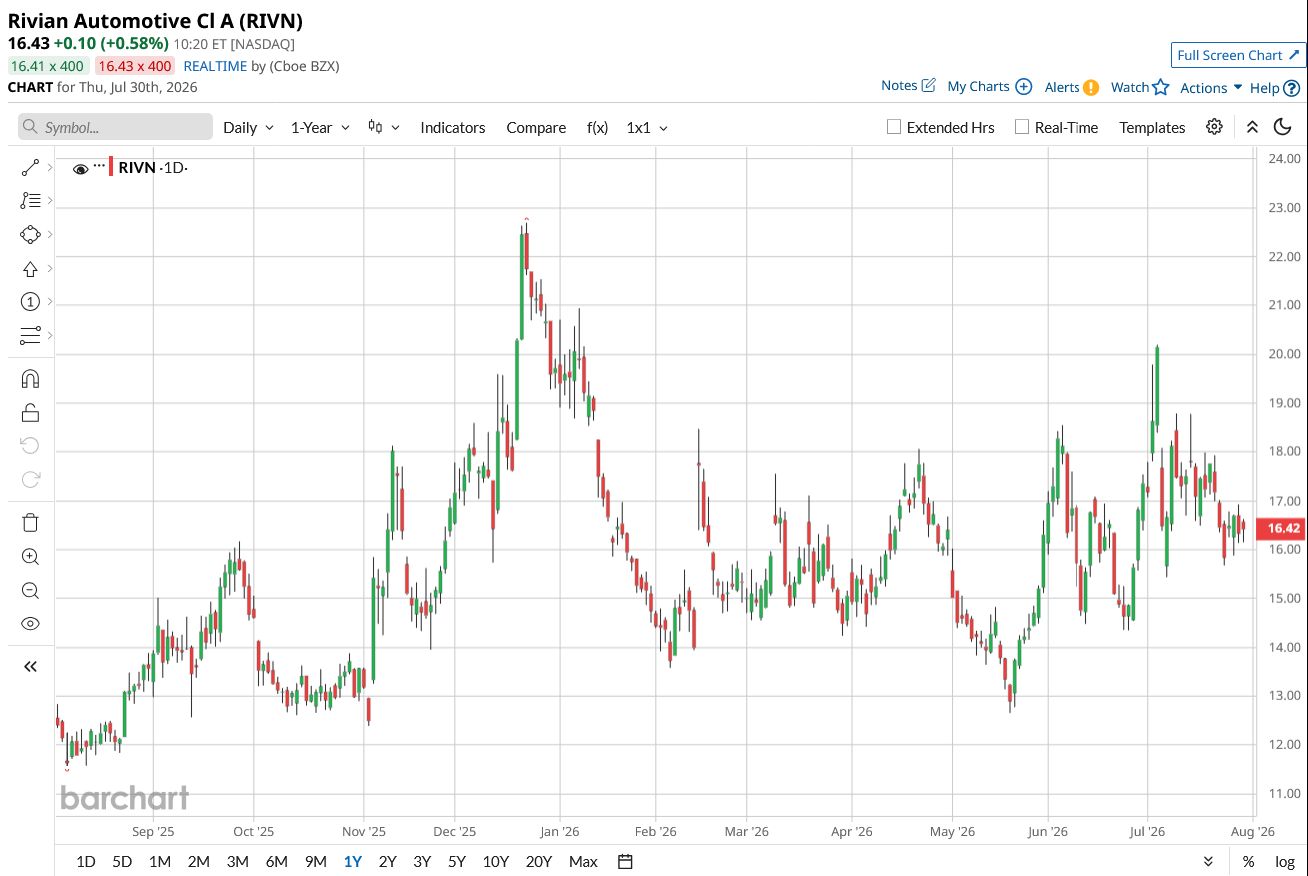
RIVN has rewarded long-term shareholders with significant gains over the past 52 weeks, with the stock rising about 26% as investors responded to improving vehicle deliveries, the launch of the R2 platform, and growing confidence in the company’s long-term growth strategy. However, the shares have declined 17% year-to-date (YTD), reflecting concerns over the competitive electric vehicle market and dilution following the company’s recent equity offering.
RIVN stock is currently trading at a premium compared to industry peers at 4.16 times sales.
 www.barchart.com
 Rivian’s Deliveries Remain Steady
On July 2, Rivian released its second-quarter 2026 production and delivery results. The company produced 12,613 vehicles and delivered 12,194 vehicles during the quarter, surpassing its previously issued delivery guidance of 9,000 to 11,000 vehicles.
Deliveries also increased from 10,661 vehicles in the second quarter of 2025, reflecting improving demand for Rivian’s R1 lineup, commercial delivery vans, and the initial rollout of its new R2.
Meanwhile, its production reached 10,236 vehicles, and deliveries increased to 10,365 vehicles in the first quarter of 2026.
Encouraged by the better-than-expected quarter, Rivian simultaneously raised its full-year 2026 delivery outlook from 62,000-67,000 vehicles to 65,000-70,000 vehicles.
The guidance reinforced confidence that demand for Rivian’s R1 vehicles, commercial vans, and newly launched R2 SUV remains stronger than expected, setting the stage for what could be a closely watched second-quarter earnings report.
Q1 Demonstrates Improving Bottom-Line
Rivian Automotive released its first-quarter 2026 results on April 30, reporting another quarter of improving financial performance as the electric vehicle maker continued its path toward profitability. Revenue increased 11% year-over-year (YoY) to $1.4 billion, driven by growth in vehicle deliveries and a sharp increase in high-margin software and services revenue.
The company also narrowed its net loss to $416 million, from $541 million a year earlier. Rivian reported a loss per share of $0.33, improving from a loss of $0.48 per share in the first quarter of 2025 and comfortably beating analysts’ expectations.
Moreover, Rivian generated $119 million in consolidated gross profit, which was an $87 million decrease from the same quarter in the previous year. Rivian ended the quarter with around $4.8 billion in cash and cash equivalents, providing substantial liquidity to fund future growth initiatives.
Additionally, analysts expect RIVN to post a Q2 loss per share of $0.82, a 15.5% YoY improvement. However, analysts anticipate loss per share to deteriorate 1.7% to $3.06 in fiscal 2026 but improve again 22.2% to $2.38 in fiscal 2027.
What Do Analysts Expect for RIVN Stock?
On July 27, Piper Sandler upgraded Rivian Automotive from “Neutral” to “Overweight” and raised its 12-month price target to $20 from $18. The firm’s more bullish stance was driven by improving demand for electric vehicles and growing confidence in the successful launch and scaling of Rivian’s R2 SUV.
On the other hand, Cantor Fitzgerald reiterated its “Neutral” rating on Rivian while maintaining its $19 price target ahead of the company’s second-quarter earnings report.
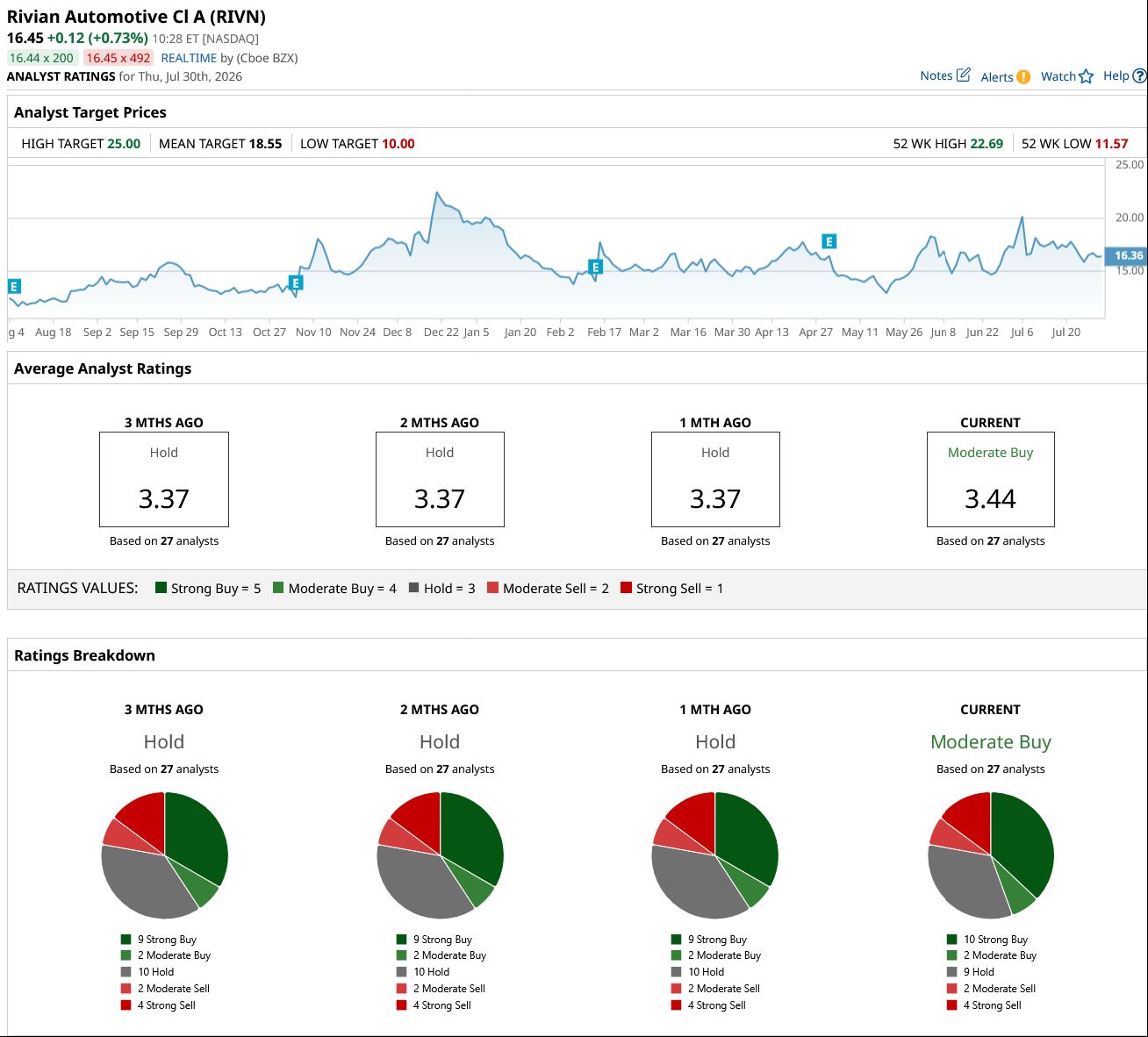
Rivian stock has a consensus “Moderate Buy” rating overall. Out of 27 analysts covering the stock, 10 recommend a “Strong Buy,” two give a “Moderate Buy,” nine analysts stay cautious with a “Hold” rating, while two suggest a “Moderate Sell,” and four rate it a “Strong Sell.”
RIVN’s average analyst price target of $18.55 suggests an upside of 13%, and the Street-high target of $25 suggests growth of 52% ahead.
 www.barchart.com
 On the date of publication, Subhasree Kar did not have (either directly or indirectly) positions in any of the securities mentioned in this article. All information and data in this article is solely for informational purposes. For more information please view the Barchart Disclosure Policy here.
More news from Barchart
HIMS Stock in Focus as FTC Lawsuit Takes Aim at Hims & Hers Business Practices Dear Rivian Stock Fans, Mark Your Calendars for July 30 1 Options Trade to Make Now to Bet on ON Semiconductor Stock Bouncing Back The Charts Reveal Significant Price Movement in Forte Biosciences Stock Ahead of Argenx’s Acquisition Announcement