

With computer flash-memory maker SK Hynix (SKHY) benefiting tremendously from the AI revolution, poised to buy back a huge number of its shares, and trading at an extremely attractive valuation, the name looks like an excellent investment in the medium term.
In the near future, however, SKHY stock may not climb much because the Street does not seem very bullish on flash-memory names at this point. And in the long term, South Korea-based SK Hynix could very well be significantly undermined by innovations that will meaningfully reduce the amount of memory needed to perform each AI-powered task. But in the next four months to 12 months, SKHY stock looks well-positioned to produce excellent returns for investors.
More Top Stocks Daily: Go behind Wall Street’s hottest headlines with Barchart’s Active Investor newsletter.
 www.barchart.com
 About SK Hynix
SK Hynix develops and produces a wide range of computer memory, including DRAM, NAND flash memory, solid-state drives (SSDs), and multi-chip packages (MCPs).
The company, which has a market cap of $1.19 trillion, also provides foundry services for non-memory semiconductors, serving customers across data centers, networking, mobile devices, PCs, consumer electronics, and automotive applications.
A Big Lift From the AI Boom and Huge Future Share Buybacks
Showing that SK Hynix, like its peers Micron (MU) and Sandisk (SNDK), is benefiting tremendously from the proliferation of AI, the South Korea-based firm reported outstanding second-quarter results on July 29.
Specifically, its revenue jumped 257% versus the same period a year earlier to $56.9 billion, while its operating profit soared 557% year-over-year (YoY) to $43.4 billion.
And within the next 12 to 18 months, the company's growth could accelerate as cheaper Chinese AI models start to proliferate widely in the West, causing the utilization of AI to grow at an even faster pace than is the case presently.
Meanwhile, after the firm recently announced a $29 billion share buyback plan and stated that it intends to return over 50% of its total cash flow from 2025 to 2027 to shareholders, JPMorgan estimated that the firm would return a staggering total of at least $130 billion to the owners of its stock.
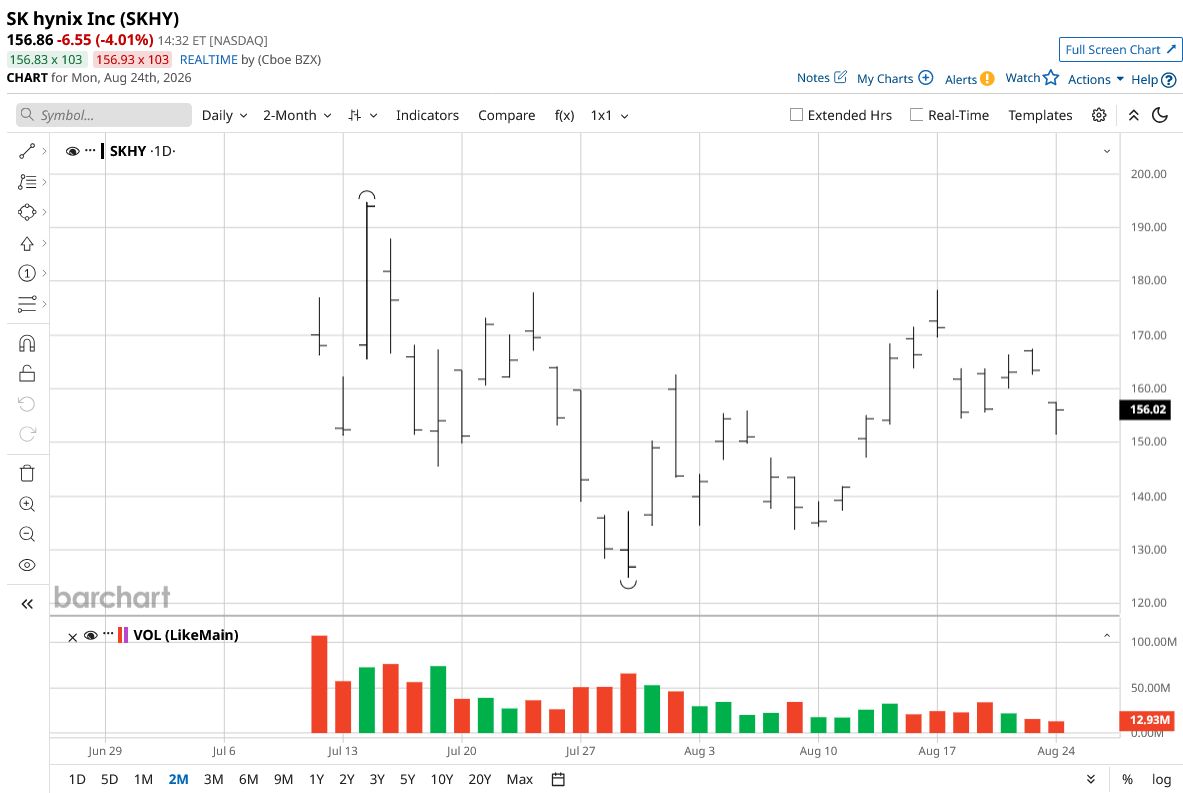
For the past five trading days, SKHY stock has done poorly and is down about 9%. Micron and Sandisk also did not perform very well over the same period. Barring a major catalyst, such as meaningfully better-than-expected earnings from Nvidia (NVDA), which is due to report its financial results on Aug. 26, SK Hynix may stay rangebound for the next few weeks.
A Major Long-Term Threat From Technological Innovation
As I wrote in a previous column, “In March, Alphabet announced that it had developed TurboQuant, 'a new compression method that it says could reduce the amount of memory required to run large language models by six times,' CNBC reported.”
Some commentators have argued that TurboQuant will not affect the amount of memory needed to power AI models. But a statement by SK Hynix's CFO, Kim Woo-hyun, seems to contradict this theory.
“Although memory-efficiency technologies may appear to reduce memory usage per individual device, in reality they are evolving in a direction that maximizes the amount of context that can be processed per unit of memory.” But if many fewer units of memory are needed to provide AI-powered services, as the CFO suggests, then the amount of memory needed for each device may drop sharply.
It's true that, as AI enables computers to perform an enormous number of complicated tasks at an even greater scale, the amount of memory needed to power AI in each device could climb despite the efficiencies to which the CFO alluded. And the number of AI-powered devices is likely to climb tremendously. But it's very difficult, if not impossible, to determine whether the increased demand for memory stemming from the latter catalysts will outpace the technological innovations that will reduce the demand for the commodity for each task.
A number of commentators have also argued that products become more lucrative as they get cheaper and proliferate. But history shows that this theory is not always valid. PCs, airplane flights, and automobiles, for example, have all generally become much cheaper and much more popular over time. However, the inflation-adjusted profits of some of the companies that provide them are meaningfully below their peak levels.
Valuation and the Bottom Line on SKHY Stock
Given SK Hynix's rapid growth and the huge amount of funds that it will return to shareholders, SKHY Stock has an extremely low forward price-earnings ratio of 6.4x. Nevertheless, the shares may not do very well in the short term or the long term. But they do look appealing for investors with time horizons of four months to 12 months.
On the date of publication, Larry Ramer did not have (either directly or indirectly) positions in any of the securities mentioned in this article. All information and data in this article is solely for informational purposes. For more information please view the Barchart Disclosure Policy here.
More news from Barchart
Why Wolfe Research Just Named Nvidia Stock Its Top AI Pick Michael Burry Says He Would Buy Alibaba Stock When It Crashes 50%. You Shouldn’t Wait That Long. Nvidia Scored an H200 Win in China, But These Analysts Warn It May Not Be a Reason to Buy NVDA Stock Applied Materials Drops 34%. Here’s Why You Should Buy the Dip in AMAT Stock.