

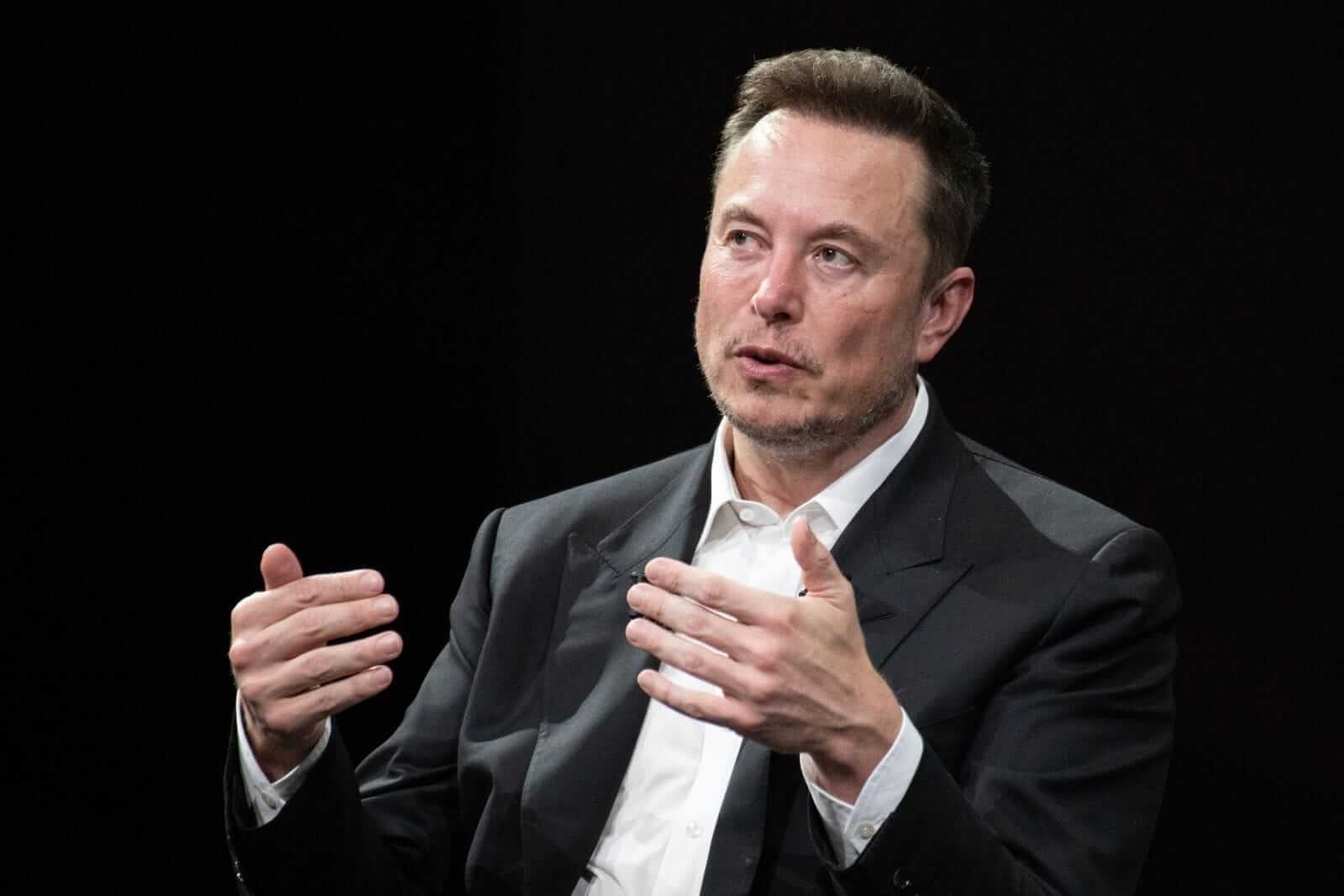
The U.S. national debt has grown so enormous that another trillion can almost sound like a rounding error. But for Tesla (TSLA) CEO Elon Musk, the numbers point to a much bigger problem — and his proposed solution involves artificial intelligence (AI), robotics, and a race against the clock.
Musk issued the warning during an episode of the “Dwarkesh Podcast” in February 2026, arguing that the U.S. could face financial failure without AI and robotics.
Join 200K+ Subscribers: Find out why the midday Barchart Brief newsletter is a must-read for thousands daily.
“In the absence of AI and robotics, we’re actually totally screwed because the national debt is piling up like crazy,” Musk said during the interview.
He then pointed to the cost of servicing the debt.
“The interest payments [on the] national debt exceed the military budget, which is a trillion dollars. So [we have] over a trillion dollars just in interest payments,” Musk said.
Musk took the warning even further.
Sponsored Content: The Clean Coal Comeback Just Passed $30M. See Why Investors Are Watching ‘FASF.’
“It’s the only thing that could solve the national debt. We are 1,000% going to go bankrupt as a country, and fail as a country, without AI and robots,” Elon Musk said during the February 2026 podcast. “Nothing else will solve the national debt. We just need enough time to build the AI and robots to not go bankrupt before then.”
The Debt Problem Is Measured in Trillions
Musk’s comments came as the national debt was already approaching $40 trillion. By August, it had crossed that mark.
On Aug. 18, 2026, the U.S. national debt officially crossed $40 trillion for the first time, with U.S. Treasury figures putting total public debt outstanding at just over $40.05 trillion.
The interest bill has become an equally striking figure. Through the first 10 months of fiscal 2026, the federal government had paid roughly $963 billion in net interest costs, putting the annual bill on track to exceed $1 trillion.
That interest expense is now among the largest items in the federal budget. It can also compete with other major government priorities for limited federal dollars.
Musk’s concern is that the debt isn’t simply large — it’s becoming increasingly expensive to carry.
The U.S. debt held by the public accounts is roughly $32.3 trillion of the total, while intragovernmental holdings make up the rest. As more debt is refinanced at higher rates, the government’s interest costs can continue rising.
Musk’s Bet on Productivity
Musk’s argument is that traditional approaches won’t be enough to solve a problem of this size. His bet is that AI and robotics could dramatically increase economic productivity, allowing the U.S. economy to produce far more goods and services with fewer human hours.
In theory, that kind of productivity boom could help the economy grow faster than the debt burden, while a larger economy could also generate more taxable income and revenue.
That’s why Musk isn’t presenting AI and robotics as simply another technology trend. He sees them as a potential economic lifeline.
The challenge is the timeline.
AI adoption is already accelerating across industries, while robotics companies are working to bring increasingly capable machines into factories, warehouses, and other workplaces. But there’s no guarantee that the productivity gains will arrive quickly enough or at a large enough scale to offset the United States' fiscal imbalance.
There is also a fundamental distinction between growing the economy and fixing the federal budget. Even rapid economic growth wouldn’t automatically eliminate the gap between government spending and revenue.
Still, the investment implications are significant.
If AI and robotics produce the productivity boom Musk expects, companies building the infrastructure and software behind that transformation could stand to benefit. Semiconductor manufacturers, AI developers, automation companies, and robotics firms are among the businesses positioned around the theme.
If the productivity revolution falls short, investors still have to contend with the other side of the equation — a national debt above $40 trillion and an annual interest bill moving beyond $1 trillion.
Musk’s forecast is deliberately extreme. But the underlying numbers are difficult to ignore.
The debt has crossed $40 trillion. The cost of servicing it is approaching another trillion-dollar milestone. And Musk’s argument is that the U.S. needs AI and robots to dramatically expand economic productivity before the debt becomes impossible to manage.
For investors, the question isn’t whether robots can literally pay the United States' bills. It’s whether the productivity gains from AI and automation can become large enough to change the economic equation before the interest bill gets even bigger.
On the date of publication, Caleb Naysmith did not have (either directly or indirectly) positions in any of the securities mentioned in this article. All information and data in this article is solely for informational purposes. For more information please view the Barchart Disclosure Policy here.
More news from Barchart
Elon Musk Says We’re ‘1000% Going to Go Bankrupt’ Without Al and Robots — ‘We’re Totally Screwed’ as Interest on National Debt Tops $1 Trillion Will this Watson Wednesday be Driven by Wheat or Whisky? S&P Futures Muted With Focus on U.S. PCE Inflation Data and Nvidia Earnings Mark Cuban Says ‘No Chance’ Radiologists Get Replaced by AI — Medicine Is a Business and the Stakes Are ‘Life and Death’