


Headline stock indexes can easily mask underlying market weakness, and that’s exactly what I think is happening right now.
When I look under the hood at sector-level momentum, I see risk increasing. This is not a new development. But if the trend is our friend, it’s telling us that “winter’s coming.”
More Yield, Less Trap: Sign up free to get Barchart’s daily Dividend Investor newsletter straight to your inbox.
Check out this snapshot as of Wednesday’s market close of ROAR Scores – my proprietary technical analysis system – for all 11 S&P 500 Index ($SPX) sectors. ROAR is designed to identify the risks associated with investing in any ETF or stock.
I then built my “ROAR Score” into a full-fledged DIY security analysis, portfolio construction, and investment research platform, with the help of my friends at PiTrade.com.
Using this toolset, I can take a close look at the 11 sectors, where I see a budding breakdown. That is a strong hint to me that market breadth is quietly deteriorating, with sector after sector rolling over into technical weakness.
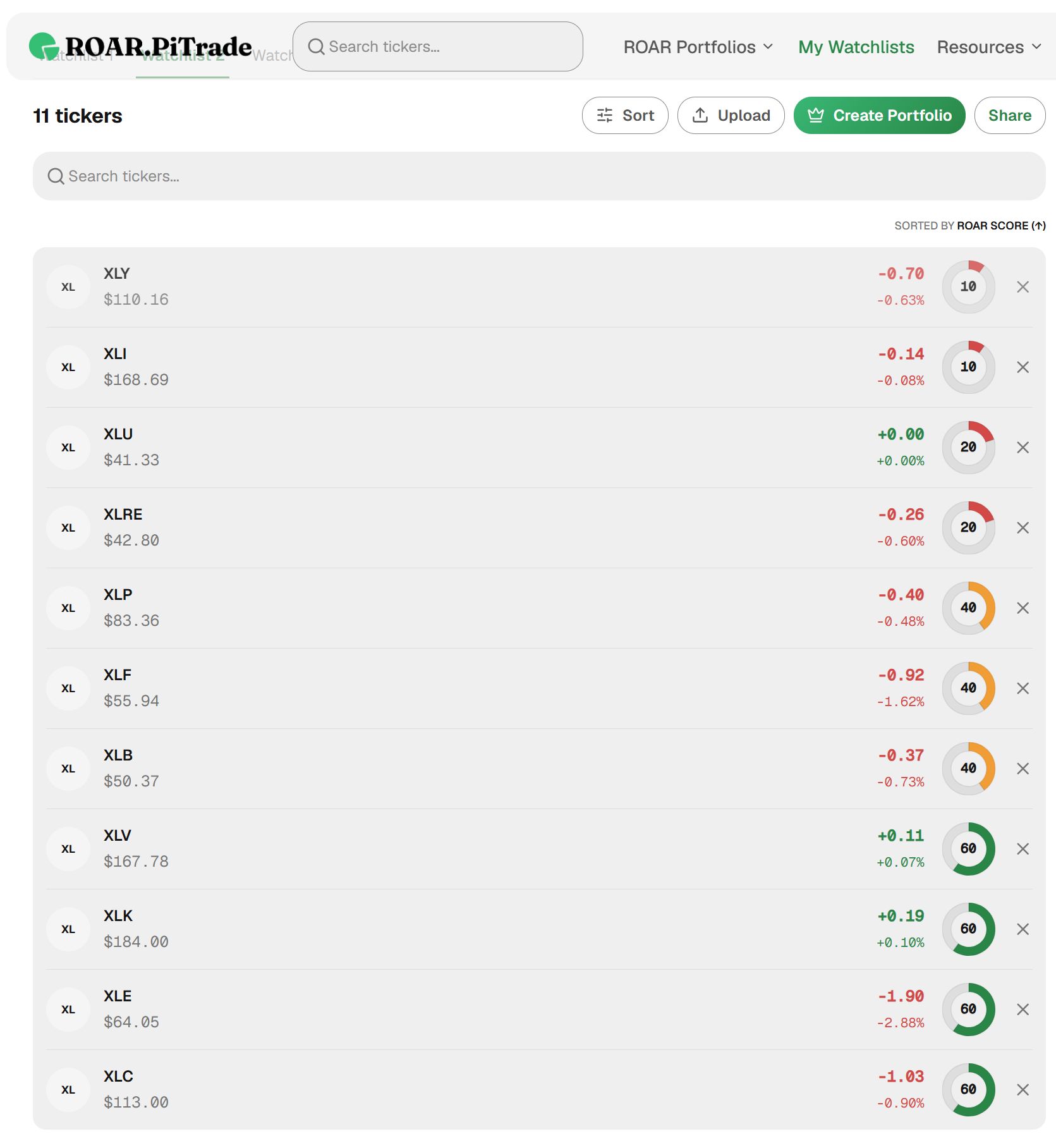 Chart courtesy of Rob Isbitts via ROAR.PiTrade.com
 Understanding the ROAR Score and How to Use It to Manage Risk
The ROAR Score is a quantitative risk-management metric engineered to evaluate “Return Opportunity And Risk (ROAR).” I do not mean risk of a minor pullback. We all know how much short-term noise exists in this algorithmically driven, S&P 500 Index fund-obsessed market. I’m talking about the risk of “major” loss.
Depending on how volatile a stock or ETF typically is, that could be a 10%-20% move in most cases. One simple way to think of ROAR is that it seeks to answer the question “what are the odds that the next 10% move is UP and not DOWN?” The score can be loosely interpreted that way.
However, as I emphasize regularly to subscribers, the TREND in the score is more important than the actual “spot” score today.
The most powerful use of ROAR analysis is to combine securities and use the platform to automate the allocation among that set of tickers and backtest before investing. That essentially creates a programmatic approach to buying, selling, and position-sizing.
Yes, there are many systems that sound like that. But as my regular readers here know, I’m not the “how do I double my money in a year?” guy. I’m a RISK MANAGEMENT pro. Everything else is secondary. So ROAR is more like a 21st century version of combining securities with the goal of not losing big along the way. To me, that’s the way to create successful long-term outcomes.
ROAR Scores are smoothed over a 10-day “rolling window” to eliminate daily algorithmic noise and false breakouts. I use a 0-to-100 scale, as follows. The higher the score, the more likely the ETF or stock has strong momentum.
But momentum is a fickle beast. So again, direction of the trend matters far more than any single snapshot. A sector ETF dropping from 60 to 40 signals that the car is going in reverse, making an immediate forward turn unlikely.
What ROAR Says About the 11 S&P 500 Sectors Right Now
I see a lack of strong leadership. It is more a case of whether a sector ETF is hanging in there, or already let go and is in pending freefall. No sector has truly cratered yet. But ROAR is less a timing system than a risk management system. That’s a big difference.
The S&P Energy Sector SPDR (XLE) and S&P Communication Sector SPDR (XLC) are currently the best at scores of 60, along with the S&P Technology Sector SPDR (XLK) and S&P Healthcare Sector SPDR (XLV). But they were all higher not long ago, and the trend of every one of the 11 sectors except those first two is down.
Consumer Discretionary (XLY) and Industrials (XLI) sit at a ROAR Scores of 10, while Utilities (XLU) and Real Estate (XLRE) hover at 20. Elevated long-end interest rates and consumer belt-tightening have caused severe technical breakdowns across these interest-sensitive and cyclical groups. They look like “toast” to me right now.
Consumer Staples (XLP), Financials (XLF), and Materials (XLB) have all dropped to 40. Their transition into this low-neutral zone indicates that traditional defensive and value sectors are failing to attract sustained safe-haven inflows. This is a theme I’ve been pointing out here for a while. As someone who managed money through the dot-com era, I look at XLP, XLU, and XLRE to be the last line of defense, as they were back then. Today? Not so much.
The four remaining “green” sectors, Healthcare (XLV), Technology (XLK), Energy (XLE), and Communication Services (XLC) each cling to a ROAR Score of 60. However, unless they get a quick, sustained kick higher (5% or so in the near term), they appear to be a fleet of sinking ships.
The final pillars holding up the market are actively beginning to fade. Taken collectively, index breadth is collapsing before our eyes. Is it a death knell for the S&P 500? If I were a “risky” writer, I’d scream “the market is tanking right now!”
Conclusion: The S&P 500 Faces Very High Risk, But There’s Always a Chance for Return
However, I can’t say that and still be a card-carrying, risk-managed investor. ROAR Scores, like any indicator, might be very accurate. But like an NBA player that shoots free throws at around a 90% success rate, no indicator works all the time.
As it turns out, some of the very best “buys” occur at very low ROAR Scores. So those scores of 10 are saying two things at once: 1) Risk is very elevated, 2) For those willing to take big shots, they are closer to their ultimate bottom than the rest.
To me, watching sectors fade one by one is not a signal to aggressively buy the dip. Not to me at least. Instead, it is a clear warning to reduce exposure, hold cash buffers, and prioritize active risk management over “hopium” as an investment strategy.
Rob Isbitts is a semi-retired CIO, former fiduciary investment advisor, and Barchart columnist. Check out his other work at ETFYourself.com (featuring the Fresh Charts weekly trading post), and ROAR.PiTrade.com, helping investors to better-manage their own portfolios.
On the date of publication, Rob Isbitts did not have (either directly or indirectly) positions in any of the securities mentioned in this article. All information and data in this article is solely for informational purposes. For more information please view the Barchart Disclosure Policy here.
More news from Barchart
The 11 S&P 500 Sectors Are Fading Quickly. Protect Yourself Against a Stock Market Crash Now. Dear Tesla Stock Fans, Mark Your Calendars for September 30 How the 3M Stock Turnaround Is Happening Faster Than Expected How to Play AAPL Stock Amid Reports Apple Is Building Its Own AI Server