

Tesla (TSLA) investors have a key date to watch as the company’s ambitious Robotaxi strategy faces a fresh regulatory test. The National Highway Traffic Safety Administration (NHTSA) has requested Tesla to answer a series of questions by Sept. 30 regarding how the company self-certified its Cybercab as compliant with federal motor vehicle safety standards. The inquiry comes shortly after Tesla began commercial deployment of Cybercab in Austin, Texas on Sept. 3.
The NHTSA is examining the technical data and certification process Tesla relied on, including whether temporarily installed human-driver controls or other equipment played a role in establishing compliance. The agency is also asking whether the Cybercab can be driven by a human, whether occupants can move the vehicle through touchscreen controls, and what limits apply to its speed, operating hours, and more. The questions are particularly significant because the Cybercab lacks conventional controls such as a steering wheel, accelerator and brake pedals, as well as a rearview mirror.
Don’t Miss a Day: From crude oil to coffee, sign up free for Barchart’s best-in-class commodity analysis.
With robotaxis emerging as an increasingly important part of Tesla’s long-term growth strategy, the company’s Sept. 30 response could provide investors with greater clarity on the regulatory path for scaling Cybercab in the United States.
About Tesla Stock
Tesla is an automotive and clean energy company headquartered in Austin, Texas. Tesla designs, manufactures, and sells electric vehicles (EVs) alongside energy storage solutions such as Powerwall and Megapack, solar products, and related services. Over the years, Tesla has expanded globally with a network of production facilities, showrooms, service centers, and Supercharger stations. The company has also increasingly emphasized advanced software and autonomous capabilities as part of its long-term strategy. Tesla is one of the world’s most valuable companies with a current market capitalization of $1.4 trillion.
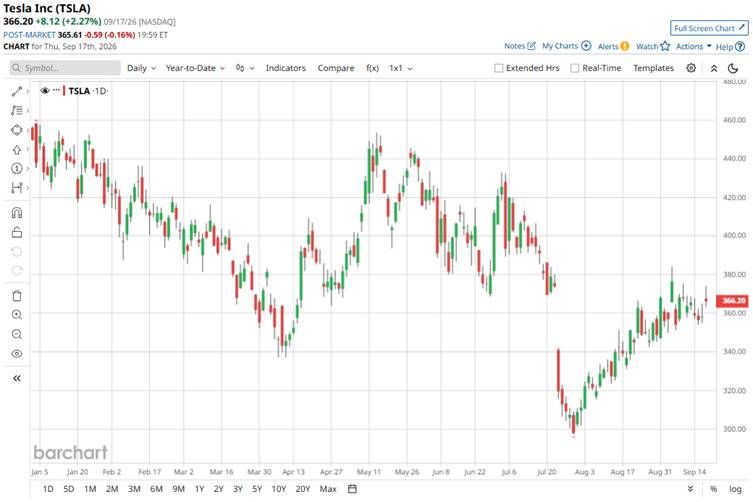
TSLA stock has struggled to keep pace with the company’s steady push into EVs, autonomous driving, robotics, and artificial intelligence (AI) this year. The stock closed at $364.27 on Sept. 18, down slightly after a recent rebound. Shares have gained about 8% over the past month, but the broader picture remains challenging; TSLA stock is still down 19% year-to-date (YTD) and about 27% below its 52-week high of $498.83. The stock has slumped 13% over the past year.
The decline is notable given Tesla’s continued product and technology developments, including the expansion of its Robotaxi service and the rollout of the Cybercab, as investors have increasingly focused on whether these initiatives can translate into meaningful revenue and earnings growth. Plus, concerns around vehicle demand, profitability, and the pace at which Tesla can scale its autonomous-driving ambitions have continued to weigh on shares.
However, the recent momentum suggests investor interest may be returning. With the Cybercab now operating commercially in Austin and further developments in Tesla’s Full Self-Driving (FSD) and robotics businesses on the horizon, it will be worth watching whether recent momentum can develop into a more sustained recovery.
 www.barchart.com
 In terms of valuation, TSLA stock has a forward price-to-earnings (P/E) ratio of 417.7 times, which is well above industry average. The stock also trades at 15.1 times sales, which is a premium compared to peers.
Mixed Financial Performance
Released on July 22, Tesla’s second-quarter results showed strong top-line growth and vehicle deliveries, but profitability remained under pressure as the company stepped up investments in AI, autonomy, and next-generation products.
Revenue climbed 26% year-over-year (YOY) to $28.2 billion, helped by higher vehicle deliveries, growth in Services and Other, and stronger Energy Generation and Storage revenue. Automotive revenue increased 23% YOY to $20.5 billion, Energy Generation and Storage revenue rose 13% YOY to $3.1 billion, and Services and Other revenue surged 50% YOY to $4.6 billion.
Tesla’s vehicle business posted steady quarterly deliveries. The company delivered 480,126 vehicles, up 25% YOY, while production increased 10% to 451,758 vehicles. Model 3/Y deliveries jumped 25% to 467,762 vehicles, while deliveries of other models rose 19% to 12,364 vehicles. Energy storage deployments also increased 41% YOY to 13.5 gigawatt-hours. Meanwhile, active FSD subscriptions reached 1.48 million, up 56% YOY.
The stronger sales volumes did not translate into higher operating profits, however. Gross profit rose 23% to $4.8 billion, but total gross margin declined to 16.8% from 17.2% a year earlier. Operating expenses jumped 47% YOY to $4.4 billion. As a result, operating income plunged 57% to $398 million, while operating margin fell to 1.4% from 4.1%. Adjusted EBITDA declined 4% to $3.3 billion, with the adjusted EBITDA margin dropping to 11.6% from 15.1%.
On the bottom line, non-GAAP net income fell 17% to $1.2 billion, while adjusted EPS dropped 18% to $0.33. Tesla’s results reflected the rising cost of its push into AI and other initiatives, along with lower regulatory-credit revenue and lower vehicle average selling prices.
Cash flow also reflected Tesla’s aggressive investment cycle. Operating cash flow increased 85% YOY to $4.7 billion, but capital expenditures surged 142% YOY to $5.8 billion. That drove free cash flow to -$1.1 billion, compared with positive free cash flow of $146 million a year earlier. Tesla ended the quarter with $43.5 billion in cash, cash equivalents and short-term investments, up 18% YOY.
Management emphasized capacity utilization, product launches, and long-term investments in AI, autonomy, energy, and robotics. Meanwhile, Tesla remains optimistic about its hardware-related profits to eventually be accompanied by accelerating AI, software, and fleet-based profits.
Looking forward, analysts forecast EPS to decline 19% YOY to $0.88 in fiscal 2026 before rising 57% to $1.38 in fiscal 2027.
What Do Analysts Expect for Tesla Stock?
Analyst sentiment on Tesla remains mixed as investors weigh the company’s Robotaxi, Cybercab, and AI opportunities against concerns over valuation, vehicle demand, and execution.
Barclays analyst Dan Levy recently maintained an “Equal Weight” rating on Tesla stock with a $370 price target, while Goldman Sachs reiterated a “Neutral” rating with a $360 target. On the bullish side, StoneX analyst Mickey Legg maintained a “Buy” rating on TSLA stock on Sept. 3 with a $475 price target. RBC Capital analyst Tom Narayan also has a “Buy” rating on Tesla with a $480 price target, adding to the group of analysts who continue to see significant upside from the company's autonomous strategy and longer-term tech opportunities.
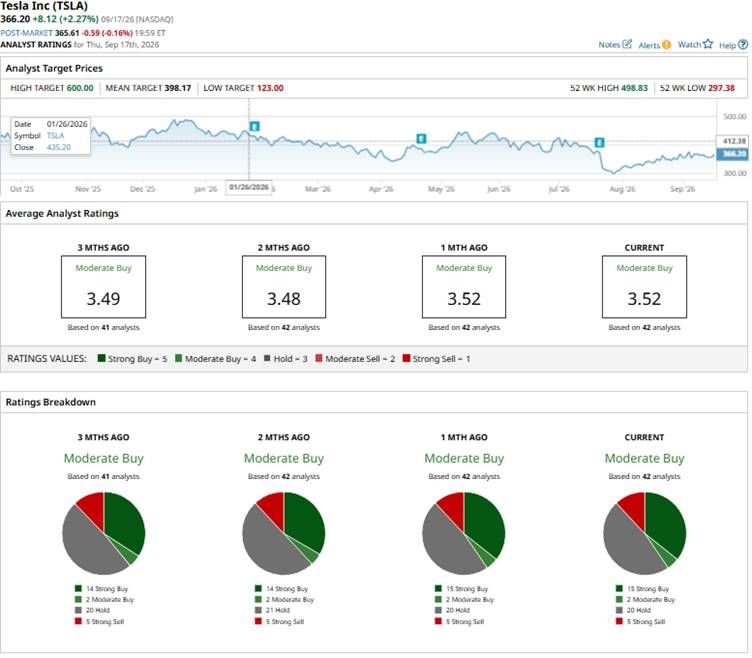
Overall, TSLA stock has a consensus “Moderate Buy” rating on Wall Street. Of the 42 analysts covering the stock, 15 advise a “Strong Buy” rating, two recommend a “Moderate Buy,” 20 analysts have a “Hold” rating, and five have a “Strong Sell.” The average price target of $398.17 indicates potential upside of 9% from current levels, while the Street-high target of $600 suggests the stock could rally as much as 65% from here.
 www.barchart.com
 On the date of publication, Subhasree Kar did not have (either directly or indirectly) positions in any of the securities mentioned in this article. All information and data in this article is solely for informational purposes. For more information please view the Barchart Disclosure Policy here.
More news from Barchart
The 11 S&P 500 Sectors Are Fading Quickly. Protect Yourself Against a Stock Market Crash Now. Dear Tesla Stock Fans, Mark Your Calendars for September 30 How the 3M Stock Turnaround Is Happening Faster Than Expected How to Play AAPL Stock Amid Reports Apple Is Building Its Own AI Server