

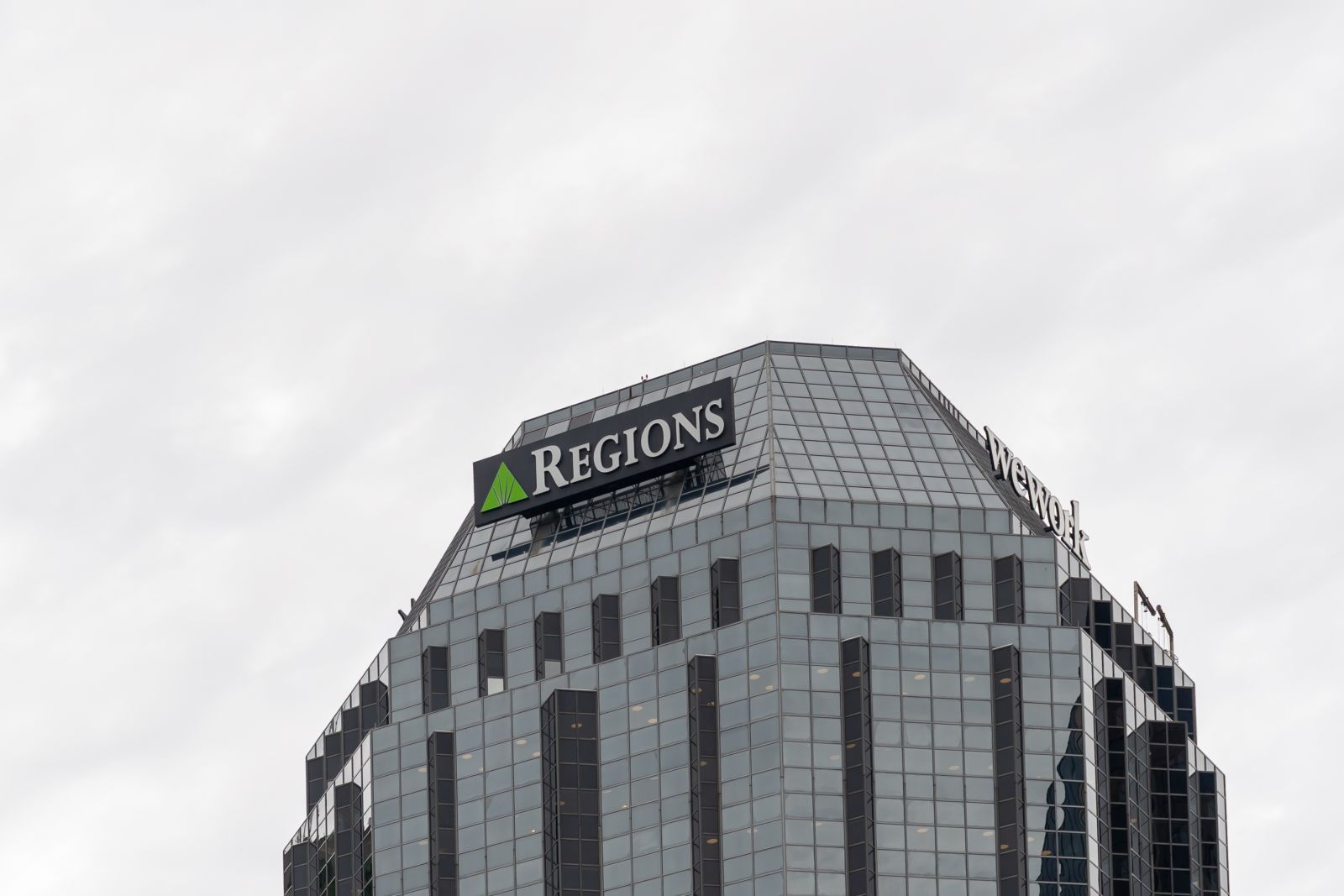
Regions Financial Corporation (RF) is a prominent regional U.S. bank headquartered in Birmingham, Alabama, serving customers across 15 states in the Southeast, Midwest and Texas. With a market cap of $24.4 billion, the company provides consumer and commercial banking, wealth management, credit life insurance, leasing, commercial accounts receivable factoring, specialty mortgage financing, and securities brokerage services.
Companies worth between $10 billion and $200 billion are generally described as “large-cap stocks,” and RF perfectly fits that description, with its market cap exceeding this mark, underscoring its size, influence, and dominance within the regional banks industry. Regions Financial benefits from a strong regional franchise across the U.S. Southeast, a sticky deposit base, and a diversified business model spanning consumer, commercial, wealth management, and investment banking. Its scale and deep commercial-banking relationships provide cross-selling opportunities, while continued digital investment supports efficiency and customer retention.
More Top Stocks Daily: Go behind Wall Street’s hottest headlines with Barchart’s Active Investor newsletter.
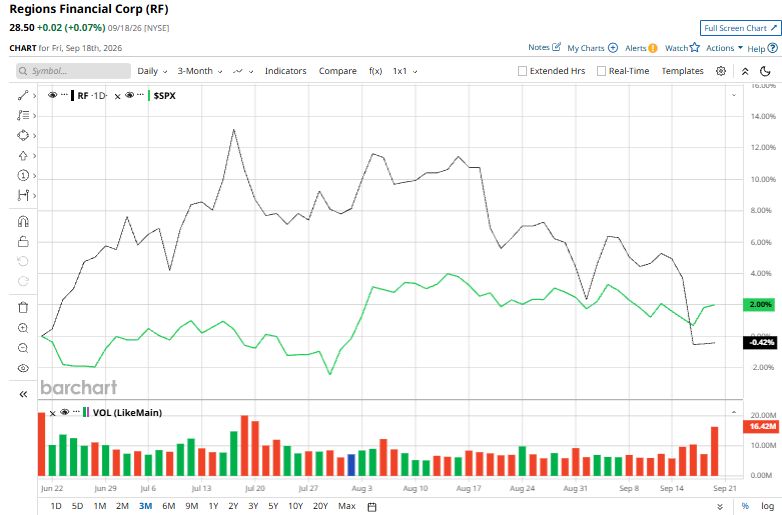
Yet, RF shares slipped 12.2% from their 52-week high of $32.47, achieved on Jul. 17. Over the past three months, RF stock has declined marginally, trailing the S&P 500 Index’s ($SPX) 2% increase.
 www.barchart.com
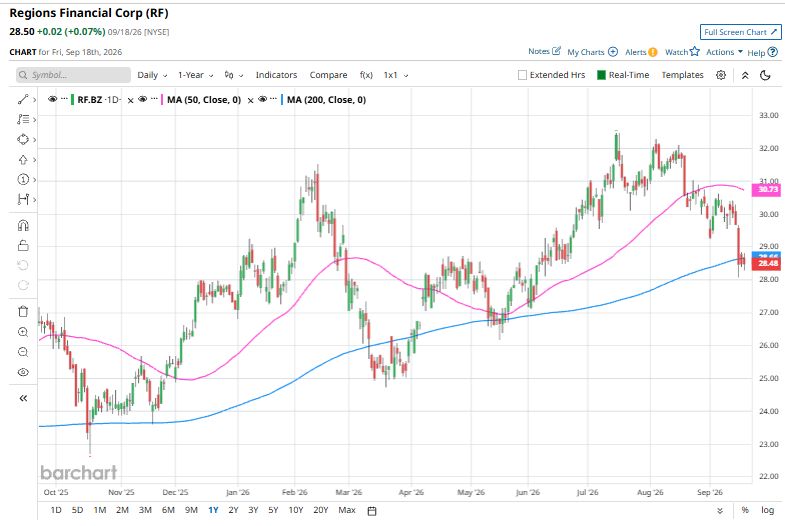
Shares of RF rose 5.2% on a YTD basis, underperforming SPX’s 11.8% YTD gains. The stock has climbed 4% over the past 52 weeks, underperforming the index’s 15.4% returns over the last year.
To confirm the bullish trend, RF has been trading above its 50-day moving average since mid-August. The stock is trading above its 200-day moving average since early April.
 www.barchart.com
Regions Financial has lagged the broader market as investors weighed sluggish revenue growth, margin pressure, and rising operating costs. Net interest income grew only 5.3% annually over the past five years, slower than many banking peers, while projected NII growth of 4.1% points to continued modest top-line expansion. More importantly, revenue growth has not translated into comparable EPS growth, suggesting weaker incremental profitability.
The pressure intensified on Sept. 16, when RF shares fell 3.8% after the Federal Reserve raised its benchmark rate by 25 basis points to a 3.75%–4% target range and signaled another hike could come this year. With inflation still elevated, investors grew more cautious about the impact of tighter financial conditions on loan demand, lending growth, and capital-markets activity.
RF’s rival, PNC Financial Services Group, Inc. (PNC) shares have outperformed, with an 11.7% uptick on a YTD basis and a 13% gain over the past 52 weeks.
Wall Street analysts are cautious on RF’s prospects. The stock has a consensus “Hold” rating from the 23 analysts covering it, and the mean price target of $32.90 suggests a potential upside of 15.4% from current price levels.
On the date of publication, Kritika Sarmah did not have (either directly or indirectly) positions in any of the securities mentioned in this article. All information and data in this article is solely for informational purposes. For more information please view the Barchart Disclosure Policy here.
More news from Barchart
Eli Lilly vs. Novo: The Obesity-Drug Battle Is Entering Its Next Round U.S. Stock Futures Climb as Oil Falls, Optimism Builds Ahead of Trump-Xi Summit Apple Wants to Enter the AI Inference Market. It Will Have to Swallow Its Pride First. A Longtime Bear on FuelCell Energy Stock Just Turned Bullish. Here’s What Changed.