


Markets can forgive a company a lot when investors can see a path to growth. GameStop (GME) has spent years searching for that path, moving from video-game retailer to meme-stock phenomenon and now to a company increasingly built around collectibles. The latest numbers suggest the strategy may be working operationally. But a better business does not automatically make a better stock.
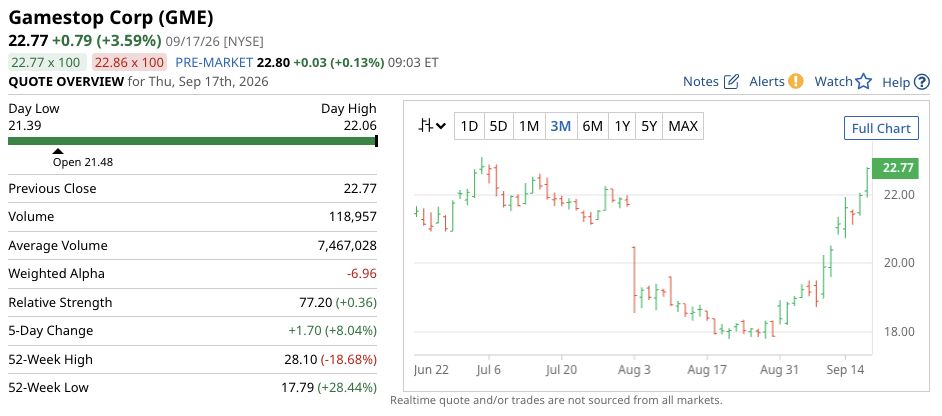
GameStop touched a two-year intraday low of $17.79 on Aug. 20. By Sept. 17, it had closed at $22.77, a 28% gain from that low. The rally comes as Jim Cramer says the turnaround is finally taking hold.
More Top Stocks Daily: Go behind Wall Street’s hottest headlines with Barchart’s Active Investor newsletter.
That may be true. The bigger question for investors is what they are actually buying.
GameStop Is Becoming a Collectibles Company
Let's start with the good news. GameStop's latest transformation is showing up in the income statement.
In its fiscal second quarter ended Aug. 1, collectibles revenue jumped 57% year-over-year (YoY) to $356.3 million, representing 45.1% of total sales. Video-game revenue, meanwhile, fell 47% to $263.2 million.
The shift is unmistakable. GameStop still sells video games and pre-owned products while maintaining a small Bitcoin (BTCUSD) position, but collectibles are increasingly the centerpiece. The company generated $160.2 million of operating income in the quarter, up from $66.4 million a year earlier, and raised its fiscal 2026 adjusted EBITDA forecast to more than $650 million.
The collectibles market is large—Grand View Research estimates it will reach $335.7 billion globally in 2026 and $535.5 billion by 2033—but GameStop is hardly alone.
eBay (EBAY) operates a massive secondary marketplace, while Target (TGT) says its trading-card business was on track to exceed $1 billion in 2025. The Pokémon Company sells collectibles and trading cards directly through Pokémon Center, while Hasbro (HAS) uses its Wizards of the Coast business and its Secret Lair store to sell premium Magic: The Gathering products directly to fans. That's a pretty crowded field, one populated with bigger, healthier, and better-financed businesses.
Cramer Says Buy. Inverse Cramer Says What?
On Thursday's Mad Money, Jim Cramer said GameStop is profitable, its turnaround is showing success, and, “I'm willing to say that stock is a buy.”
That endorsement comes with an obvious punchline for longtime meme-stock investors. A cottage industry of “Inverse Cramer” strategies has developed around fading his calls.
Quiver Quantitative actually runs an Inverse Cramer strategy, and on X, the popular CramerTracker account highlighted its portfolio's three-year performance numbers, claiming the inverse strategy returned 171.6% versus 146.6% for the Nancy Pelosi tracker. Of course, investors shouldn't buy or sell GME simply because Cramer said so.
The business still deserves the attention—and the stock deserves more scrutiny.
The Turnaround Is Real. The Growth Story Isn't.
GameStop has made genuine progress. But investors should notice what the numbers don't say. Second-quarter sales declined 19% to $790.2 million, even as operating income more than doubled. That is partly the result of store closures and the comparison with the Nintendo (NTDOY) Switch 2 launch, but it still shows that GameStop is not returning to its old-growth model.
Meanwhile, the company had $5.4 billion in cash, securities, digital assets, and related receivables against roughly $2.8 billion of long-term debt at the end of the quarter. It also owned about $4.9 billion of EBAY stock.
That balance sheet gives GameStop room to experiment. It doesn't prove that collectibles can become a durable growth engine. And that's the part investors need to remember.
Bottom Line on GME Stock
In short, Cramer isn't wrong that GameStop's turnaround is producing tangible results. Collectibles revenue is growing, profitability has improved, and management has created a much healthier financial position.
But GME is no longer the growth stock many investors once imagined it could become. It is a profitable, cash-rich retailer attempting to carve out a niche in a competitive collectibles market.
The stock can still produce sharp rallies because GameStop has commonly traded on emotion, not fundamentals. For long-term investors, the evidence says to stay on the sidelines and look for better investment opportunities that can grow your money over the long haul.
On the date of publication, Rich Duprey did not have (either directly or indirectly) positions in any of the securities mentioned in this article. All information and data in this article is solely for informational purposes. For more information please view the Barchart Disclosure Policy here.
More news from Barchart
Did Jim Cramer Just Give GameStop Stock the Kiss of Death When He Said the Turnaround Is Working? The Fed Just Raised Rates for the First Time Since 2023. CoreWeave’s CEO Sees an ‘Inflection Point,’ But Its $51 Billion Debt Problem Just Got Worse. Out of 200 Large-Cap, 1-Month Losers, This Video Game Stock Stands Out Marvell Technology Stock Price Targets Are Rising - What's the Best MRVL Play?