

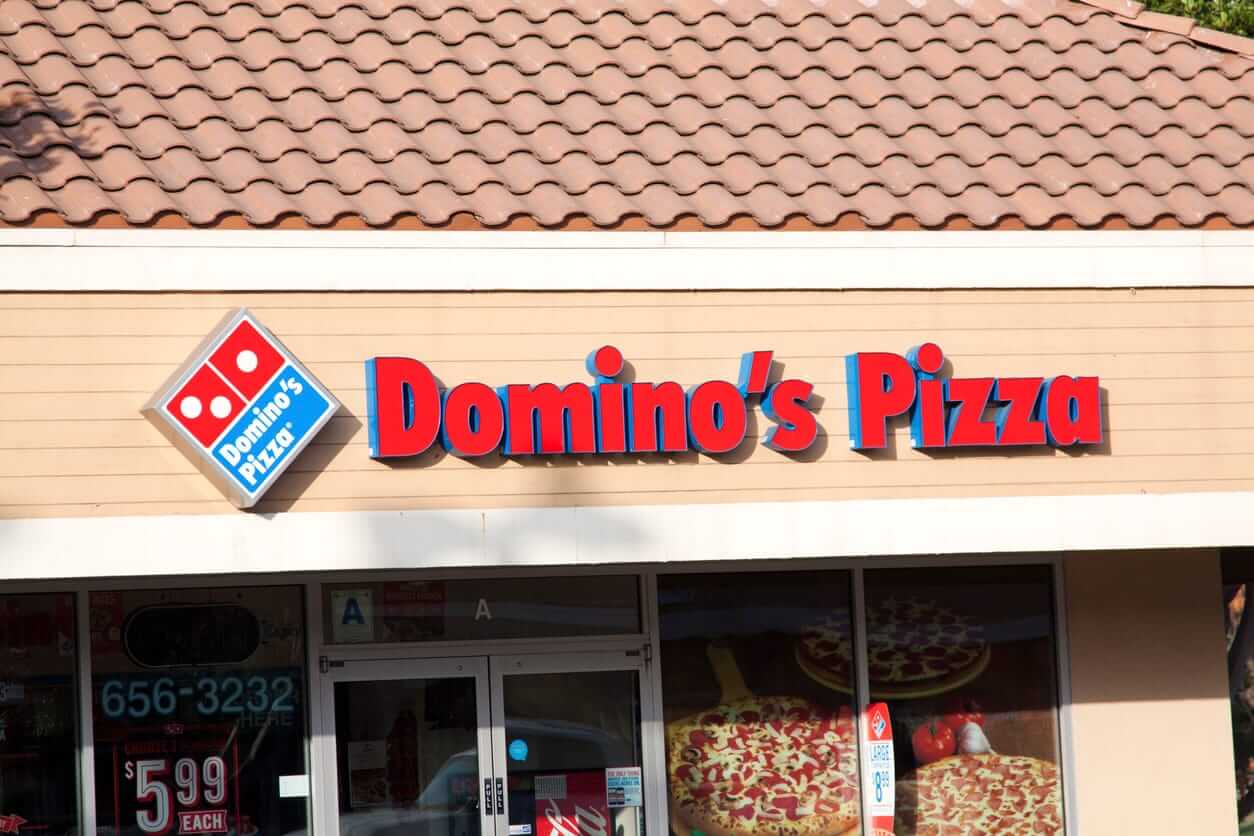
Founded in 1960, Domino's Pizza, Inc. (DPZ) is the world’s largest pizza company, with a sizable presence across both delivery and carryout. The company ranks among the world’s leading publicly traded restaurant brands, operating a global system of more than 22,500 stores across over 90 markets. Domino’s generated more than $20.6 billion in global retail sales over the trailing four quarters ended June 14, 2026.
Its business is largely franchise-driven, with independent franchise owners accounting for 99% of Domino’s stores as of the end of the second quarter of 2026. Digital ordering has also become a major part of Domino’s U.S. business. In 2025, more than 85% of U.S. retail sales were generated through digital channels, reflecting the company’s continued development of innovative ordering platforms. Domino’s is considered a large-cap stock, although its current size sits close to the traditional threshold for that classification.
More Top Stocks Daily: Go behind Wall Street’s hottest headlines with Barchart’s Active Investor newsletter.
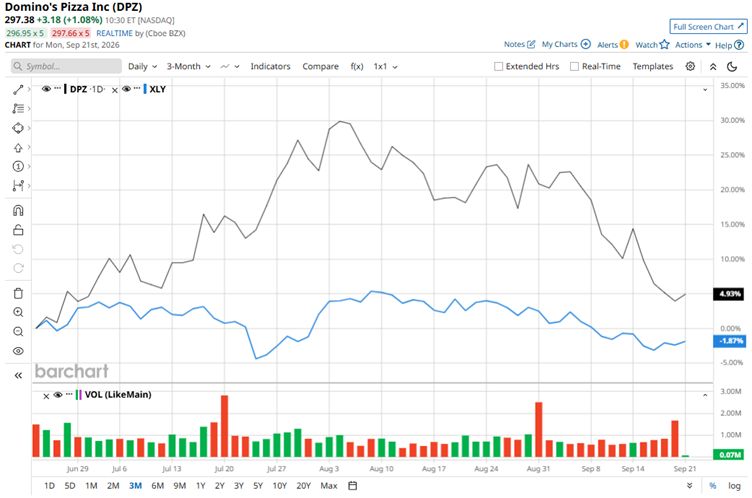
As of writing, the company’s market capitalization stands at around $9.73 billion, compared with the conventional $10 billion or more benchmark typically used to define large-cap stocks. Despite the company's dominant position in the pizza chain industry, on Wall Street, however, Domino’s shares have had a considerably tougher run. The stock has plunged nearly 32.9% from its 52-week high of $442.35, reached in December last year. Over the past three months, shares have fallen almost 5.3%, broadly mirroring the 5% decline recorded by the State Street Consumer Discretionary Select Sector SPDR ETF (XLY).
 www.barchart.com
 The longer-term picture has been even more challenging. Domino’s shares have declined nearly 30.7% over the past year and are down 28.8% so far in 2026. By comparison, the broader XLY has fallen only 7.7% over the past year and 6.7% so far in 2026. That wider performance gap highlights just how much pressure Domino’s stock has faced relative to the broader consumer discretionary sector.
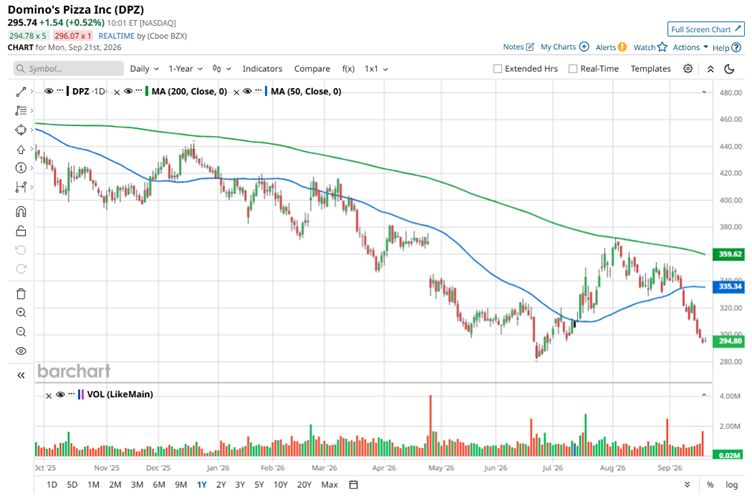
From a technical standpoint, the stock has remained under pressure for an extended stretch, trading below its 200-day moving average since December last year. It has also stayed below its 50-day moving average over the same period, despite a few brief fluctuations along the way, signaling that the stock has struggled to regain sustained upward momentum.
 www.barchart.com
 Domino’s stock has been under pressure as same-store sales growth slows, competition among pizza chains intensifies, and inflation continues to weigh on consumer spending. Rival pizza and fast-food chains have also leaned heavily into aggressive value deals, putting further pressure on Domino’s market share.
That pressure was evident in the company’s second-quarter results, with U.S. same-store sales growing just 0.1% for the quarter ended June 14, the slowest pace in five quarters and well below analysts’ estimate of 0.62%. Higher living costs and a sluggish U.S. labor market appear to have made consumers more cautious about spending on dining out, adding another challenge for the pizza chain.
Things haven’t been smooth sailing for Domino’s peers either, as the broader pizza landscape continues to face a challenging operating environment. In fact, the pressure has been even more pronounced for Papa John's International, Inc. (PZZA), with shares plunging 58% over the past year and another 48.2% so far in 2026. That marks a steeper decline than Domino’s over both periods, underscoring the broader weakness facing the pizza-chain stocks.
Nevertheless, broader industry headwinds and Domino’s underwhelming stock performance have done little to dampen Wall Street’s overall optimism for the company. The stock still carries a consensus “Moderate Buy” rating from 29 analysts covering the company, while the average price target of $383.21 suggests analysts see potential for the shares to gain about 29.6% from current levels.
On the date of publication, Anushka Mukherjee did not have (either directly or indirectly) positions in any of the securities mentioned in this article. All information and data in this article is solely for informational purposes. For more information please view the Barchart Disclosure Policy here.
More news from Barchart
Did Jim Cramer Just Give GameStop Stock the Kiss of Death When He Said the Turnaround Is Working? The Fed Just Raised Rates for the First Time Since 2023. CoreWeave’s CEO Sees an ‘Inflection Point,’ But Its $51 Billion Debt Problem Just Got Worse. Out of 200 Large-Cap, 1-Month Losers, This Video Game Stock Stands Out Marvell Technology Stock Price Targets Are Rising - What's the Best MRVL Play?