


Flooring specialist Mohawk Industries’ (MHK) stock fell 7% on Monday after CEO Jeffrey Lorberbaum and some of the family’s trusts reported significant stock sales ahead of Lorberbaum’s retirement on Sept. 30.
Lorberbaum has been Mohawk’s CEO since January 2001. Twenty-five years in the top job is a long run for anyone. At age 71, retiring’s a smart move. The stock sales were clearly planned long in advance.
More Top Stocks Daily: Go behind Wall Street’s hottest headlines with Barchart’s Active Investor newsletter.
According to S&P Global Market Intelligence, Lorberbaum still held 8.56 million Mohawk shares as of the Sept. 18 filing. You can hardly blame the guy for taking some money off the table even at lower share prices. His stake is still worth over $1 billion.
People sell stock for all kinds of reasons. They only buy for one reason: they feel the stock is undervalued. It’s debatable whether these sales actually caused yesterday's 1.90 million in share volume, almost double the 30-day average.
A more likely reason is that investors remain concerned about the housing industry generally and, specifically, about the company’s ability to maintain margins in such a weak economic environment.
Down nearly 14% in the past month, is yesterday’s big drop an opportunity to buy the dip? Or should investors wait for more blood to be shed before jumping on board?
I lean toward the latter answer. Here’s why.
MHK Is a Very Volatile Stock
Mohawk’s share price has moved up or down more than 5% in a single day on 16 occasions over the past 12 months. So, the 7% move from yesterday isn’t unusual. By comparison, Nike (NKE) stock has had five moves of 5% or more in the past 12 months. Nike stock is down 49% over this period compared to 9% for Mohawk.
The odds are good that Mohawk’s share price will test $100 on the downside soon enough. MHK last traded below $100 in mid-May. However, there is a counterargument: the Barchart Technical Opinion is a 56% Buy in the near-term. It could just as easily bounce back to $140, where it traded in mid-August.
If you’re into options, a Long Strangle, where you buy a long call above the current share price and buy a long put below the current share price, is a defined-risk bet you could make on the stock’s volatility increasing and, with it, the share price, in either direction.
The only difficulty with this strategy is that Mohawk’s options volume is very low. Yesterday’s volume was 328 contracts, slightly less than five times the 30-day average, with two trades accounting for 150 of the 328. In the past three months, daily volume has exceeded 328 on 12 occasions. If you’re patient, you’ll get one of those days.
Mohawk’s Valuation: Cheap or Dear?
Mohawk, according to S&P Global Market Intelligence’s analyst EPS estimate, should earn $9.84 in 2026 and $10.06 in 2027. Based on yesterday’s closing price of $117.27, the shares trade at 11.9x 2026 earnings and 11.7x 2027 earnings.
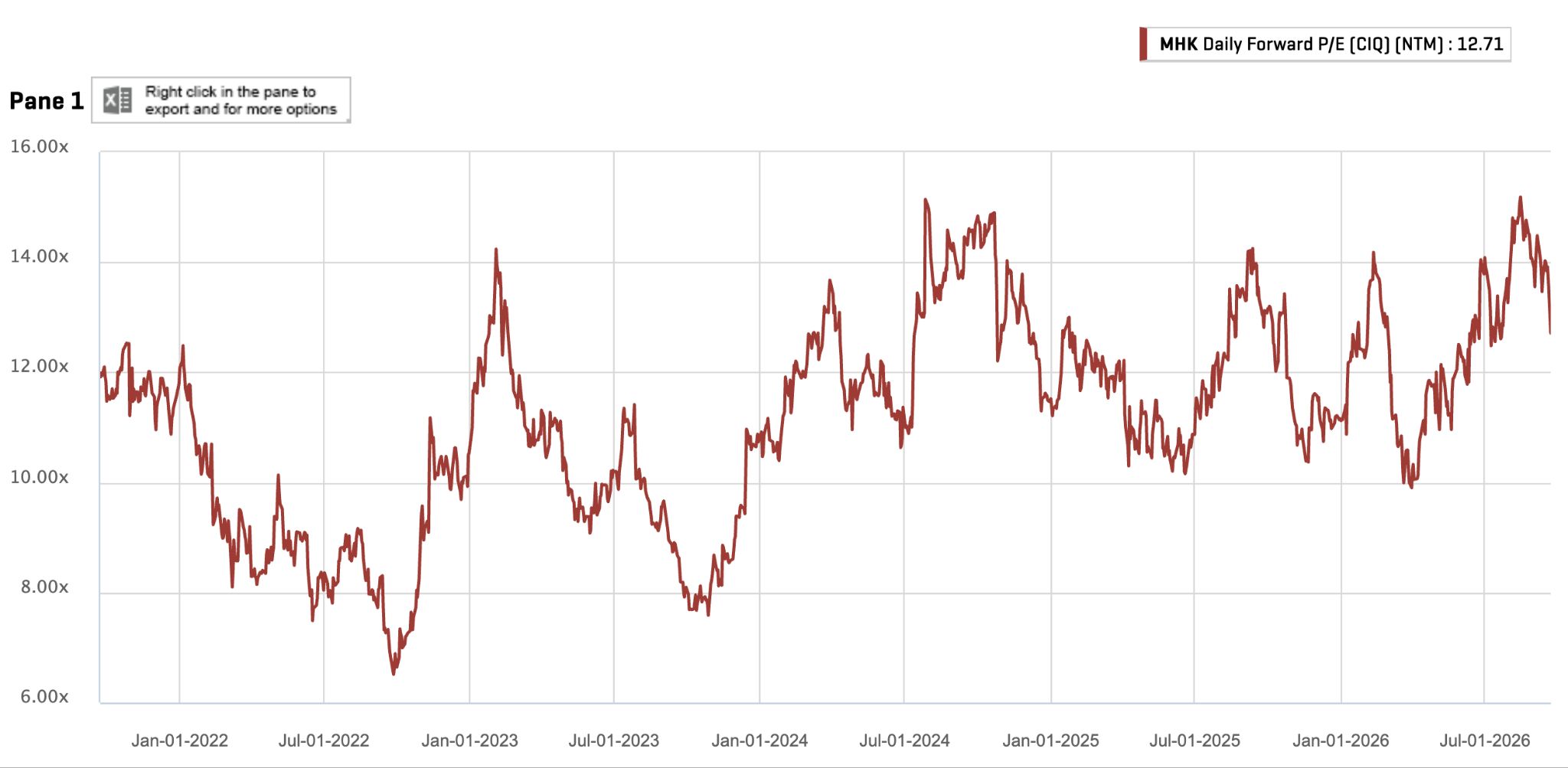
Here’s a chart showing the forward P/E over the past five years. The highest multiple over this period was 15.18x in August, the lowest was 6.51x in September 2022, and the average was 11.17, so while the multiple has come down quite a bit since August, it’s still not what you would call historically cheap.
Source: S&P Global Market Intelligence
How about free cash yield?
In the trailing 12 months ended July 4, 2026, its levered free cash flow was $967 million. Based on an enterprise value of $8.60 billion, its free cash flow yield is 11.2%. I consider anything above 8% value territory. It’s the highest it’s been since Q4 2020.
Mohawk’s balance sheet and long-term solvency are healthy. It finished Q2 2026 with $1.51 billion in net debt, the lowest level in the past five years, and 41% below the five-year high of $2.55 billion. As a result, its EBIT (earnings before interest and taxes) in the 12 months ended July 4 was 61.4 times its interest expense, almost one-third the five-year average multiple of 22.1x.
I would say MHK stock is fair value, leaning toward cheap, but certainly not dear.
When Can Investors Expect Better Results From Residential Segment?
While the company doesn’t break out sales by commercial versus residential applications, a realistic estimate would be between 20-25% for commercial and 75-80% for residential.
“The commercial sector continued to outperform residential and our differentiated offering enhanced our mix and margins. The new home construction market remains pressured, and existing home sales continue to be affected by affordability challenges,” stated CEO Jeff Lorberbaum in its Q2 2026 conference call.
Despite the struggles, it is growing sales by taking market share. Sales in all major geographic markets and product categories rose year over year in the second quarter. Meanwhile, it is controlling costs as best it can. Margins are stable, if not growing by leaps and bounds. In Q2 2026, they were 27.4%, up 100 basis points from a year ago. Price increases and tariff refunds contributed to the increase. It won’t hesitate to raise prices if required in the second half of 2026.
The biggest question mark for investors is mortgage rates. If they remain high, that will be a major headwind to the remodel market, a big part of Mohawk’s business. With inflation remaining stubbornly high, barring the end of tariffs or the Iran war (lower gas prices), this headwind will remain well into 2027.
My guess is sales growth will be in the 5-7% range in 2026 and 2027 with 8-10% earnings per share growth, excluding tariff refunds.
Better Early Than Late
While Mohawk’s business is healthier than it’s been in several years, it has no control over the macroeconomic conditions that exist right now. That hampers stronger top-line sales and bottom-line earnings growth.
In my opinion, it’s better to be early to the party than late.
MHK stock may fall some more in the final quarter of 2026 and into 2027. What may be will be. The shares have fallen below $100 three times in 2026. It did so again in June 2025, never in 2024, and moved lower from December 2023 to $76.02 on Oct. 23, 2023, a five-year low. You have to go back another three years to October 2020 for the next time below $100.
Will you be able to buy Mohawk shares below $100 in the next 12-18 months? Who knows. But if you buy at current prices and set aside some dry powder in case it does happen, you’ll have killed two birds with one stone.
If you’re a risk-tolerant investor, I like MHK at these prices.
On the date of publication, Will Ashworth did not have (either directly or indirectly) positions in any of the securities mentioned in this article. All information and data in this article is solely for informational purposes. For more information please view the Barchart Disclosure Policy here.
More news from Barchart
A CEO Shakeup Just Tanked This Stock. How to Play It Here. Nvidia Stock is Historically Cheap. The Decade-Low Multiple Reflects Risks, But This Looks Like a Can't-Miss Buy Opportunity for NVDA. Nvidia Just Gave Einride Stock a Big Boost. How to Play ENRD Here. The Case for Buying Netflix Stock