


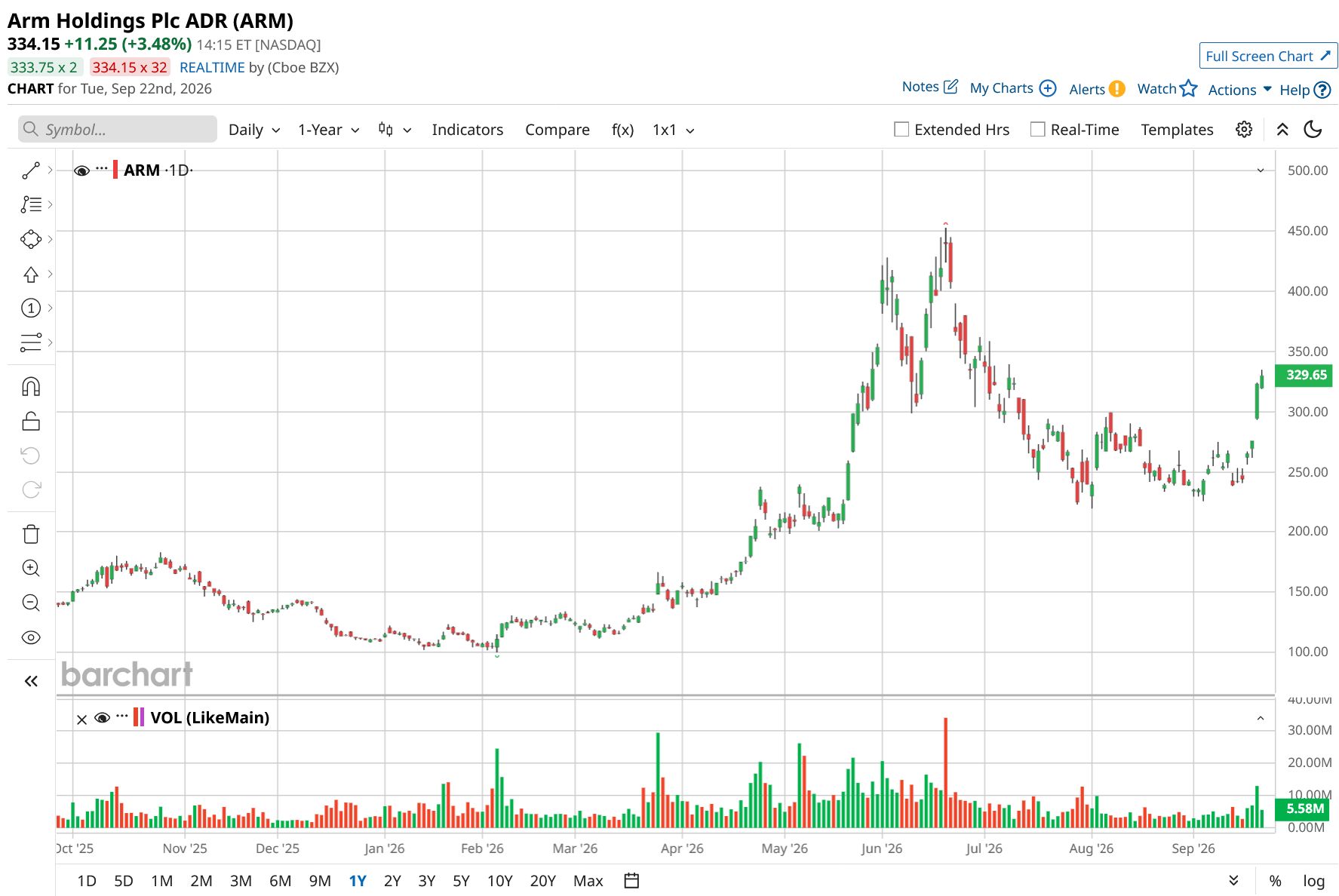
Arm Holdings (ARM) has been on a strong run. The stock has gained around 37% over the past month, including a sharp 17.2% jump on Sept. 21. The rally reflects growing investor confidence in the long-term demand for Arm-based computing as artificial intelligence (AI) drives a structural increase in demand for computing capacity across data centers, cloud infrastructure, automotive systems, PCs, smartphones, and edge devices.
Arm’s investment case strengthened further following recent comments from CEO Rene Haas. In a Sept. 16 CNBC interview, Haas said he is increasingly confident Arm will secure sufficient manufacturing capacity to meet more than $2 billion of customer demand for its newly introduced AGI CPU. The latest comments therefore strengthen the growth narrative around Arm, particularly in AI and data center computing.
More Top Stocks Daily: Go behind Wall Street’s hottest headlines with Barchart’s Active Investor newsletter.
However, the stock’s valuation creates a significant counterweight. With ARM trading at an elevated multiple, it creates a difficult risk-reward equation after the recent rally.
 www.barchart.com
 AGI CPU Demand Has Already Surpassed Initial Expectations
Arm introduced its AGI CPU in March, initially identifying a roughly $1 billion opportunity for fiscal 2027 and fiscal 2028. The company later said it had delivered initial products to several customers and secured manufacturing capacity to support that opportunity.
Demand now appears to be outpacing those initial expectations. During the Q1 conference call, the company said customer demand for the AGI CPU exceeded $2 billion, with new customers continuing to join the pipeline. Arm is also working with its manufacturing and supply-chain partners to increase capacity.
That development is important because it changes the scale of the potential opportunity. The original $1 billion target suggested a meaningful new revenue stream. Demand above $2 billion, if converted into actual shipments and ultimately recognized as revenue and royalties, could substantially increase the economic significance of Arm's AI CPU strategy.
Arm’s Growth to Remain Strong
Arm entered fiscal 2027 with strong operating momentum, with first-quarter revenue rising 22% year-over-year (YoY) to $1.29 billion. The increase was driven primarily by continued strength in royalty and licensing income, indicating that demand for Arm-based computing architectures remains robust across several end markets.
The data center market is expected to be a key driver of Arm's growth. The continued deployment of Arm-based processors by major hyperscale cloud providers is expanding the company’s royalty opportunity. At the same time, the increasing integration of Arm technology into networking infrastructure, including Data Processing Units (DPUs) and SmartNICs, is creating additional sources of recurring royalty revenue. This shift is strategically important because it indicates that cloud computing and AI infrastructure are becoming increasingly significant contributors to Arm’s growth profile.
Arm has also shown it can maintain royalty growth despite challenges in consumer electronics. While smartphone demand has remained relatively subdued, the increasing adoption of edge-AI capabilities has supported demand for Arm-based technologies. The transition to Armv9 and more sophisticated compute subsystems has also increased the royalty value generated per device, helping offset weaker handset volumes and elevated memory costs. In the automotive market, rising adoption of advanced driver-assistance systems (ADAS) and autonomous-driving technologies provides another avenue for royalty expansion as vehicles require increasingly sophisticated computing architectures.
Licensing revenue represents another indispensable component of Arm’s growth strategy. Demand for next-generation architectures and deeper engagements with major customers are supporting higher-value licensing agreements. More importantly, annualized contract value (ACV) increased 13% YoY in Q1. Because ACV provides a forward-looking view of licensing activity, its growth suggests Arm’s underlying licensing demand remains healthy.
Overall, expanding royalty opportunities and a healthy licensing pipeline suggest that Arm is likely to sustain its growth momentum in the quarters ahead.
ARM's Valuation Is the Problem
Arm’s growth outlook remains solid. However, the stock’s valuation is considerably harder to justify. ARM's forward earnings multiple of 239.2 and price-to-sales (P/S) ratio of around 59.8 imply that the stock already reflects the positives.
Overall, Arm’s long-term growth story remains compelling, supported by rising AI opportunities and strength across its businesses. However, its elevated valuation makes fresh buying difficult at current levels, supporting the view that ARM stock is too good to sell but too expensive to buy.
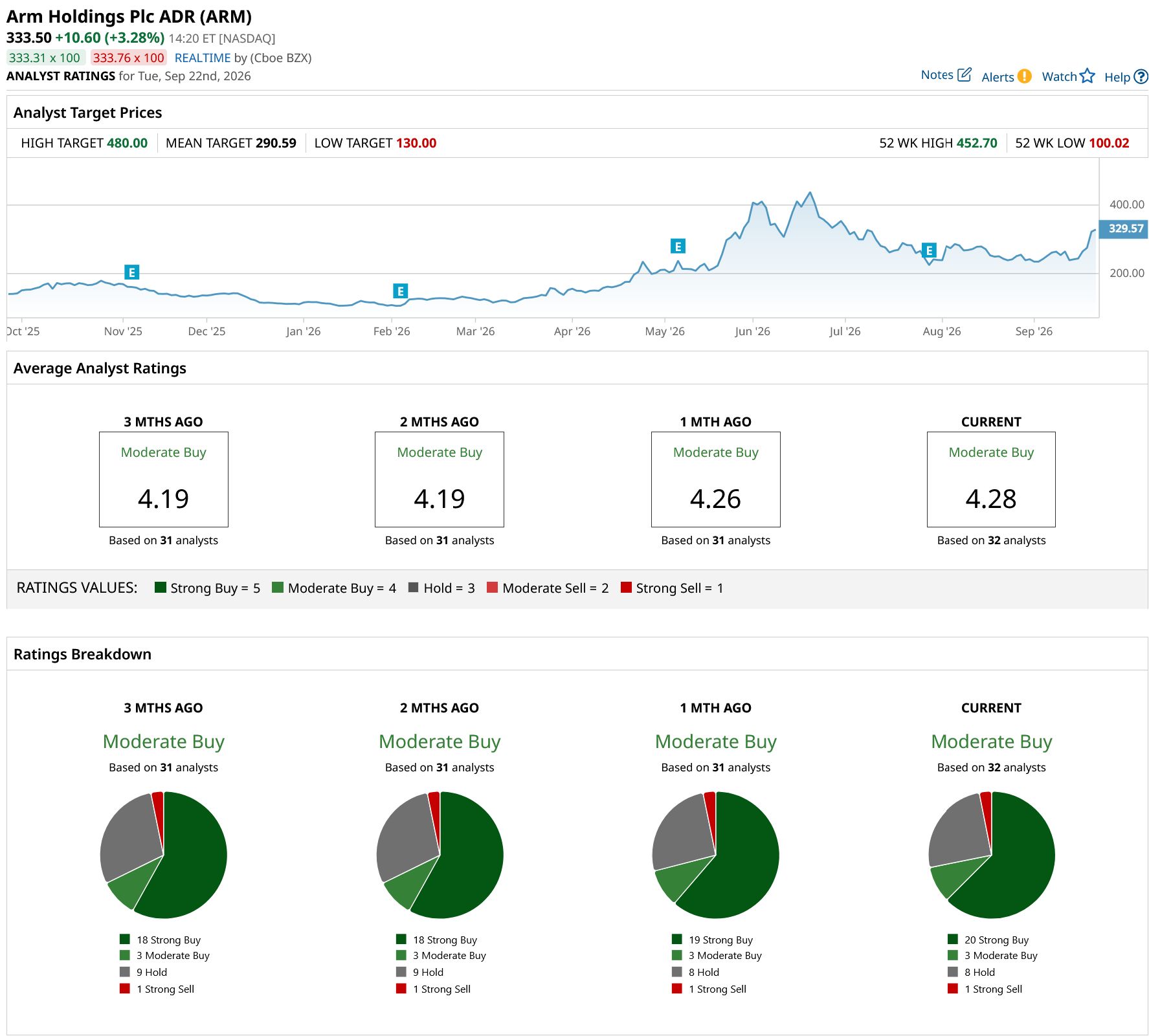
Analysts currently have a "Moderate Buy" consensus rating on ARM stock.
 www.barchart.com
 On the date of publication, Amit Singh did not have (either directly or indirectly) positions in any of the securities mentioned in this article. All information and data in this article is solely for informational purposes. For more information please view the Barchart Disclosure Policy here.
More news from Barchart
Dear Microsoft Stock Fans, Mark Your Calendars for September 24 SanDisk Just Scored a New 'Buy' Rating. Here's Why. This High-Growth Energy Stock Continues to Plunge. Don’t Rush to Buy the Dip. Arm Stock: Too Good to Sell, Too Expensive to Buy