


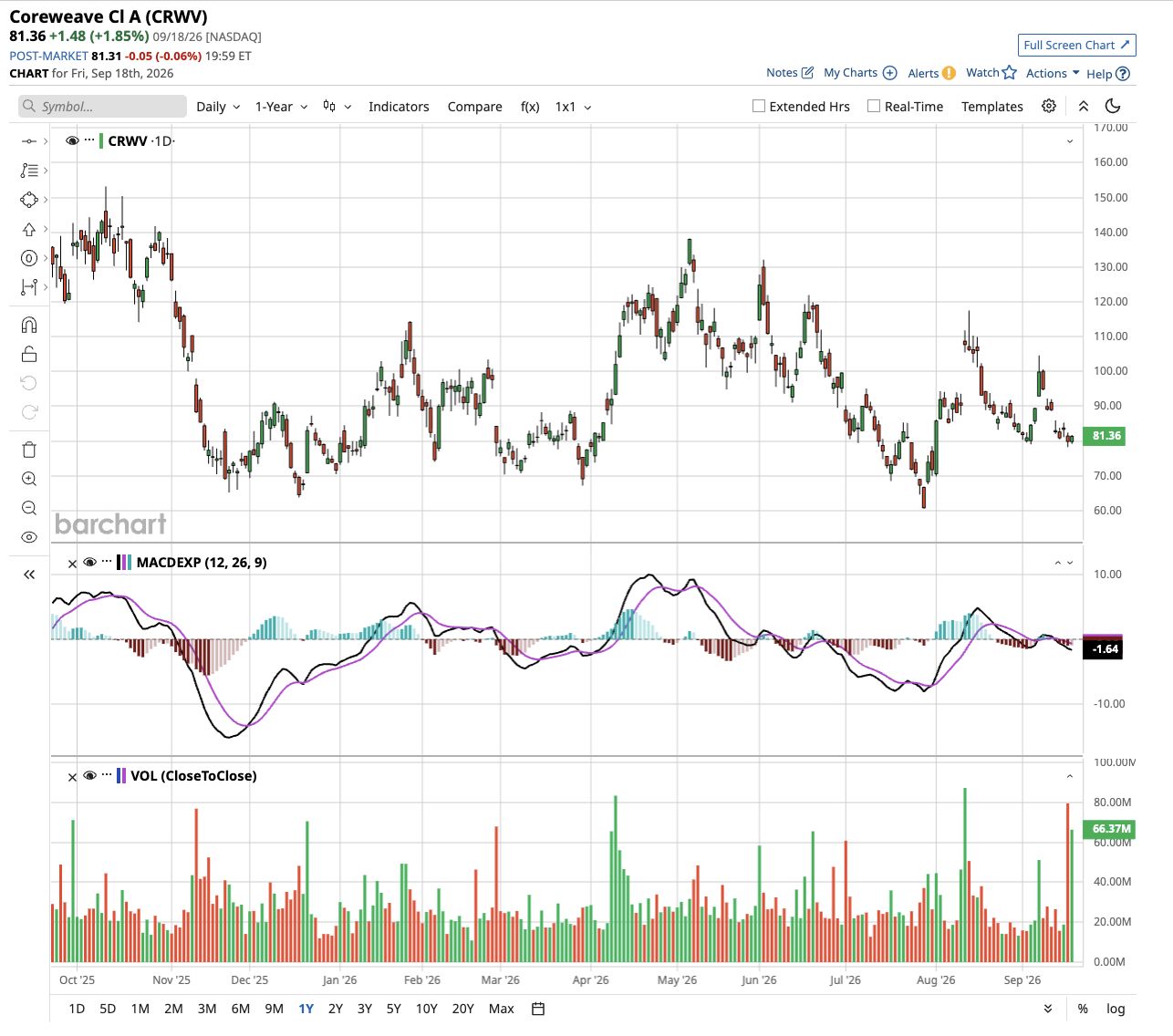
CoreWeave (CRWV) investors were reminded last week how expensive it is to build the infrastructure behind the artificial intelligence (AI) boom. On Sept. 17, the company announced plans to raise $3 billion through convertible senior notes due 2033. The offer came with an option for underwriters to buy another $500 million, pushing the total potential raise toward $3.5 billion before it eventually priced upsized at $3.7 billion.
The same day, CoreWeave also unveiled a separate at-the-market stock program, allowing it to sell up to 35 million Class A shares over time. Together, the two moves show a company racing to keep pace with demand that it says still outstrips supply.
More Top Stocks Daily: Go behind Wall Street’s hottest headlines with Barchart’s Active Investor newsletter.
 www.barchart.com
 Why CoreWeave Stock Reacts to Capex News
CoreWeave builds AI factories packed with Nvidia (NVDA) GPUs, and that hardware — plus the power and cooling needed to run it — costs billions every quarter.
CFO Nitin Agrawal told investors on the company's second-quarter earnings call in August that CoreWeave expects 2026 capital expenditures of $35 billion to $39 billion, up from earlier guidance, as it rushes to deliver capacity to customers already lined up.
Data compiled by TIKR shows just how steep that curve gets. Capex is projected to climb significantly from roughly $10 billion in 2025, while net debt is projected to follow a similar path. Free cash flow, meanwhile, is expected to stay deeply negative through most of that window.
The Numbers Behind CoreWeave's Growth Story
Revenue increased from $229 million in 2023 to $1.9 billion in 2024, then to $5.1 billion in 2025. CoreWeave's trailing 12-month revenue now sits at $7.6 billion.
In Q2, the company reported revenue of $2.57 billion. However, operating income swung to a loss of $49 million year-over-year (YOY), while net loss came in at $626 million, widening significantly from a loss of $290 million in the prior-year period. CoreWeave's operating profit has swung to a trailing loss, with the company posting a net loss over the same period, largely due to interest expense that has climbed alongside its debt load.
Total assets have grown from under $5 billion in 2023 to $77 billion by the end of Q2, driven mostly by property, plant and equipment. Total liabilities have grown just as fast, reaching $72 billion in Q2, with long-term debt standing at $27.6 billion.
None of this is unusual for a company scaling infrastructure this quickly. But it does explain why CoreWeave keeps returning to capital markets rather than funding growth purely from operations.
What the Convertible Notes Mean for CoreWeave Stock
Convertible notes allow CoreWeave to borrow money now while giving lenders the option to convert that debt into stock later, usually at a set price above today's trading price. This is often a cheaper way to raise money than issuing new stock outright, since investors accept a lower interest rate in exchange for that future upside.
CoreWeave also entered into capped call transactions tied to the notes, a move designed to limit dilution to existing shareholders if noteholders eventually convert. In plain terms, the company is trying to raise money without handing over too much ownership down the road.
The at-the-market equity program adds another layer of flexibility. CoreWeave said the program supports its goal of moving its credit profile toward investment grade, which would eventually let it borrow at lower rates.
Enterprise Demand Keeps Pressure on CoreWeave
None of this financing happens in a vacuum. On CoreWeave's August earnings call, CEO Michael Intrator pointed to enterprise customers like Caterpillar (CAT) as a new demand driver, with companies wanting their own dedicated AI infrastructure rather than shared cloud capacity.
Agrawal noted that revenue backlog reached $104 billion in Q2, not counting more than $25 billion in new commitments signed early in Q3. Contracted power reached 4.2 gigawatts, with a path toward at least 8 GW by 2030.
That backlog is the reason CoreWeave keeps spending aggressively on capacity. Customers are waiting, and every gigawatt of power the company brings online converts into contracted revenue. The convertible note and equity program simply give CoreWeave more room to keep building while that demand holds.
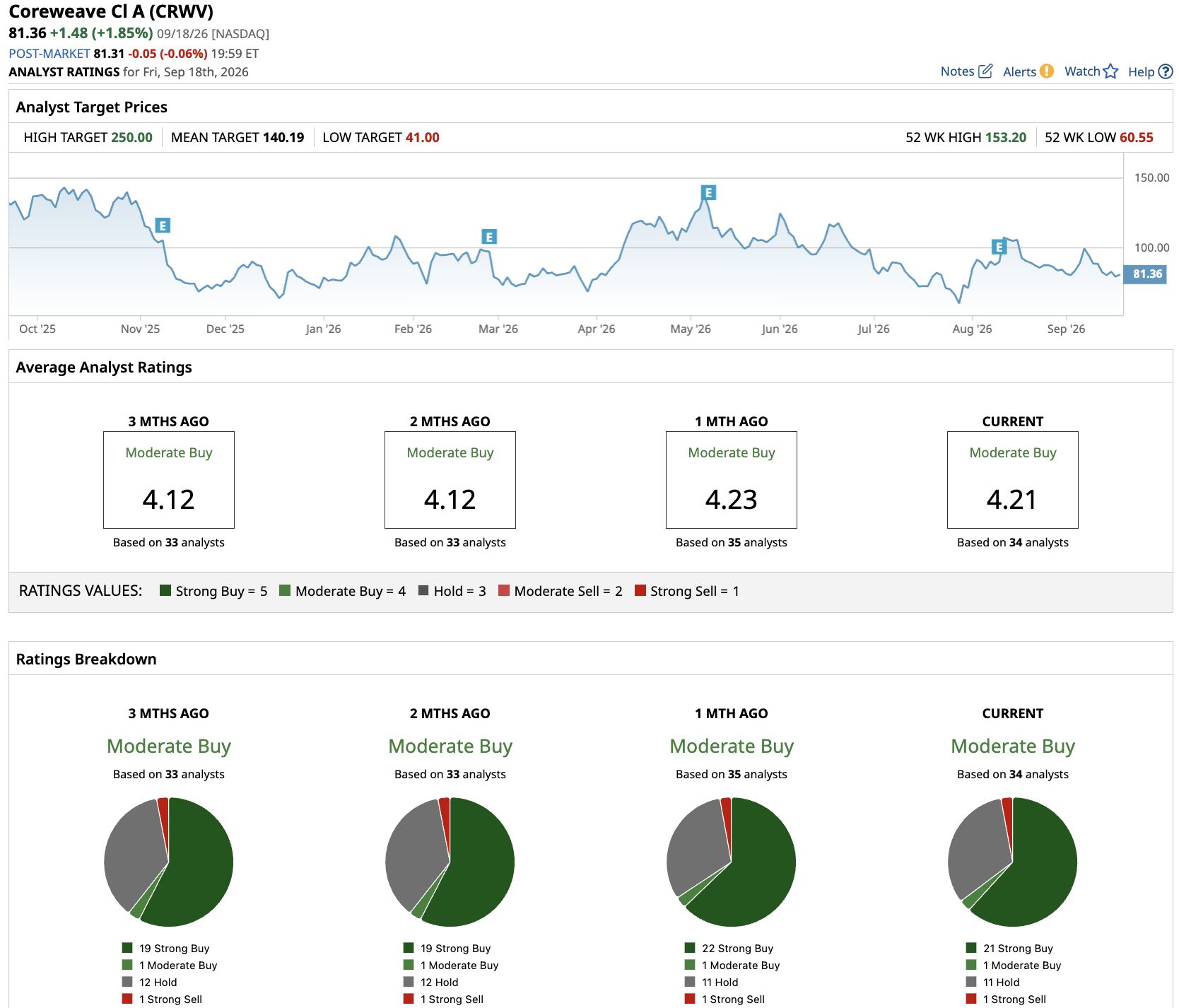
Overall, CoreWeave has a consensus “Moderate Buy” rating on Wall Street. Out of 35 analysts covering CRWV stock, 21 recommend a “Strong Buy” rating, one recommends a “Moderate Buy” rating, 11 recommend a “Hold” rating, and two analysts recommend a “Strong Sell.” The average price target of $136.15 points to potential upside of 57% from current levels.
For now, CoreWeave investors are being asked to accept short-term dilution risk and rising debt in exchange for a company that says it is still nowhere near catching up to demand. Whether that trade pays off likely depends on how quickly today's spending turns into tomorrow's cash flow.
 www.barchart.com
 On the date of publication, Aditya Raghunath did not have (either directly or indirectly) positions in any of the securities mentioned in this article. All information and data in this article is solely for informational purposes. For more information please view the Barchart Disclosure Policy here.
More news from Barchart
Billionaire Mark Cuban Said He’d Trust a Seeing-Eye Dog Over a Self-Driving Car, ‘A Dog Will Recognize Adversarial Situations Better Than AI Can’ CoreWeave Priced an Upsized $3.7 Billion Convertible Note as Capex Spending Spikes. What That Means for CRWV Stock Fans. A $1 Billion Reason to Buy On Holdings Stock Palantir Hires Ex-Labour Deputy Tom Watson as It Aims to Expand U.K. Operations