


Meta Platforms (META) just announced Petal, an undersea transoceanic cable stretching about 4,300 miles between France and the United States. When it enters service in 2029, Petal will be the first transoceanic cable to carry a full petabit of data per second, double what today’s best cables manage at that distance.
This is a genuine engineering milestone. Meta has quietly become one of the world’s most aggressive builders of undersea cables, with more than 20 projects over the past decade. The news went largely unnoticed, mainly because of the excitement surrounding the company's recently launched artificial intelligence (AI) agent Muse, which has been touted as a game changer for the company's future.
More Top Stocks Daily: Go behind Wall Street’s hottest headlines with Barchart’s Active Investor newsletter.
But why is Meta even building it? The answer is AI. Training and running AI models means moving huge amounts of data between continents. For years, tech companies rented space on cables built by telecom groups. That no longer works at the scale AI demands, so Meta, Alphabet (GOOGL), and Microsoft (MSFT) have shifted to owning the pipes outright. Petal is one piece of a far larger push alongside Project Waterworth, a more than 31,000-mile cable project spanning five continents. As I previously covered when Meta expanded its Hyperion data center past $50 billion, the company is trying to own every layer of the AI stack. The cables simply connect the data centers.
This ties into Meta’s spending debate as well. Meta's capital expenditures are guided to be as high as $145 billion this year, and free cash flow has collapsed. For a company of this size, Petal alone won’t move META stock much. But it shows how Meta thinks. The company believes AI will be won on infrastructure, so it keeps spending, even though the payoff isn't clear yet.
About Meta Stock
Meta Platforms owns Facebook, Instagram, WhatsApp, and Messenger, and makes most of its money from advertising. It is also spending heavily on AI, from its own models and data centers to the undersea cables that connect them. Founded in 2004, the company is headquartered in Menlo Park, California.
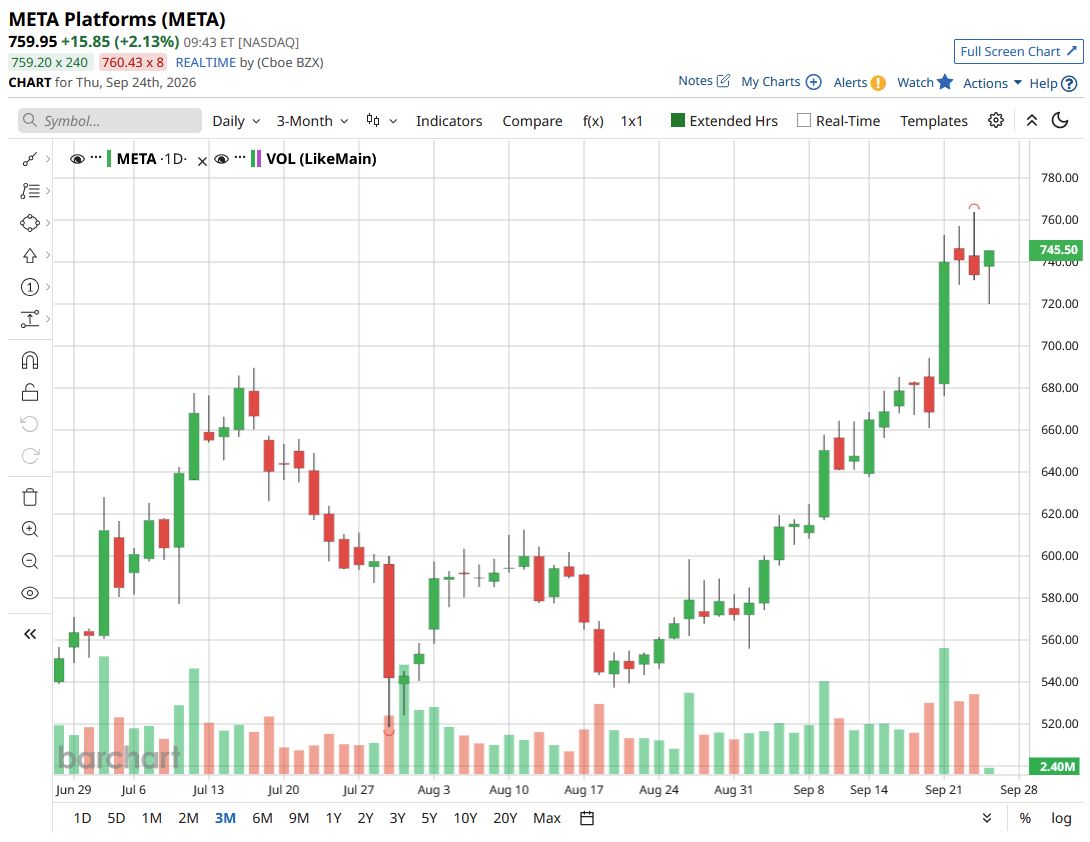
META stock is up 14% year-to-date (YTD), marginally ahead of the S&P 500’s ($SPX) 13% gain over the same period. The latest boost came on Sept. 21, when shares jumped more than 11% in their best day of trading since April 2025. That day, Wells Fargo raised its price target while Muse reached the top spot on Apple’s (AAPL) U.S. App Store. META stock now sits close to its 52-week high.
 www.barchart.com
 Meta is trading slightly above its own history, a shift from the discount it carried earlier this year. Its forward price-to-earnings (P/E) ratio of 27.3 times sits above the five-year average of about 22 times. The price-to-sales (P/S) ratio of 9.8 times shows a similar premium.
Although it trades at a modest premium, META stock still doesn’t look too stretched. The EPS outlook is steady rather than explosive. Analysts expect a decline of just 6% in fiscal 2026 as heavy investments weigh on earnings. The numbers then get better, with a 23% increase expected in fiscal 2027.
The balance sheet is also solid. Meta holds about $90 billion in cash against roughly $112 billion in debt. Investors are paying up marginally, betting that the infrastructure spending — cables included — eventually pays off.
Q3 Revenue Outlook Points to Continued Growth
Meta Platforms reported its second-quarter fiscal 2026 earnings on July 29. The company’s revenue was up in every segment of the business. Family of Apps revenue climbed 28% year-over-year (YOY) to $60.4 billion. Family of Apps ad revenue was $59.4 billion, up 27% YOY.
Meta’s operating results were mixed. Operating income fell 8% YOY to $18.8 billion, with a 31% operating margin. The company said legal charges of $2.4 billion and severance costs of $1.2 billion weighed on results. Spending also remained elevated because of AI hiring and infrastructure costs. Meta incurred capital expenditures of $31.1 billion during the quarter.
Looking forward, the company expects Q3 fiscal 2026 total revenue in the range of $61 billion to $64 billion. For full-year 2026, Meta raised the lower end of its expense outlook to $165 billion to $169 billion. The company also narrowed its capex guidance to $130 billion to $145 billion, up from a prior range of $125 billion to $145 billion.
On the Q2 earnings call, Bank of America analyst Justin Post asked CEO Mark Zuckerberg about how Meta’s AI lab is performing. Zuckerberg said that he was happy with the lab's progress and believes Meta is very good at bringing AI experiences to billions of people.
What Do Analysts Expect for Meta Stock?
Wall Street has grown noticeably more bullish on Meta Platforms stock, with four firms raising their price targets considerably. Wells Fargo, Cantor Fitzgerald, KeyBanc, and Citizens JMP all recently raised their targets by more than $100 while keeping “Overweight" and "Outperform” ratings. The price target raises came as Muse’s strong early adoption gave analysts fresh confidence in Meta’s AI strategy.
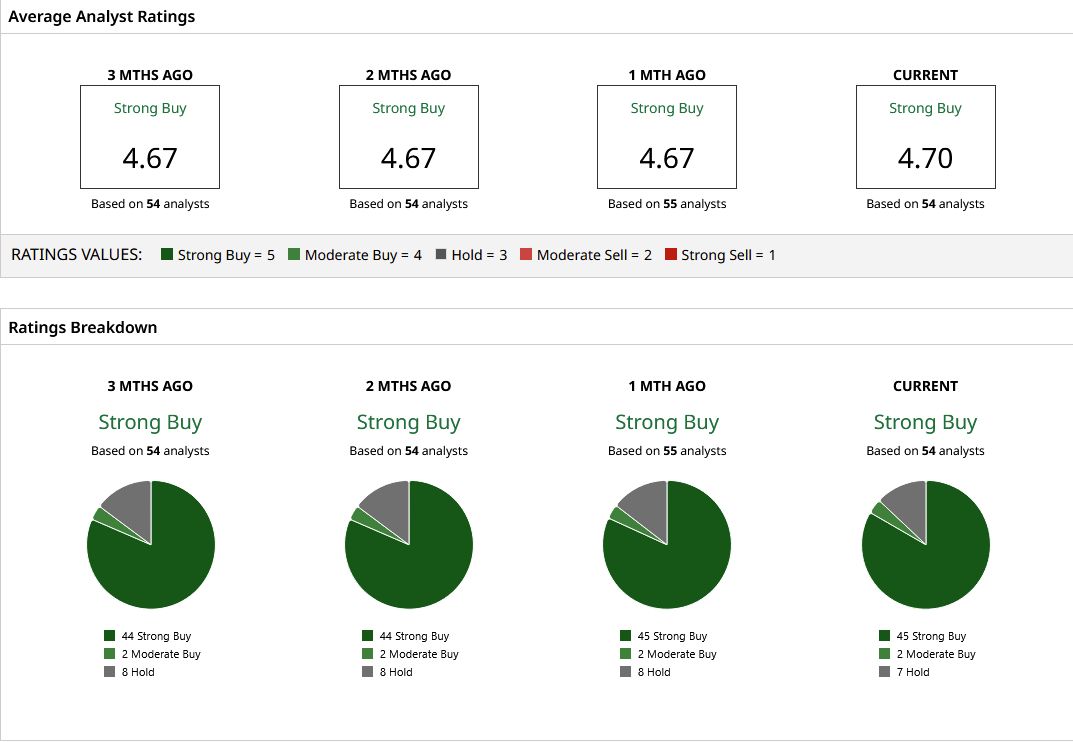
Based on the 54 analysts with coverage, META stock holds a consensus “Strong Buy” rating on Wall Street. The mean price target of $794.24 indicates potential upside of just 6% from current levels, reflecting the sharp surge in shares this month. However, some recent target raises from analysts may not be fully reflected in the average price target yet.
 www.barchart.com
 On the date of publication, Jabran Kundi did not have (either directly or indirectly) positions in any of the securities mentioned in this article. All information and data in this article is solely for informational purposes. For more information please view the Barchart Disclosure Policy here.
More news from Barchart
While Everyone’s Debating Muse, Mark Zuckerberg Is Quietly Building a 4,300-Mile Cable Under the Ocean. Here’s What It’s For. HP Stock Slips as PC Maker Warns of Industry Decline in 2027 Muse Could Be the Third ‘S-Curve’ in AI So Buy Meta Platforms Stock Now How to Trade Qualcomm Stock Near Multi-Month Highs