


Bank stocks may have a new AI risk to watch, and Wells Fargo (WFC) could sit close to the center of it.
Meta Platforms' (META) Muse is designed to do more than answer questions. The personal AI agent can handle multistep tasks across third-party services, raising a bigger question for banks: what happens when customers have an automated tool that can compare financial products and act on their behalf?
More Top Stocks Daily: Go behind Wall Street’s hottest headlines with Barchart’s Active Investor newsletter.
That is very critical because deposits are a key source of funding for lenders. If an AI agent makes it easier for customers to identify higher savings yields and move money, banks could face more pressure to offer competitive rates. However, higher deposit costs can weigh on net interest margins, the difference between what a bank earns on assets and pays on funding.
But in this stage, Wells Fargo’s consumer franchise makes that issue worth watching. Its deposit base reached roughly $1.5 trillion on average in the second quarter, giving changes in customer behavior potential relevance to future funding costs.
Why Wells Fargo Stock Is Under Pressure
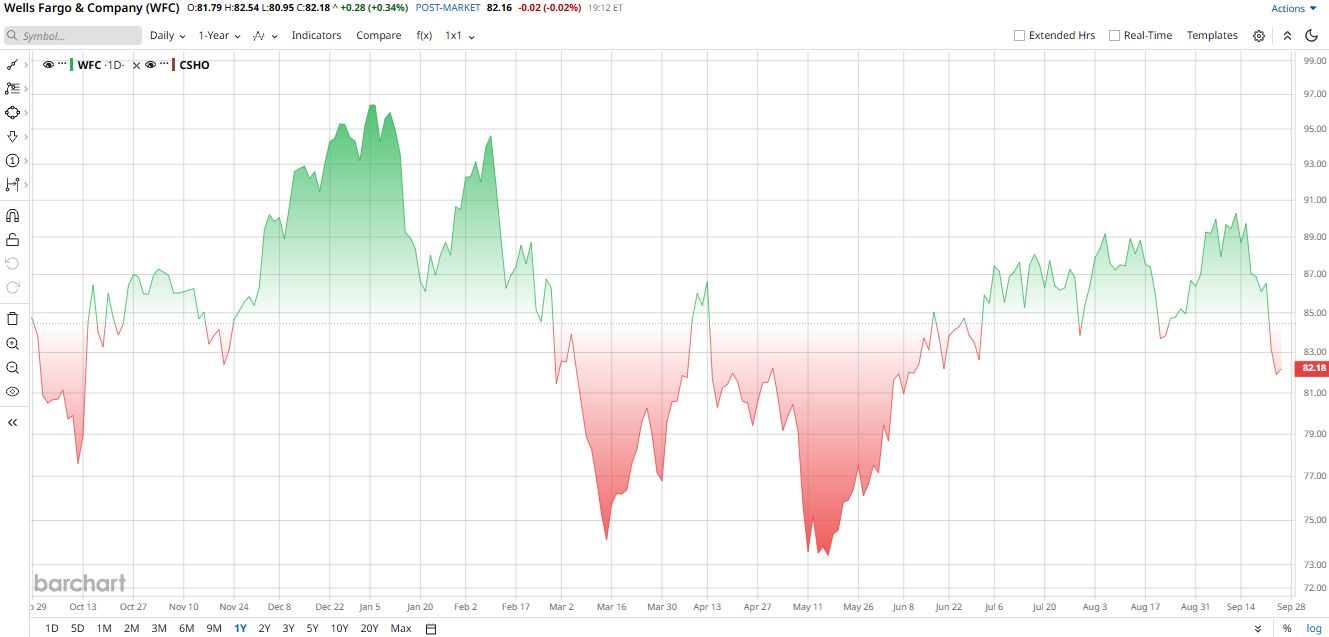
Wells Fargo has already had a difficult 2026. The shares are down about 11% year to date (YTD). The recent weakness came as investors digested concerns about banks and consumer-inertia businesses after Muse’s rapid rise.
Moreover, on Sept. 22, Wells Fargo fell roughly 4% as major financial stocks sold off amid concerns that agentic AI could disrupt companies that benefit from customers staying with existing providers.
But Muse has a problem more with a shift in customer habits than a hit to its bottom line. According to Wells Fargo, deposit balances, mix, and pricing are some of the factors that can impact NII. Management's forecast for 2026 net interest income is approximately $50 billion.
This is the story of the headline risk. Muse isn't even creating an economic quid pro quo that could work to any bank's detriment. It simply makes the shift a little easier. If customers put up with the better rates, it may be more expensive to maintain those deposits.
 www.barchart.com
 The Q2 Numbers Give WFC Stock Some Support
Wells Fargo’s second-quarter results showed why the bank remains financially important to investors. Revenue rose 9% year over year to $22.62 billion, while net income increased 17% to $6.41 billion. Diluted operating EPS reached $2.00, compared with $1.60 a year earlier.
Net interest income climbed 5% to $12.32 billion, and non-interest income rose 13% to $10.31 billion. Average loans increased 12% to roughly $1.03 trillion, while average deposits rose 10% to about $1.47 trillion.
That growth gives Wells Fargo more room to absorb changes in its funding environment. But the bank also faces the need to protect deposit relationships as technology makes shopping around easier.
The issue is especially relevant because the first quarter already showed how sensitive the stock can be to interest-income concerns. Wells Fargo reported $12.1 billion of net interest income in Q1, below the $12.3 billion Wall Street expected, helping send shares lower.
What Wall Street Says About Wells Fargo Stock?
Wall Street is mostly positive on Wells Fargo, but the Muse news added caution. Goldman Sachs kept its rating at Buy, but lowered its price forecast to $107 from $111 on Sept. 16. Morgan Stanley currently carries an Equal Weight rating on the stock, which has a $102 price target, while JPMorgan Chase — the latest rating with a $95.50 price target — is Neutral.
Bank of America continues to have an outlier of its own, which is a Buy rating. Its analysts have said that the deposit-disruption hypothesis remains a hypothesis until deposit costs start increasing at a rate that exceeds what can be accounted for by normal competitive forces and rates.
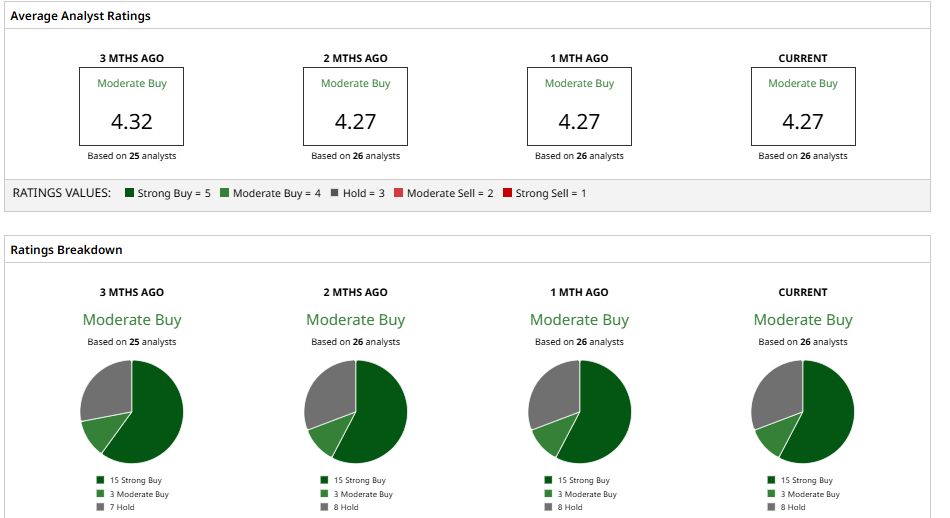
Overall, the consensus around Wall Street is “ Moderate Buy,” and the mean price target is set at $101, which implies 23% upside potential.
Now, the real question is whether agentic AI is a paradigm shift that alters how consumers handle bank accounts. The next one to keep an eye on for Wells Fargo is deposit pricing and its impact on the company's net interest income.
 www.barchart.com
 On the date of publication, Nauman Khan did not have (either directly or indirectly) positions in any of the securities mentioned in this article. All information and data in this article is solely for informational purposes. For more information please view the Barchart Disclosure Policy here.
More news from Barchart
Wells Fargo and Other Bank Stocks Are Facing a New AI Threat — From Meta Dear Marvell Stock Fans, Mark Your Calendars for Oct. 6 How to Play Bloom Energy Stock Amid Oracle Data Center Force Majeure Rumors 98,828 Reasons to Sell Rivian Stock