


Enterprise software companies are spending heavily on AI while looking for ways to cut costs. Oracle (ORCL) began another round of layoffs in September as it put more money into AI infrastructure. Earlier in May, Bridgewater Associates also sold its stakes in Workday (WDAY) and other software companies and increased its exposure to AI infrastructure.
Workday is now making cuts of its own. On Sept. 29, it said it would reduce its workforce by about 2.5%, mainly in Product and Technology, and give up some office space. The related costs will lower its GAAP operating-margin outlook, though its subscription-revenue and non-GAAP margin forecasts are unchanged.
More Top Stocks Daily: Go behind Wall Street’s hottest headlines with Barchart’s Active Investor newsletter.
The move follows a fiscal second quarter in which Workday’s subscription revenue grew 13.9% to $2.47 billion. Growth, in other words, has not stopped, but neither has the push for greater efficiency. Can Workday make its cost base leaner without cutting into the innovation that sustains that growth? Let’s dive in.
Workday’s Financial Growth
Based in Pleasanton, California, Workday provides cloud software for human resources, finance, and planning. Its applications help organizations manage employees, analyze spending, and make operating decisions. Workday is also adding AI tools to those applications, making product development central to its growth plans.
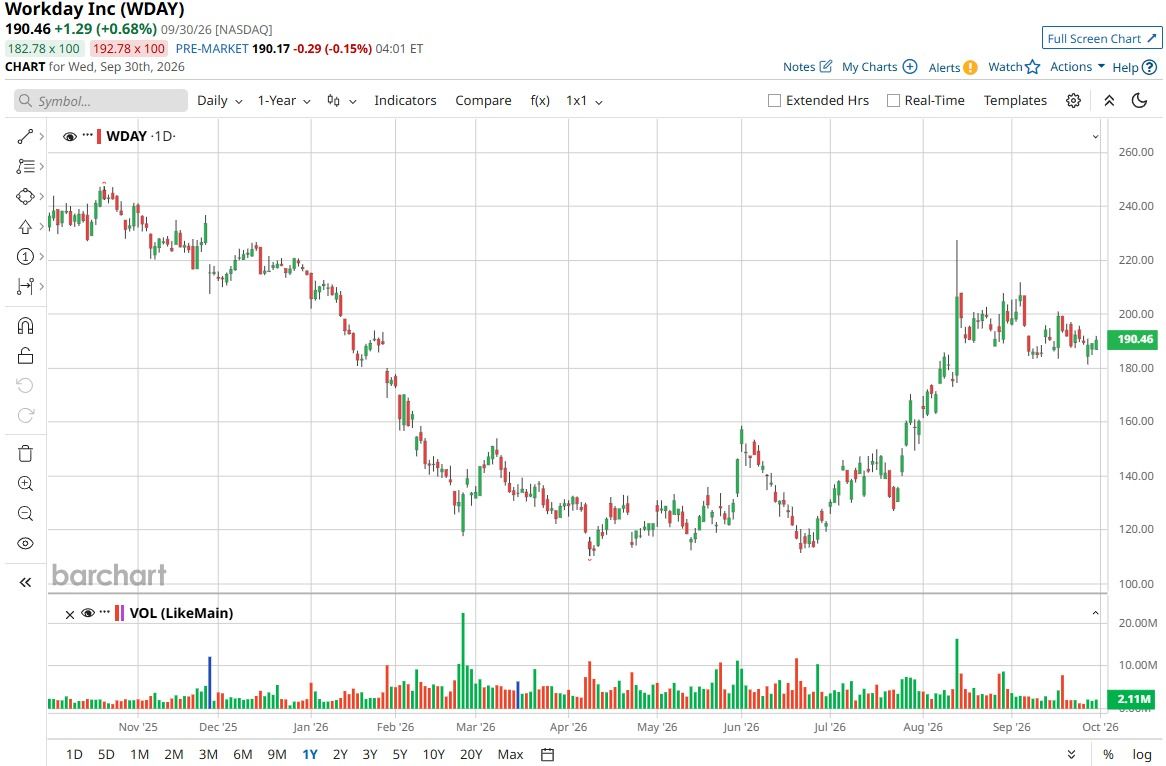
Workday shares ended Sept. 30 at $190.46, down 11.32% so far this year and 20.88% over the past 52 weeks.
 www.barchart.com
 Its $45.59 billion market value comes with a 35.61x forward earnings multiple and 26.09x price-to-cash-flow ratio, above sector medians of 29.20x and 18.49x, respectively.
Workday released its fiscal second quarter 2027 results on August 27, giving investors a baseline for judging the cuts. The company generated $2.65 billion in revenue, up 12.8% from a year earlier and 0.5% above analysts’ $2.64 billion estimate. Its adjusted earnings reached $2.75 per share, beating the $2.61 estimate by 5.3%.
The company’s adjusted operating income rose to $824 million, exceeding the $792.8 million estimate by 3.9%. This produced a 31.1% adjusted operating margin, while its GAAP operating margin improved to 11.8% from 10.6%.
The job cuts will change the near-term picture. Workday expects $65 million to $80 million in related charges, including $40 million to $55 million in cash costs for severance and benefits. It also expects $10 million in noncash stock compensation charges and $15 million in non-cash charges tied to office leases. The company expects to record $55 million to $70 million of the total in fiscal Q3 and the remaining $10 million in Q4.
Because of those charges, Workday expects its GAAP operating margin to be about 20 to 21 percentage points below its non-GAAP margin in Q3. It expects a gap of about 19 points for the full year.
The outlook comes as other measures still point to demand. Workday’s billings reached $2.71 billion, up 13.6% year over year. More than 5,500 customers used at least one of its internally developed AI agents, up over 35% sequentially. Its AI products also generated more than $100 million in new annual contract value, accounting for over 25% of all new contract value closed.
Workday’s Government Deals
Workday’s government business is growing just as it prepares to reduce staff. Workday said on Sept. 2 that it was signing a new state or local government customer nearly every week. More than 100 had selected Workday over the previous two years. Those wins bring work for the teams responsible for getting customers onto its software.
Recent customers include Delaware, Massachusetts, the New Jersey Transit Authority, and the New York State Unified Court System. Also moving to Workday are Bexar County, Utah Transit Authority, Bell Gardens, and Fond du Lac. The agencies want to replace older, separate systems for HR and finance.
The projects vary in size. Bell Gardens brought Workday’s HR and finance applications into use in five months. Akron, Ohio, replaced systems that were 30 years old. Its employees can now check leave balances without contacting HR, and managers can see overtime figures without asking IT for a report. Akron is also testing Workday’s Self-Service, Payroll, and Financial Audit AI agents.
Georgia’s rollout covered more than 200 agencies and over 70,000 employees in about 30 months. The state says the system has helped automate data entry and grants tracking.
The announcement does not put a value on these contracts, but the pace of signings shows why execution matters. Workday still has to deliver on those contracts. With the cuts focused on Product and Technology, investors should watch whether deployments stay on schedule and the software keeps improving.
What Analysts Expect From Workday
Workday’s next earnings report is expected on Nov. 24, giving investors their first results since the company announced the cuts. Analysts expect $1.27 per share for the quarter ending in October, up from $1.09 a year earlier. That would be 16.51% growth.
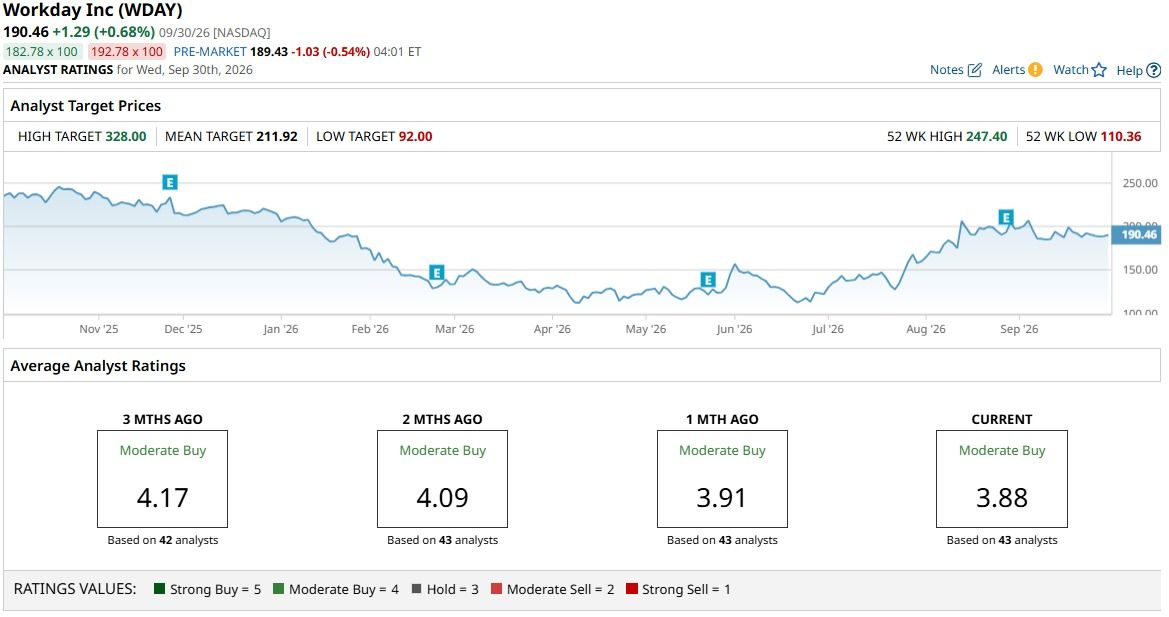
Analysts had been positive about Workday even before the restructuring. Needham raised its price target to $230 on August 28 and kept its Buy rating after Workday’s second-quarter results. That target is about 20.8% above the Sept. 30 share price of $190.46.
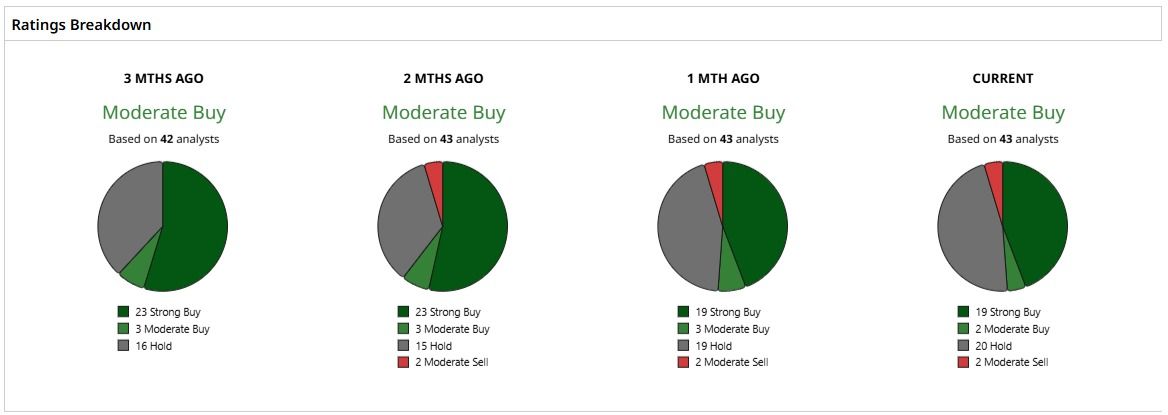
The broader view was less bullish than Needham’s. In the recent survey, 43 analysts gave Workday a “Moderate Buy” consensus rating. Their average target of $211.92 implies approximately 11.3% upside from the Sept. 30 price.
 www.barchart.com
 Conclusion
Investors should view Workday’s cuts as a reasonable attempt to improve efficiency, not a sign that growth has stalled. Subscription revenue is rising, and government deals point to continued demand. That gives Workday room to absorb a temporary hit to reported margins, provided the cuts do not disrupt product development or customer rollouts. The plan makes sense on paper, but the next few quarters will show whether a leaner team can keep up with the work.
On the date of publication, Ebube Jones did not have (either directly or indirectly) positions in any of the securities mentioned in this article. All information and data in this article is solely for informational purposes. For more information please view the Barchart Disclosure Policy here.
More news from Barchart
Commercializing AI Agents Will Help Okta Accelerate Its Growth Micron Beat on Earnings and Guided Above Estimates. How Investors Should Play MU Stock Here. Workday Plans to Cut 2.5% of Its Workforce and Revise Its Margin Outlook. How Investors Should View the Move. Chevron Stock May Attract Value Investors, Especially If It Hikes the Dividend Next Year