


Constellation Energy (CEG), the largest nuclear power operator in the United States, has signed a 20-year, 690 MW nuclear power agreement with the largest e-commerce operator in the country, Amazon (AMZN). Not stated explicitly, but the deal will primarily involve servicing the cloud giant's AI computing needs.
Under the terms of the deal, Amazon will invest $3 billion to augment and expand Constellation's Calvert Cliffs nuclear plant in Maryland. Currently operating at a capacity of 1,790 MW, the cash injection of $3 billion is expected to bring another 190 MW of power online between 2030 and 2032, which is to be included in the 690 MW.
Don’t Miss a Day: From crude oil to coffee, sign up free for Barchart’s best-in-class commodity analysis.
The deal also has a retail angle, with Constellation set to supply electricity to support Amazon’s operations across the 13-state PJM market. This retail supply arrangement is separate from the 20-year PPA for power generated at Calvert Cliffs, with electricity delivered through the regional grid.
Commenting on the deal, CEO Joe Dominguez said, “Amazon's commitment supports the long-term operation of Calvert Cliffs for generations to come and creates a strong foundation for future investment in both the facility and in advanced nuclear technologies.”
About Constellation Energy
Spun off from Exelon (EXC) in 2022, Constellation is primarily an independent power producer and competitive energy supplier. It owns and operates power-generation facilities, sells electricity into wholesale markets, and enters into long-term power-purchase agreements (PPAs) with businesses, utilities, and public-sector customers.
It also supplies retail electricity and natural gas and provides energy management, efficiency, and sustainability services to commercial and residential customers. Its customer base includes major corporations, data center operators, public agencies, and households. The company reports serving approximately 2.5 million customer accounts, including around 80% of the Fortune 100.
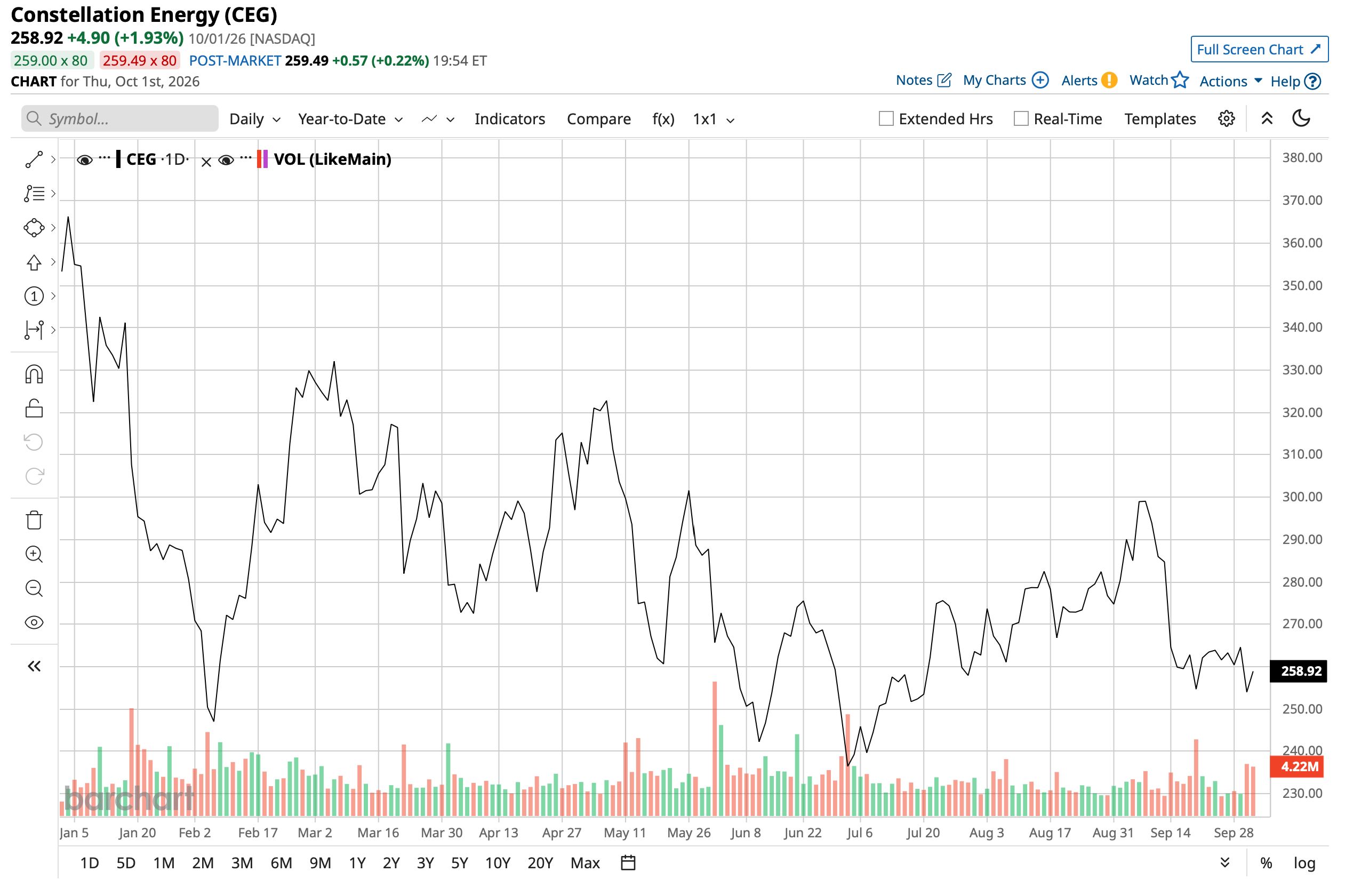
Valued at a market cap of $90 billion, CEG stock is down 28% on a year-to-date (YTD) basis. The stock also offers a dividend yield of 0.64%.
So, with a giant like Amazon now as its customer, does that make CEG stock an attractive investment option now? Let's find out.
 www.barchart.com
 Nuclear Leader
The enormous amounts of energy that will be required for the wider AI infrastructure buildout are not lost on anyone. While the International Energy Agency (IEA) expects data center electricity consumption to almost double from 485 TWh to 945 TWh in 2030, Goldman Sachs Research projects it to grow by 170% in the same period.
Within this, nuclear, due to its reliability and round-the-clock capabilities, is projected to play a crucial role. Constellation, with a market share of 22% and by virtue of being the largest nuclear power operator in the country, is poised to be a natural beneficiary. And it has received some major endorsements from key AI industry players over the years for this. Keeping the latest Amazon deal aside, in 2024, Constellation signed a 20-year, 835 MW PPA with Microsoft (MSFT) to restart Three Mile Island Unit 1, rechristened Crane Clean Energy Center. The agreement supports Microsoft's objective of matching the electricity consumption of its data centers in the PJM region with carbon-free energy.
Further, in June 2025, the company signed a similar PPA with Meta (META). The 20-year agreement will begin in June 2027 and covers 1,121 MW of emissions-free nuclear energy and is intended to secure the plant's long-term operations beyond the expiration of Illinois' existing Zero Emission Credit program.
But what is attracting these players towards Constellation? Well, the appeal is not that Constellation is the only nuclear seller. It is that the company can offer substantial amounts of electricity from operating plants, and then use lengthy contracts to justify adding capacity or extending a plant’s life. Its nuclear fleet generated 44,160 GWh in the second quarter of 2026. For a data center operator that needs power around the clock, that scale makes a large, long-duration purchase possible.
Finally, in all this, where does the $16.4 billion acquisition of Calpine fit? Calpine brings natural gas and geothermal plants, along with a stronger presence in Texas and California. That makes Constellation more than a nuclear specialist when a customer requires a broader power supply across several regions. While nuclear plants provide steady, emissions-free output, gas generation can respond when more power is needed, while the enlarged retail business gives Constellation another way to structure supply for customers.
Constellation's Unexciting Q2
Constellation's latest Q2 print could be described as a plain one, at least on the revenue front.
Operating revenues rose by 23% from the previous year to $7.5 billion, missing the consensus estimate by $122.5 million. Nuclear output from the company's owned plants increased to 44,160 GWh from 45,170 GWh in the year-ago period. A fall in capacity factor, an indicator of electricity generation, may have fallen to 93% in Q2 2026 from 94.8% in Q2 2025; a slight decrease in the number of non-refueling outage days to 20 from 22 was reassuring. Non-refueling outages are periods when a nuclear plant is taken offline for reasons other than scheduled refueling, such as equipment repairs, maintenance, or unexpected operational issues. Fewer such outage days can indicate improved operational availability, potentially allowing Constellation to generate and sell more electricity.
Meanwhile, adjusted operating earnings moved up by 33.5% on a year-over-year (YoY) basis to $2.55 per share, coming in ahead of the consensus estimate of $2.29 per share. This was also the third consecutive quarter of earnings beats from the company. Meanwhile, Constellation raised its EPS guidance for the year to $11.50-$12.50 per share from $11-$12 per share earlier.
Net cash from operations for the six months ended June 30, 2026, remained almost identical to the same period of 2025, at $1.55 billion (vs. $1.58 billion). However, Constellation ended the first half of the year with a cash balance of $697 million, much lower than its short-term debt levels of $5.6 billion, which can lead to liquidity issues.
Shifting focus to valuations, Constellation is trading at slightly overvalued levels. Its forward P/E, P/S, and P/CF of 20.92, 2.54, and 11.43 are within the range of sector medians of 16.86, 2.51, and 8.08, respectively.
What Does Wall Street Think About CEG Stock?
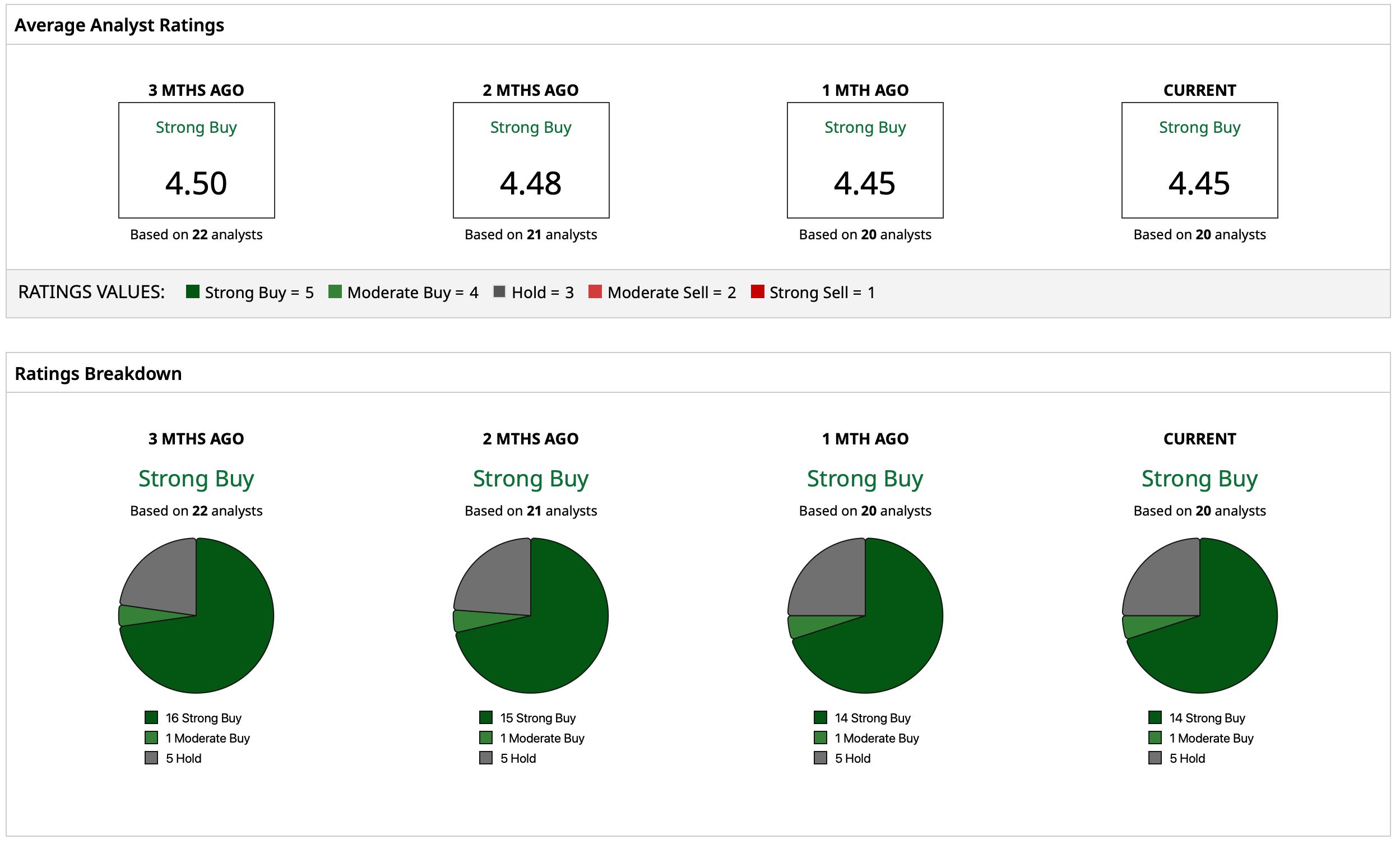
Analysts are bullish about CEG stock, assigning it an overall consensus rating of “Strong Buy.” The mean target price of $339.30 indicates a potential upside of 31% from current levels. Out of 20 analysts covering the stock, 14 have a “Strong Buy” rating, one has a “Moderate Buy” rating, and five have a “Hold” rating.
 www.barchart.com
 On the date of publication, Pathikrit Bose did not have (either directly or indirectly) positions in any of the securities mentioned in this article. All information and data in this article is solely for informational purposes. For more information please view the Barchart Disclosure Policy here.
More news from Barchart
What a 20-Year Deal With Amazon Means for Constellation Energy Stock How to Play DJT Stock as Trump Media Finally Files for TAE Merger Fervo Stock Surges as It Declares Commercial Operation Ahead of Schedule G7 Agrees to Release 100 Million Barrels as U.S. Diesel Hits $6.39 Per Gallon — But the Real Crisis Is in the Bankruptcy Courts