

Michael Burry is betting against parts of the AI trade, but his latest comments make an unexpectedly bullish case. Washington has too much at stake to let the buildout fail. Speaking in a recent Substack chat, the “Big Short” investors said the Trump administration recognizes that the AI narrative and buildout are “the only thing keeping this economy going.” He added, “They cannot afford to let it fall,” while also questioning what policymakers could realistically do to prevent a downturn.
Why This Hits SOXX Holders?
For investors holding the iShares Semiconductor ETF (SOXX), the argument matters because the ETF is heavily exposed to the AI trade. The fund has gained more than 95% this year, while about 35% of its assets are concentrated in just four stocks: AMD (AMD), Micron (MU), Intel (INTC), and Nvidia (NVDA). That concentration makes Washington’s potential support for the AI buildout a meaningful portfolio issue.
More Top Stocks Daily: Go behind Wall Street’s hottest headlines with Barchart’s Active Investor newsletter.
Burry’s own trades highlight the tension. He has short positions in Nvidia and Micron, two of SOXX’s largest holdings, as well as Palantir (PLTR), Oracle (ORCL), Nebius (NBIS), and CoreWeave (CRWV). His argument is that the scale of AI capital spending does not guarantee durable returns. He has also warned that hyperscalers could eventually be forced to take write-offs if AI infrastructure spending grows faster than demand.
The political angle is worth watching, but it should not be overstated. Disclosures show the president made more than 1,000 trades in July, primarily in technology stocks such as Nvidia, Oracle, and Marvell (MRVL). However, trading activity alone does not indicate a policy direction, nor does it explain how any potential support would ultimately reach chipmakers.
What Investors Should Do?
The key point is that government support may cushion sentiment, but it cannot guarantee a return on the capital being spent. As long as hyperscaler capex continues to rise, SOXX’s largest holdings should continue to benefit. But if buyers start pulling back, no administration can replace that demand. After the fund’s sharp rise, investors should size positions with this risk in mind, keep an eye on quarterly capex guidance from major cloud buyers, and consider the top-four weighting the central risk rather than a footnote. Michael Burry may be early in his call, but SOXX’s concentration leaves it sensitive if the market gets the AI spending story wrong in either direction.
About SOXX
The iShares Semiconductor ETF is an exchange-traded fund that invests in leading U.S.-listed semiconductor and semiconductor equipment companies. SOXX closely tracks the performance of the ICE Semiconductor Index, giving investors exposure to the broader chip industry through a single investment. The fund holds a mix of major semiconductor companies and typically invests most of its assets in the stocks that make up its benchmark index. iShares Semiconductor ETF was formed on July 10, 2001, and is domiciled in the United States.
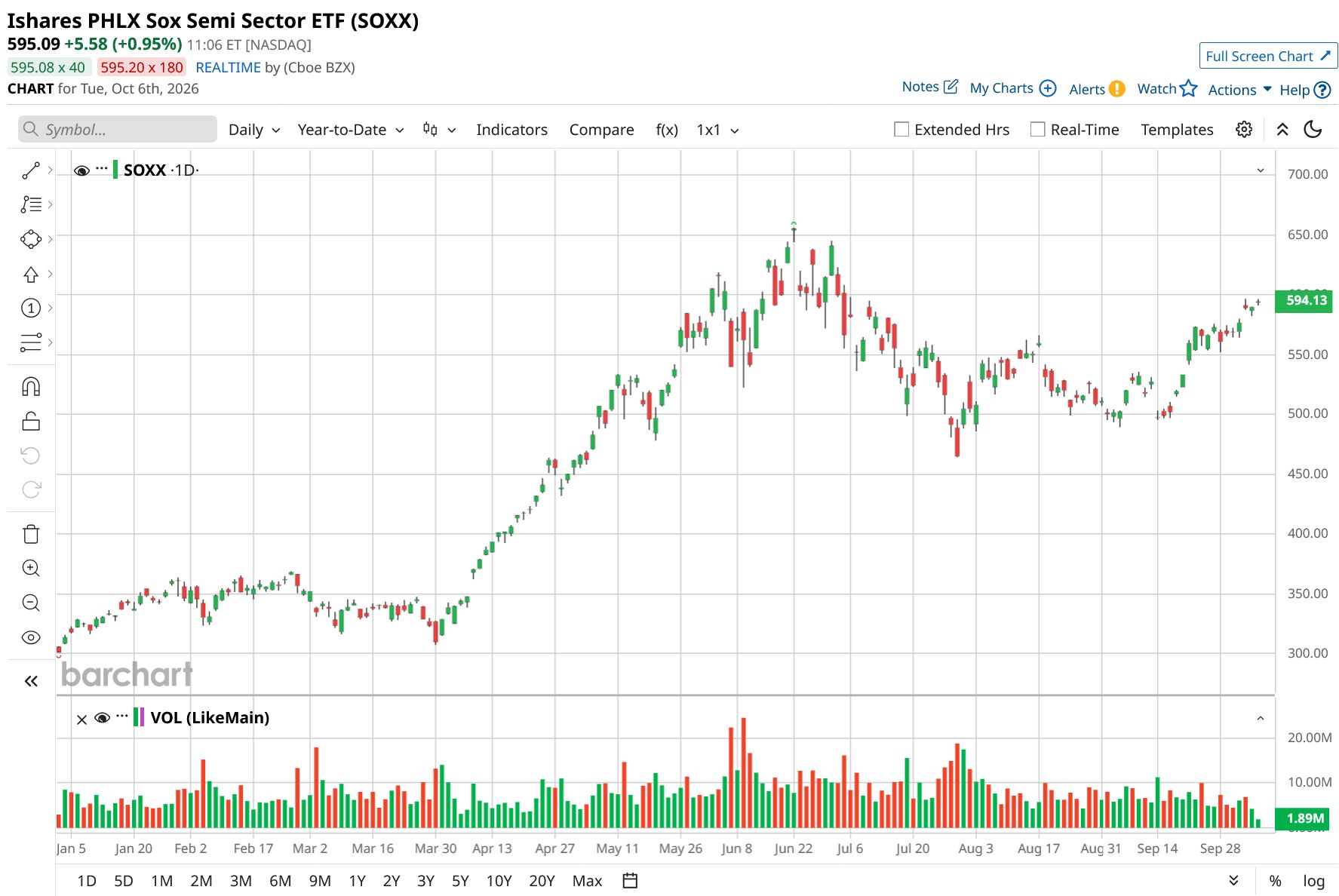
The iShares Semiconductor ETF (SOXX) has gained about 106% over the past year, highlighting the strength of the semiconductor rally. Despite periods of volatility, the ETF remains close to its 52-week high, suggesting investors continue to view semiconductors as one of the primary beneficiaries of AI-driven spending.
 www.barchart.com
 The Companies Driving SOXX's Strong Performance
SOXX's top holdings highlight the semiconductor growth drivers that have driven the sector's rally over the past year. Intel is the ETF's largest position at roughly 9.6% of assets, followed by AMD at 9.3%, Micron at 7.9%, and Nvidia at 7.4%. Together, these four companies account for about one-third of the fund, giving investors significant exposure to AI processors, memory chips, and semiconductor manufacturing.
At a time when CPU shortage is the talk of the town, government backing to support this growth before it becomes a bottleneck will likely drive these major constituents' stock price up, taking the rest of the semiconductor value chain along with it for the ride. This is precisely what happened when memory stocks took off as well, mainly because a CPU or memory chip in itself isn't the only bottleneck. Unless the whole value chain moves along, these chips can't be produced. While Nvidia and AMD are among the biggest beneficiaries of AI computing demand, Micron has emerged as a key supplier of high-bandwidth memory used in AI servers. Below these giants, there are numerous smaller companies providing critical components, and they will also have a major role to play when determining this ETF's long-term returns.
On the date of publication, Jabran Kundi did not have (either directly or indirectly) positions in any of the securities mentioned in this article. All information and data in this article is solely for informational purposes. For more information please view the Barchart Disclosure Policy here.
More news from Barchart
Michael Burry Sees a Government-Backed AI Boom. A Memory-Style Rally Could Be Around the Corner. Nasdaq Futures Slip as Rising Bond Yields Weigh on Chip Stocks, FOMC Minutes on Tap A Juicy Dividend Means Investors Should Stay Patient with Pepsi Stock Before October 8 CRWD Stock Pops as CrowdStrike Launches Fourth Startup Accelerator