

I asked where cattle futures prices were heading after the 2026 grilling season in an August 21, 2026, Barchart article, where I concluded with the following:
Expect lots of volatility in the beef futures markets over the coming days and weeks. A seasonal selloff that takes prices significantly lower could be a buying opportunity for the 2027 peak season, but it leaves plenty of room to add to any long position, as prices can always fall to levels that defy even the best fundamental and technical analysis, making picking bottoms dangerous.
Don’t Miss a Day: From crude oil to coffee, sign up free for Barchart’s best-in-class commodity analysis.
Nearby live cattle futures were $2.1370 per pound on August 21, while nearby feeder cattle futures were $3.24 per pound. Prices were higher in October 2026, but they remain in a bearish trend since earlier this year.
Live cattle have trended lower since May 1, 2026
On May 1, 2026, the continuous CME live cattle futures contract reached a record high of $2.56625 per pound, where it ran out of upward momentum.
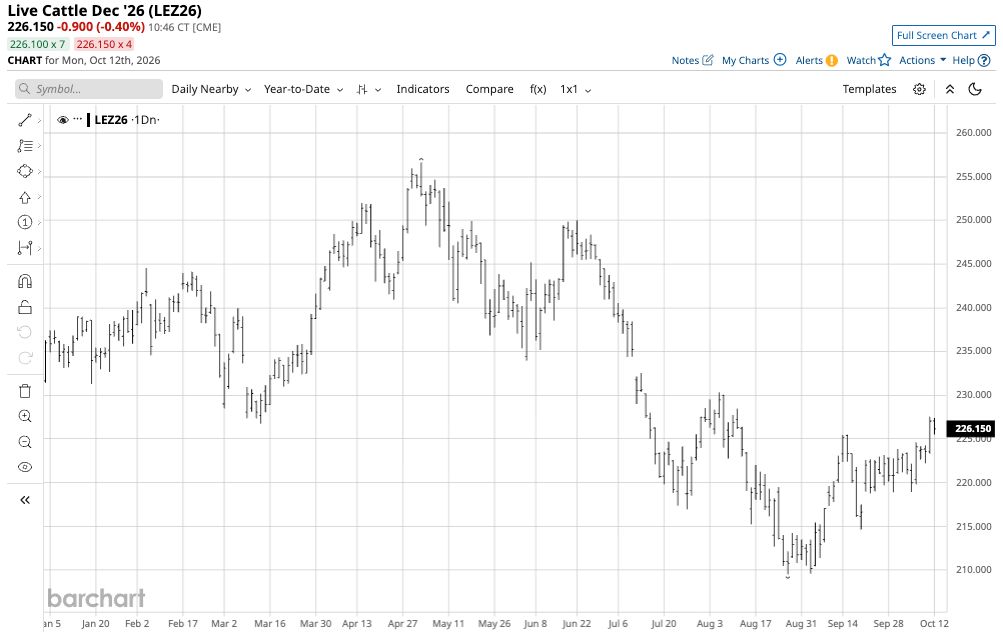
The daily year-to-date continuous contract has made lower highs and lower lows since the May 1 high, falling 18.4% to a recent low of $2.09525 per pound on August 26, 2026.
While the live cattle futures have declined, they remain in a long-term bullish trend.
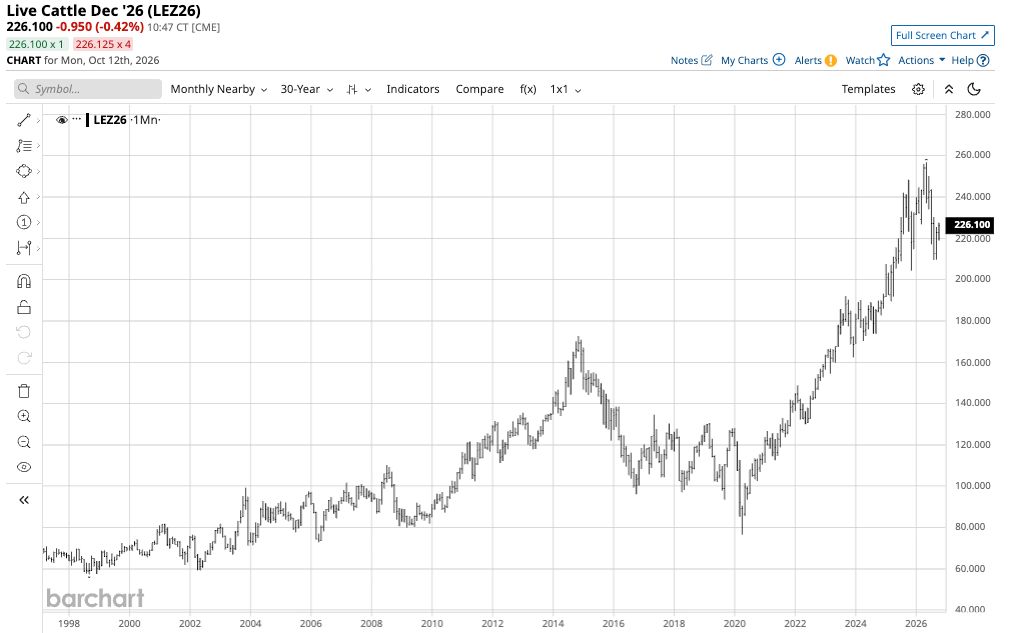
The 30-year continuous chart shows that live cattle futures remain in a bullish trend of higher lows and higher highs since the 2020 pandemic-inspired low of $0.7660 per pound.
The feeders’ bearish price action began at a lower high in April 2026
On May 1, 2026, the continuous CME feeder cattle futures contract reached a high of $3.7945 per pound, where it ran out of upward momentum.
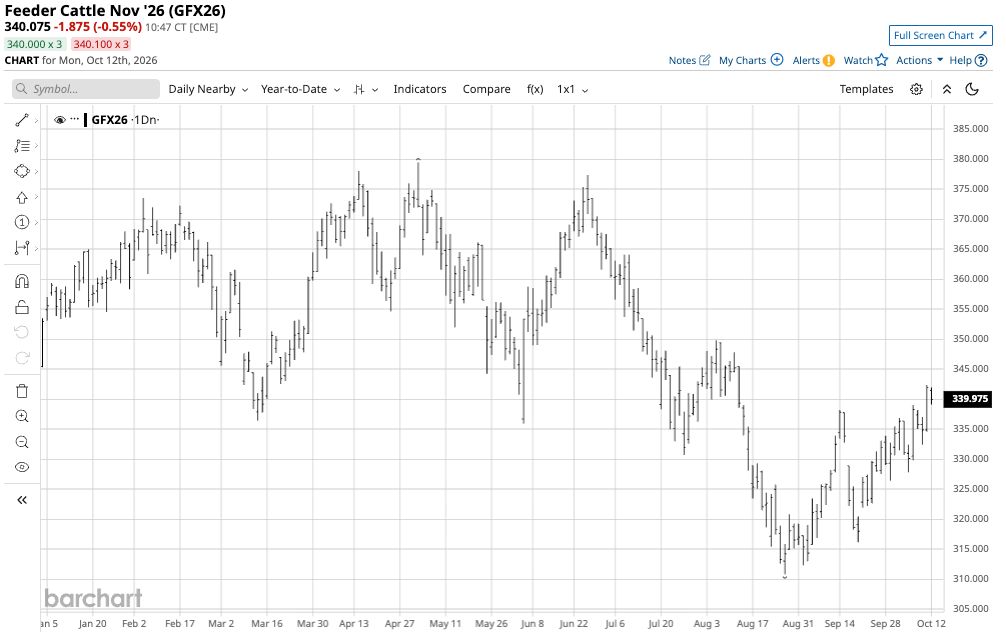
The daily year-to-date continuous contract has made lower highs and lower lows since the May 1 high, falling 18.1% to the most recent low of $3.1085 per pound on August 26, 2026.
While the feeder cattle futures have declined, they also remain in a long-term bullish trend.
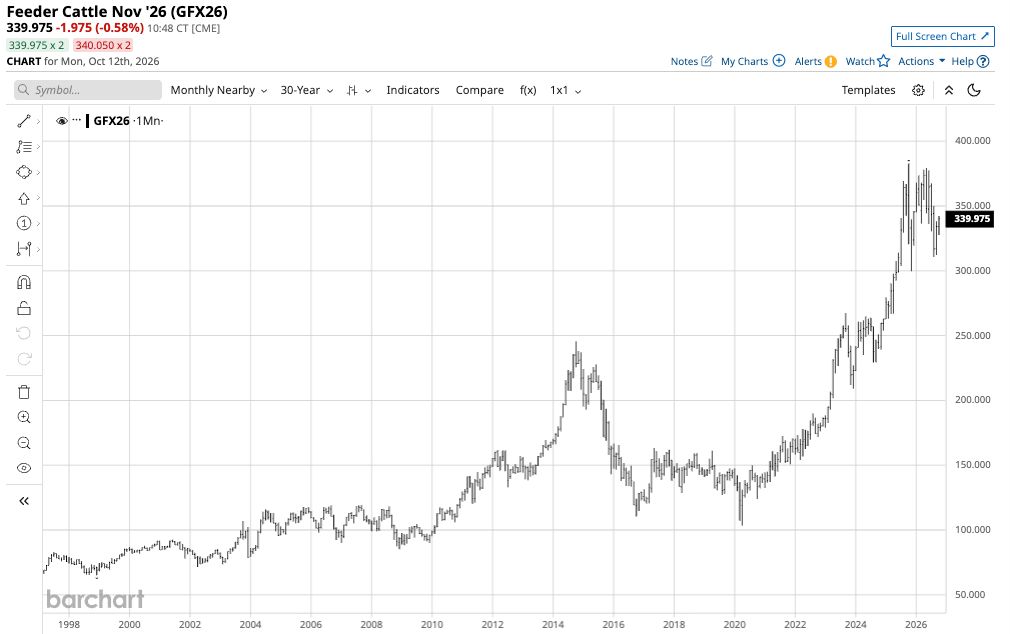
The 30-year continuous chart shows that feeder cattle futures remain in a bullish trend of higher lows and higher highs since the 2020 pandemic-inspired low of $1.03625 per pound. Feeders reached a record high of $3.8280 per pound in October 2025.
The factors weighing on beef prices
Live and feeder cattle futures prices have declined since the May 2026 highs because of temporary tariff-quota expansion under the Trump administration. On August 21, 2026, at the end of the 2026 grilling season, the U.S. administration issued an executive order suspending the 26.4% out-of-quota tariff on an additional 300,000 metric tons of imported lean beef trimmings for 90 days beginning on September 1, 2026. Meanwhile, the tariff relief came as the 2026 grilling season ended, ushering in the off-season for demand.
While live and feeder cattle prices have declined, futures markets remain bullish because herds are historically low, with the current herd at its lowest level in 75 years. Moreover, cattle inventories in major exporting countries are down, with Brazilian cattle down 8% and Chinese cattle down 14% since 2024.
Coming close to support levels on the monthly charts
In October 2026, live and feeder cattle prices were trading at $2.2610 and $3.39975 per pound, respectively.
The monthly charts show that critical technical support for live and feeder cattle futures is at the November 2025 lows of $2.04325 and $2.99525 per pound, respectively. The support levels are below the most recent August 2026 lows. However, the off-demand season will continue through late May 2027, when the 2027 grilling season gets underway. Time will tell if live and feeder cattle futures can hold above their critical technical support levels over the coming months to keep the bullish trends since the 2020 lows intact.
Futures are the only route for risk positions in beef
Small herds in the U.S. and other leading producing countries are bullish for cattle futures. The tariff issue continues to distort beef prices, which could continue. Therefore, I would be a scale-down buyer of live and feeder cattle futures, leaving plenty of room to add to long positions on further declines before seasonality supports higher demand in mid-2027.
No ETF or ETN directly tracks live and feeder cattle futures. Diversified ETFs, such as the Invesco DB Agriculture Fund (DBA) and others, allocate to beef futures along with other agricultural futures markets.
The most direct route for a risk position in live and feeder cattle is the CME’s futures contracts. At $2.26 per pound, one December live cattle futures contract covers 40,000 pounds and has a $90,400 contract value. The CME’s original margin requirement is $3,300 per contract. A market participant can control $90,400 of live cattle futures on the long or short side with a 3.65% down payment. If equity declines below $3,000 per contract, the Exchange requires maintenance margin payments.
At $3.40 per pound, one November live cattle futures contract covers 50,000 pounds and has a $170,000 contract value. The CME’s original margin requirement is $5,940 per contract. A market participant can control $170,000 of feeder cattle futures on the long or short side with a 3.49% down payment. If equity declines below $5,400 per contract, the Exchange requires maintenance margin payments.
I favor a scale-down buying approach for the live and feeder cattle futures markets, leaving plenty of room to add on further declines before the 2027 peak season begins on Memorial Day weekend in late May 2027.
On the date of publication, Andrew Hecht did not have (either directly or indirectly) positions in any of the securities mentioned in this article. All information and data in this article is solely for informational purposes. For more information please view the Barchart Disclosure Policy here.
More news from Barchart
Where Are Cattle and Beef Prices Heading During the 2026/2027 Offseason? Cattle Prices Are at Multi-Week Highs as Lean Hogs Sink to a Contract Low. What to Watch Next. Lean Hog Prices Are Rebounding. Why You Should Buy Futures Here. Corn, Soybeans, and Wheat: What Is Really Driving Grain Volatility?