

Oracle (ORCL) faces a challenge that many fast-growing AI companies are facing now. As demand for AI keeps increasing, Oracle has invested heavily to expand its AI infrastructure. But so far, Oracle hasn't turned these investments into revenue, profits, or cash while keeping spending in check. This is where investors are starting to lose patience and selling off the most heavily indebted AI stocks.
Nonetheless, a majority of the analysts covering Oracle stock still believe it is a “Strong Buy” and expect the stock to rebound to $400. Here’s why.
More Top Stocks Daily: Go behind Wall Street’s hottest headlines with Barchart’s Active Investor newsletter.
 www.barchart.com
Why Oracle Stock Is Facing Renewed Pressure
The market knows AI demand is growing and will continue growing. Experts predict the global AI market could grow at a compounded annual growth rate of 30.6% from 2026 to 2033, reaching $3 trillion. But investors are more concerned about how the companies are financing these AI infrastructure investments and how soon they will see returns. Now, Oracle has joined the discussion about the growing debt tied to AI investments. The legacy tech giant has been expanding quickly to keep up with AI leaders like Nvidia (NVDA), Advanced Micro Devices (AMD), and Broadcom (AVGO). This rapid growth means Oracle needs to invest heavily in computing power and data centers.
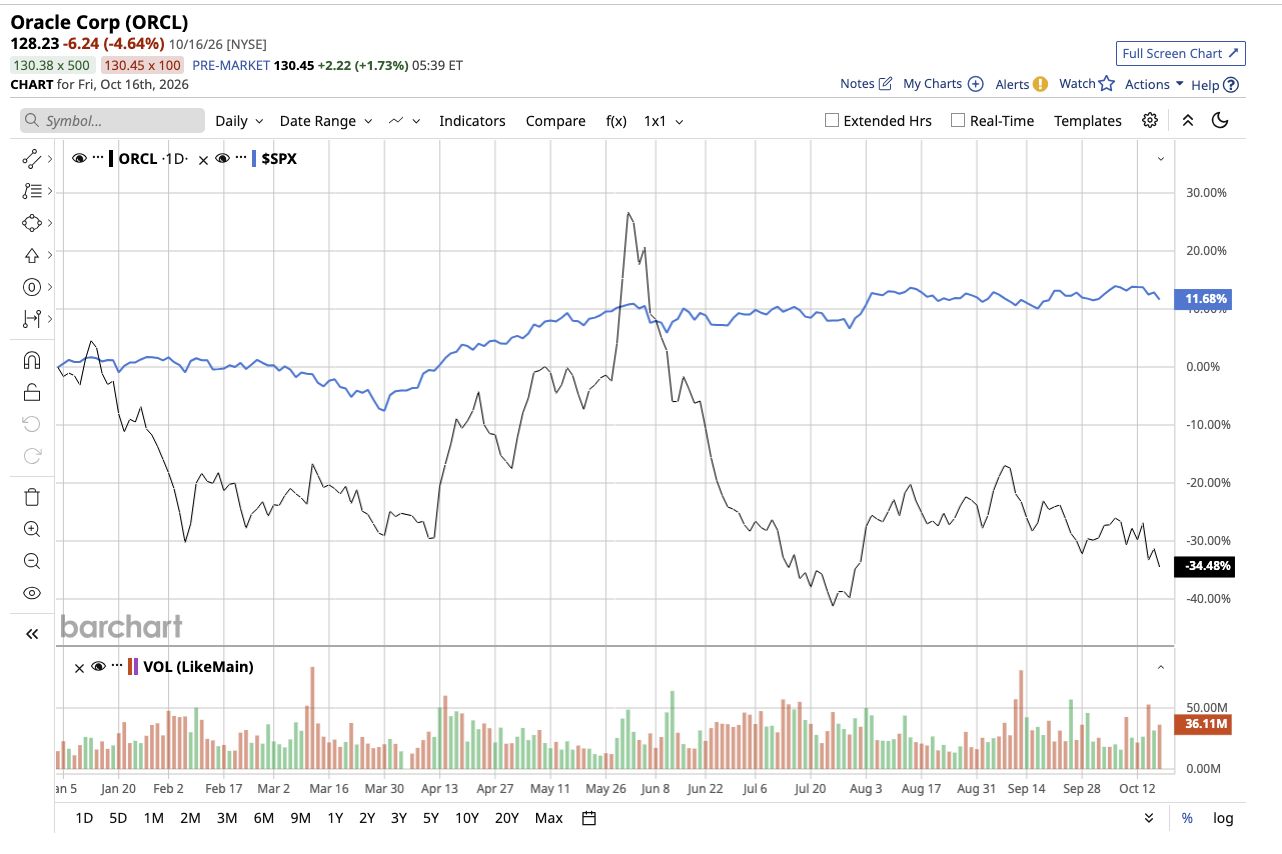
ORCL shares have dropped 34% so far this year, as AI infrastructure stocks have become especially vulnerable. The bond market has brought another layer of uncertainty. CoreWeave (CRWV), one of the sector’s most aggressive borrowers, has been caught in the sell-off as investors question whether future AI revenue will justify the massive upfront costs. Oracle is confronting similar questions about its spending, so cash flow and debt management are now key to its investment story.
The $664 Billion Backlog Is a Green Flag, but Cash Flow Is the Real Test
A key reason to be bullish about Oracle is the size of its contracted future business. At the end of the first quarter of fiscal 2027, its remaining performance obligations (RPO) stood at $664 billion, up $209 billion from the previous year. RPO shows revenue that is already contracted but not yet recognized, giving a clearer view of future business rather than current cash on hand. Management expects about half of the backlog to convert to revenue over the next 36 months. Most new contracts include customer prepayments, customer-supplied hardware, or similar deals that don't require additional capital from Oracle. This matters because it lets the company grow without paying for every new project out of its own funds.
However, there is a catch. A backlog benefits shareholders only if Oracle delivers the contracted services, collects payment, and earns a good return. Some new commitments won't affect revenue or capital spending until fiscal 2028 or later. This means there is a delay between signing contracts and seeing the financial benefits. The backlog supports long-term growth, but it does not eliminate short-term execution and financing risks.
There is a reason why investors feel uneasy putting money into the stock now despite Oracle’s rapid revenue growth and the massive backlog. In the first quarter, Oracle reported a record $23 billion in operating cash flow. But its capital spending was about $28 billion, which led to a negative free cash flow of around $5 billion. After factoring in customer prepayments, net cash capital expenditure was about $18 billion. Management now expects to spend $90 billion to $95 billion in fiscal 2027, with net cash capital expenditure limited to $70 billion. This is a major investment, even for a well-established company like Oracle. The difference between total capital expenditure and net cash spending is important because customer prepayments can help lower Oracle's immediate funding needs. However, Oracle still has to provide the infrastructure and services its customers have paid for.
If customer demand holds up and infrastructure utilization remains strong, the investment could create a powerful revenue stream. However, if there are any delays, cash-flow problems might last longer. This is the uncomfortable scenario that investors don’t want to be a part of.
Furthermore, Oracle’s debt-to-equity ratio of 1.75 shows that the company relies heavily on borrowed money. Currently, Oracle’s earnings provide a reasonable cushion against interest costs. With an interest coverage ratio of 5.25, the company generates more than enough to cover its interest expenses. Adjusted earnings climbed 30% in the first quarter to $1.92. Analysts predict a 6% increase in fiscal 2027, followed by 35% growth in fiscal 2028. This situation is manageable for now, but future cash flow is still important. If Oracle keeps borrowing to fund data centers, its interest costs and financial risks could go up.
Can ORCL Stock Rebound From Here?
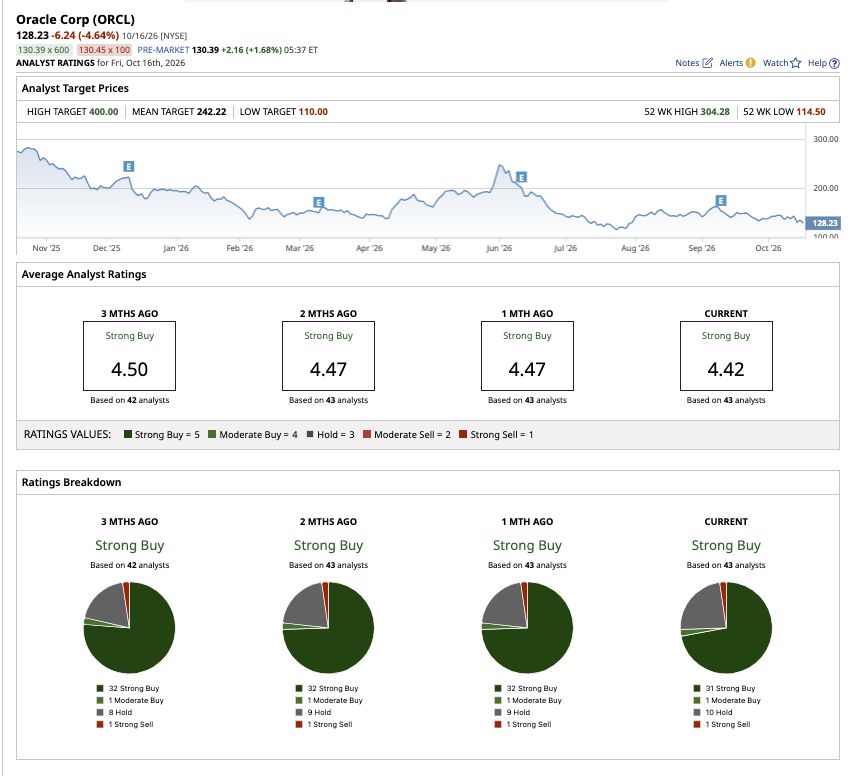
A majority of Wall Street analysts covering Oracle stock are strongly optimistic that it could bounce back. The average target price is $242.22, which points to an 88.9% potential gain. Some even see it reaching $400, a possible 212% increase from current levels.
To make this rebound last, rapid revenue growth and a large backlog are not enough. Investors want to see high spending and customer contracts turn into cash and that the company’s margins can bear the pressure of these massive investments. I feel cautiously optimistic about ORCL stock over the next three to five years, provided the company can convert its backlog into profitable revenue and meet its financing needs.
On Wall Street, around 31 analysts of the 43 covering the stock rate it a “Strong Buy,” while one says it is a “Moderate Buy,” 10 rate it a “Hold,” and one says it is a “Strong Sell.”
 www.barchart.com
On the date of publication, Sushree Mohanty did not have (either directly or indirectly) positions in any of the securities mentioned in this article. All information and data in this article is solely for informational purposes. For more information please view the Barchart Disclosure Policy here.
More news from Barchart
CoreWeave’s Debt Sparks AI Contagion Fears, But This Top Tech Investor Says Investors Are Missing Something Oracle Stock Is Falling as AI Spending Worries Mount. Most Analysts Think ORCL Could Rebound. What to Expect from SoFi’s Q3 Earnings Tesla’s Flying Car Isn’t the Game Changer Investors May Believe It Is