

If you want to know why so many investors end up getting caught flat-footed at market turns, you don’t need a complicated economic model. You just have to watch how the herd behaves.
According to Bank of America’s Global Fund Manager Survey, professional money managers are now more exposed to technology stocks than at any point since the initial rebound from the pandemic in August 2020.
Join 200K+ Subscribers: Find out why the midday Barchart Brief newsletter is a must-read for thousands daily.
Overweight allocations to the tech sector jumped from 30% to a net 37% in just one month. At the same time, global semiconductor stocks were officially crowned the market’s single most crowded trade.
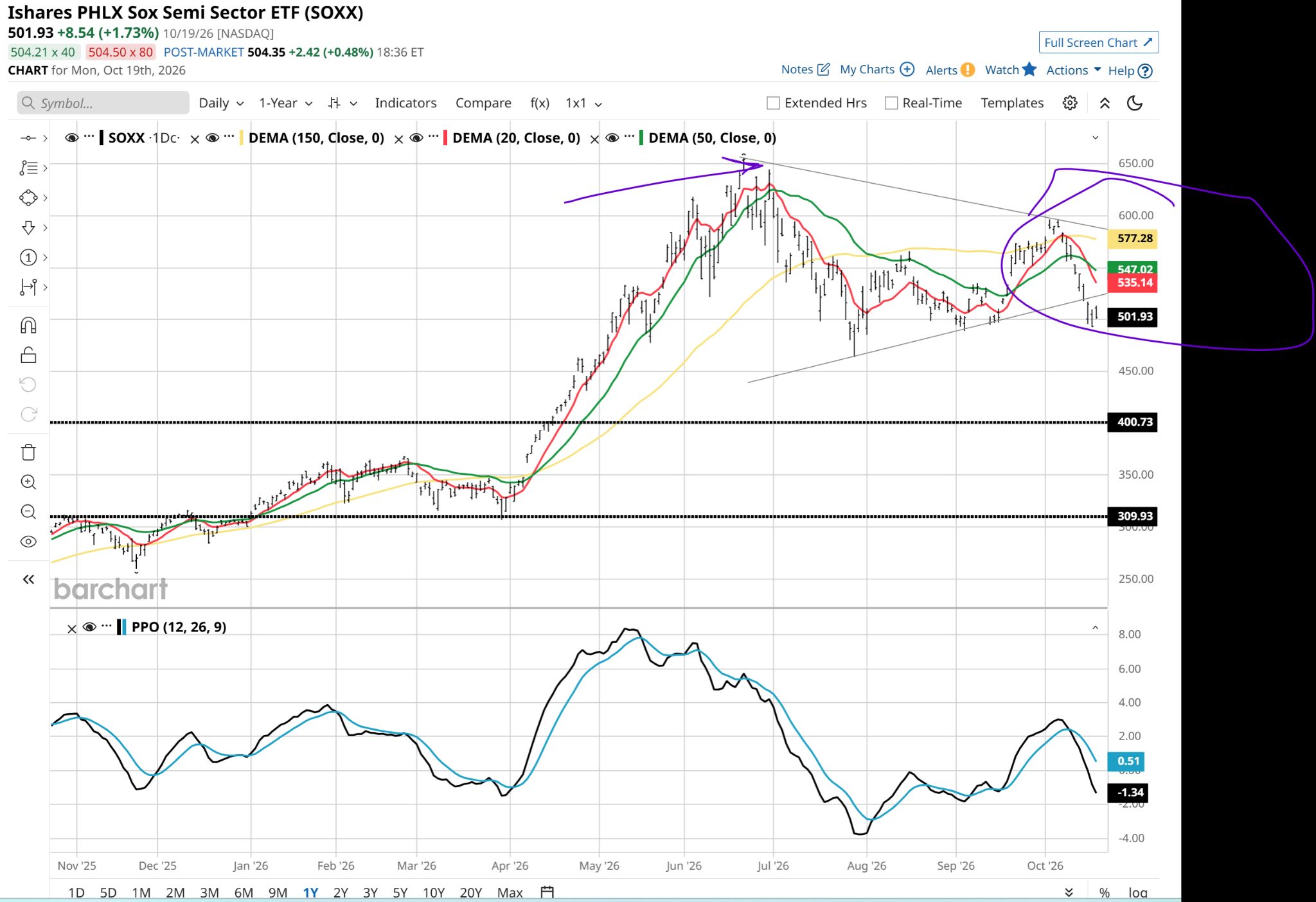
Here’s the popular iShares Semiconductor ETF (SOXX). I’ve maintained this chart for months, and I’ve seen my predictions come to life.
 www.barchart.com
Namely, I’ve seen SOXX consolidate into a smaller and smaller space, as semiconductor stocks marched toward a key decision point. The ETF broke down through that “wedge” just last Thursday. So there’s a shot at recovery, but the odds are getting longer by the day. The percentage price oscillator (PPO) indicator at bottom is not helping matters either. It recently moved into bearish territory.
Translation: Semiconductors, and thus technology stocks, are more than climbing a wall of worry. They are trying to rally to stay in a bull market. Time’s running out.
Thus, when 161 institutional managers overseeing nearly half a trillion dollars all squeeze onto the exact same side of the ship, active risk managers shouldn’t feel fear of missing out.
Here is the most astonishing statistic in the entire report: 45% of respondents agreed that an AI bubble will arrive by 2027, compared to 42% who said no.
Let that sink in. Nearly half of the institutional managers running other people’s money openly acknowledge that the artificial intelligence trade is inflating into a bubble. Yet, in the very same breath, they raised their tech exposure to a six-year peak.
It is not FOMO in the retail investor sense. It is more like FOEL: fear of earning less than their peers.
Why would anyone willingly pile into an asset they believe is forming a bubble? Two words: career risk.
In the institutional wealth management world, underperforming the benchmark during a melt-up is a fireable offense. If a fund manager sits in cash or bonds while tech surges another 10%, clients fire them for lagging the market. But if the entire market rolls over together in a brutal tech wipeout, the manager simply points to the S&P 500 Index ($SPX) and says, “Nobody could have seen this coming.”
On Wall Street, being wrong alone gets you fired. Being wrong in a crowd lets you keep your job. And that leaves zero room for error.
For all I write here about hedging, many investing pros can’t hedge. They have a “long-only” mandate. In other words, they can sell stocks, as long as they buy other stocks with the proceeds.
Now, it is generally acknowledged that even a slight pause in data center spending can cause a stock market avalanche. This is why the Invesco QQQ ETF (QQQ) takes it on the chin during days like last Friday. And the Dow Jones Industrial Average ($DOWI) skates through the week without much damage. So does the Invesco S&P 500 Equal Weight ETF (RSP).
The problem is that while non-tech stocks can pick up the slack for a little while, it tends not to last. The next phase of the decline is “all fall down.”
The survey revealed another fascinating detail: institutional investors are the least pessimistic on bonds since May 2025.
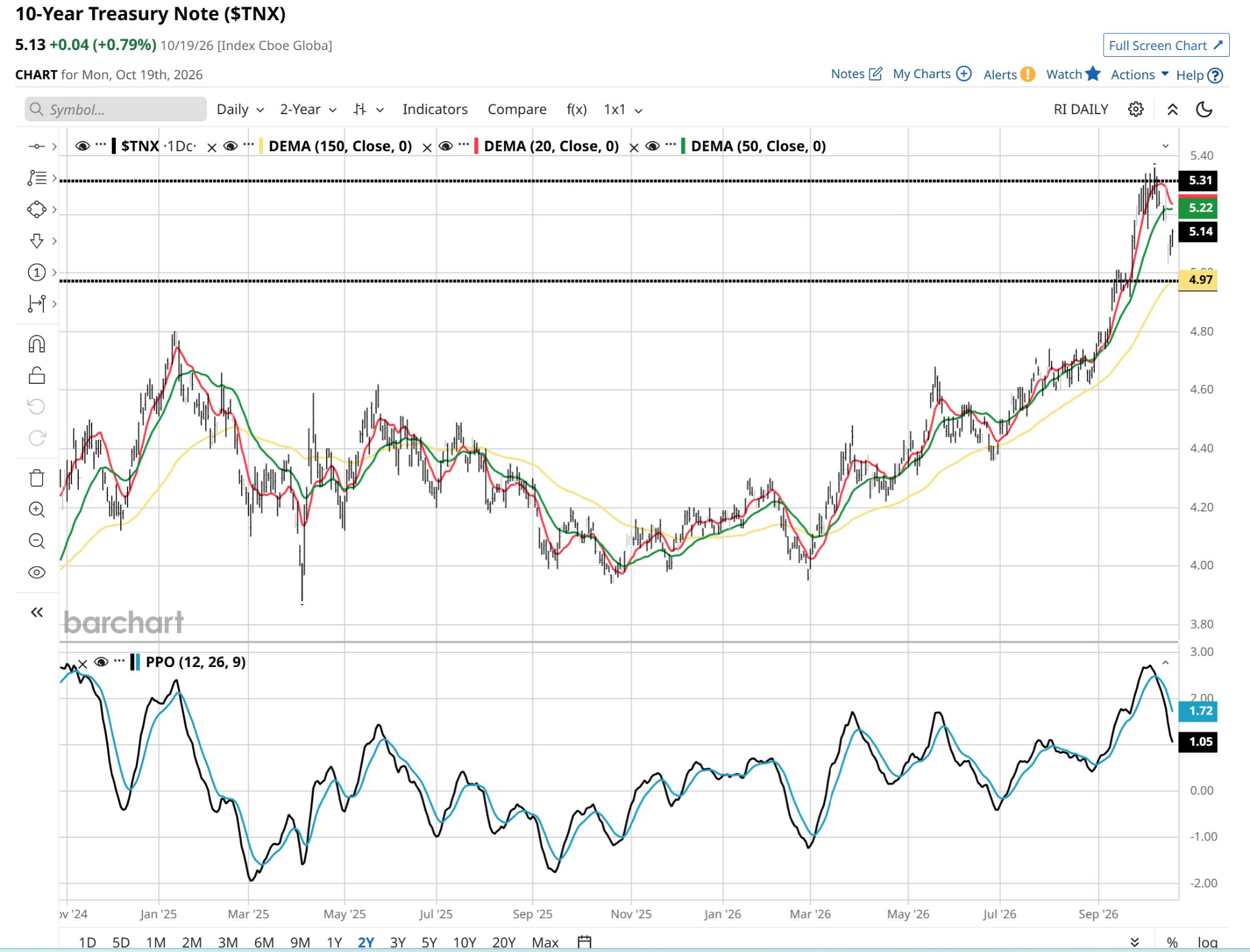
Roughly 37% of respondents said a 10-year Treasury yield hitting 6% would prompt them to rotate from stocks into bonds, while 19% said they are already shifting their money. The 10-year yield is hovering right around 5.1%.
 www.barchart.com
Presenting: The Elephant in the Room
There’s a good chance we don’t get to 6% anytime soon, if at all this decade. Thus, if rates peel back down sooner rather than later, all I’ve been filling my articles with about the “take 5” concept, with 5% being a solid long-term return for some segment of my portfolio, will be a winning approach. As I’ve also related here, I hedge my bond exposure, so that 5% aims to be a floor on the long-term total return. Not a peak.
Frankly, if nearly one-fifth of managers are already rotating and another third are preparing to pull the trigger, the dam in fixed income is already springing leaks. And rates could be pressured lower. What would really do it? A recession.
Again, my plan, as it relates to those key takeaways from the BOA survey:
Treat Tech Stocks as Rentals, Not Marriages: Trade the swings over weeks or months, but realize it is a crowded, speculative trade, not a buy-and-hold situation as in the past.
Don’t Be Bashful About Taking 5%: For part of a portfolio, I truly think it will be tough to beat 5% on a risk-adjusted basis from now through the end of this decade. The tech trade has just come too far, too fast. And if it does continue to run to the upside, taking 5% on a part of my portfolio only means I can pursue that remainder of the AI bubble with less capital at risk.
Rob Isbitts is a semi-retired CIO, former fiduciary investment advisor, Barchart columnist, and straight-talker. Download his new free e-book on hedged bond investing for retirement at ETFYourself.com. His research and model portfolios are at ROAR.PiTrade.com.
On the date of publication, Rob Isbitts did not have (either directly or indirectly) positions in any of the securities mentioned in this article. All information and data in this article is solely for informational purposes. For more information please view the Barchart Disclosure Policy here.
More news from Barchart
Smart Money Is Still Piling into Tech Stocks. Following It Is a Great Way to Be Caught Holding the Bag. Dear Future Anthropic IPO Investors, Mark Your Calendars for October 23 Nasdaq Futures Climb as SpaceX and Super Micro Provide a Boost; Meta and Tesla Earnings on Tap U.S. Farm Debt Hits a Record $605 Billion — And an $8 Billion Bailout Covers Just 1.3% of the Tab