


Tesla, Inc. (TSLA) delivered strong, positive free cash flow (FCF) on Oct. 21, even though analysts had projected negative FCF after a negative Q2. If this keeps up, as management suggested, TSLA could be undervalued.
TSLA closed at $372.22 on Friday, Oct. 23, down slightly. It was up to $386.47 on Oct. 21 before the earnings release. But is it too cheap now?
More Top Stocks Daily: Go behind Wall Street’s hottest headlines with Barchart’s Active Investor newsletter.
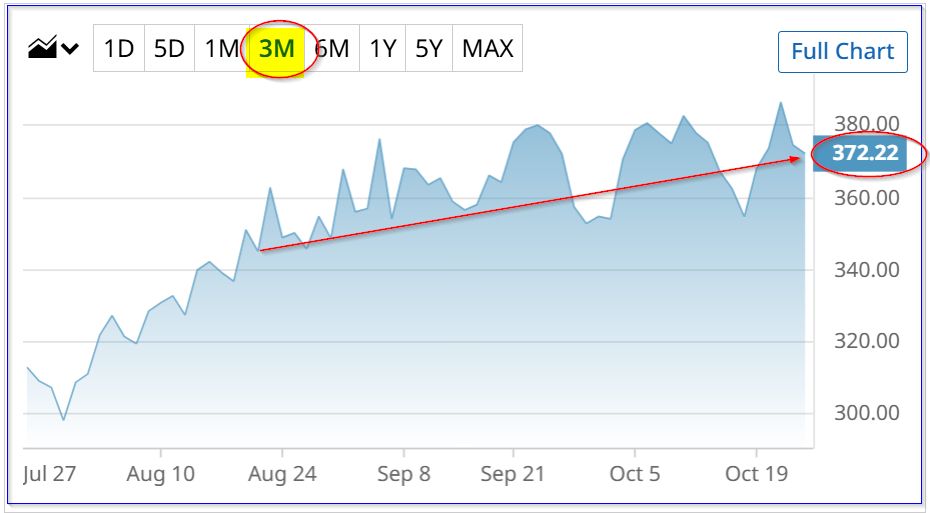 TSLA stock - last 3 months - Barchart - Oct. 23, 2026
Strong FCF Performance
Tesla generated $1.531 billion in FCF during Q3, up from -$1.092 billion last quarter but down from $3.99 billion last year. This is shown on page 5 of its Shareholder Deck.
The strong Q3 performance was from higher operating cash flow (OCF) and lower capital expenditure ("capex") compared to Q2.
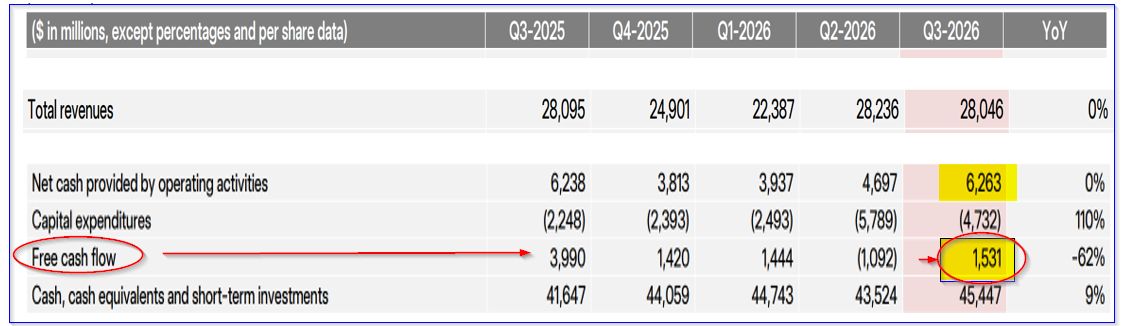 Tesla's Q3 FCF - Shareholder deck - page 5 - Oct. 21, 2026
Note also that the FCF margin has stayed strong. In Q3, it was 5.46%, close to Q1's 6.45% and 5.70% in Q4 2025.
And don't forget. Analysts were projecting negative $4.5 billion in FCF for Q3. That is shown on the company's earnings consensus page.
Management indicated that they expect capex to be lower this year at $20 billion. That's down from $25 billion in last quarter's conference call. So, since there has already been just $13 billion in capex this quarter, it implies that Q4's capex will be $7 billion. That's a huge increase.
This could account for some of the weakness in TSLA stock, despite the positive FCF. But let's look at that more carefully.
Forecasting FCF
One bright spot is that its Q3 operating cash flow (OCF) margin has increased dramatically. In Q3, it rose to 22.3% of revenue, up from 16.6% in Q2, 17.6% in Q1, and 15.3% in Q4 2025.
Therefore, it means that capex could keep rising and FCF could still stay strong.
For example, analysts are now projecting revenue will rise 13.4% next year to $122.1 billion, up from $107.7 billion forecast for 2026. (Note: $20b in 2026 capex would be 18.6% of sales).
So, if Tesla makes 23% OCF margins, operating cash flow could exceed $28 billion (i.e., $122.1b OCF x 0.23 = $28.08 billion). Assuming capex rises to 20% of sales, it would be almost $25 billion ($24.4 billion) in 2027.
As a result, FCF would become:
$28.08 billion OCF - $24.4 billion capex = $3.58 billion FCF
That seems low. For example, at a 25% OCF margin, a small increase in margin, FCF will rise to $6.125 billion. Moreover, if capex rises just 10% to $22 billion, FCF would be $2.4 billion higher at $8.525 billion.
The point is that FCF could range between $3.6 billion and $8.5 billion next year, even with higher capex spending. If revenue or OCF margins surprise on the upside, then FCF could be higher.
Conclusion and Summary
The bottom line is that analysts' lowball FCF projections will have to be redone. For example, the average price target (PT) at Yahoo! Finance is just $408.36, about 10% higher.
But if Tesla can generate $8.5 billion in FCF, that could lead to much higher FCF later as the spending pays off. As a result, its value could appreciate significantly.
On the date of publication, Mark R. Hake, CFA did not have (either directly or indirectly) positions in any of the securities mentioned in this article. All information and data in this article is solely for informational purposes. For more information please view the Barchart Disclosure Policy here.
More news from Barchart
Dell, Lenovo, Cisco, HPE, Supermicro: Why AMD’s New AI Blueprint Has Everyone Signing On Tesla Delivers Strong Free Cash Flow, Surprising Analysts - Is TSLA Undervalued? A $1.3 Billion Reason to Buy Amkor Stock Marvell’s Road to $90B: The 3 Moves Behind the Boldest Target in AI Chips