

A key argument often put forth against Oracle (ORCL) optimists was that the company's thriving cloud business stood on one strong pillar — OpenAI. The recently held Oracle World AI conference went some way to dispel that notion when the company extended partnerships with some of the key players of the AI industry, which included chipmakers and hyperscalers.
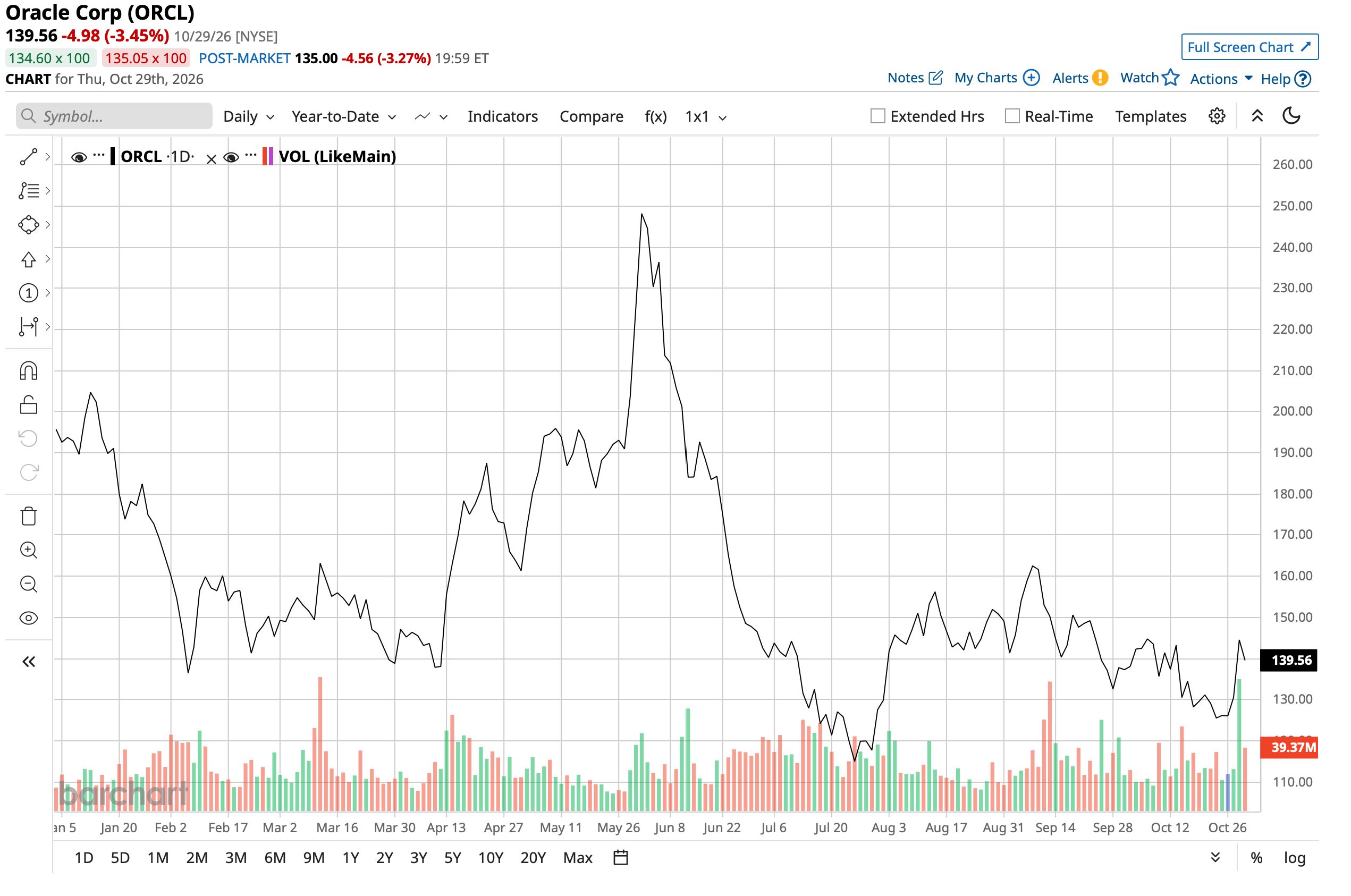
Shares are up about 11% since the conclusion of the conference, with Oracle inking deals with the likes of Nvidia (NVDA), OpenAI, Google (GOOG) (GOOGL), Cerebras (CBRS), Snowflake (SNOW), and Intel (INTC). However, shares are still down 28.4% on a YTD basis as the company's market cap stands at $437.1 billion.
More Top Stocks Daily: Go behind Wall Street’s hottest headlines with Barchart’s Active Investor newsletter.
 www.barchart.com
What Went Down At Oracle AI World?
Even though Oracle did forge renewed partnerships with many, the most eye-catching one remained the one with OpenAI. Oracle announced deeper integration of OpenAI models, ChatGPT and Codex across its applications, database and cloud offerings, with announced products including an AI Workspace for accessing Oracle software through ChatGPT, an App Composer for building applications, security capabilities, and a small-business bundle.
Oracle also announced Oracle AI Security Mesh, a managed cybersecurity service that uses OpenAI's advanced cyber models to help identify and remediate vulnerabilities across applications and infrastructure. The offering is designed to work across Oracle Cloud Infrastructure (OCI), other cloud platforms and on-premises environments.
Strategically, these could help Oracle earn more from enterprise AI adoption rather than relying primarily on supplying computing capacity. Yet, the counterweight is that OpenAI is already a major infrastructure customer, so deeper integration is not equivalent to diversifying that exposure.
Then, an industry-first phenomenon occurred when the company announced that Google’s TPUs would become available on Oracle Cloud Infrastructure in calendar 2027, making OCI the first hyperscale cloud outside Google to offer them, with deployment ramping over several years, as Oracle looks to reduce dependence on Nvidia for chips.
However, the chip leader was a feature at the conference as Oracle also announced expanded Nvidia Vera Rubin supercluster plans and additional offerings involving Cerebras (CBRS) and SambaNova, while Snowflake’s data platform was announced as a native Oracle service.
Yet, ORCL stock essentially soared on news related to the company's financial position.
At its Investor Day on October 28, Oracle set a target of more than $225 billion in total revenue by fiscal 2030, alongside a non-GAAP operating margin of at least 40% and non-GAAP earnings per share of more than $21. Management expects revenue to compound at more than 35% annually between FY2026 and FY2030. For context, Oracle generated $67.4 billion in revenue in FY2026, up 17% year over year. The new outlook therefore implies a substantial acceleration in growth, driven by the combination of cloud infrastructure, databases and enterprise applications.
Moreover, Oracle expects free cash flow to turn positive in the second half of FY2028, followed by at least $30 billion in free cash flow in FY2029, while committing to limit additional capital-market funding through FY2030 to $20 billion, excluding refinancing of existing debt, comprising approximately $10 billion in equity and $10 billion in gross debt.
Finally, the company expects its growth to become self-funded from FY2029 and net debt to adjusted EBITDA to fall below 3.5 times that year.
Q1 Can Be a Solid Base to Build Upon
Granted, Oracle's latest results may not have alleviated all concerns around the company. Yet, it can be a start. A very good one at that.
In the first quarter, Oracle delivered record revenue of $19.34 billion, representing a 30% increase from the prior year and surpassing Street estimates by $215.9 million. Total cloud revenue, which now accounts for 60% of overall company revenue compared with 48% a year earlier, reached $11.61 billion, up 62% year over year.
OCI, the company’s primary growth focus, more than doubled its revenue to $7.4 billion. Momentum accelerated after management disclosed that it had brought online an additional 850 megawatts of data center capacity while tripling the number of graphics processing units delivered in the fourth quarter of fiscal 2026 to 300000.
Remaining performance obligations a key measure of future demand, continued to climb, rising 31.5% year over year to $664 billion. This marked the ninth consecutive quarter of RPO growth, and the company expects roughly half of the total to convert into revenue over the next three years.
Earnings per share advanced 30% to $1.92, exceeding the consensus estimate of $1.74. The result represented the fourth straight quarter of earnings beats. Although gross margins declined to 60% from 67% a year earlier, reflecting the costs of expanding data center infrastructure, operating margins held steady at 42%. Capital expenditures increased sharply to $28.5 billion from $8.5 billion in the year-ago period as construction continues at full pace across sites in Texas, New Mexico, Wisconsin, and Michigan.
Net cash from operating activities remained strong at $23.1 billion, up 185.2% year over year. Free cash flow, however, stayed negative at $5.4 billion, widening from $1.9 billion in the prior sequential period. Oracle closed the first quarter with $36.4 billion in cash, well above its short-term debt of $7.6 billion. Total debt nevertheless exceeded $156 billion while interest expense rose 55% from the previous year to $1.4 billion.
The company raised its full-year earnings per share guidance to $8.10 from the $8.05 outlook provided earlier in the fourth quarter of fiscal 2026. Total revenue guidance of $90 billion was left unchanged.
For the second quarter of fiscal 2027, Oracle expects revenue growth of 30% to 34% year over year and earnings per share between $1.85 and $1.93, with the midpoint aligning with the consensus estimate of $1.89.
The subdued performance of the stock this year has brought Oracle’s valuation to attractive levels. The forward price-to-earnings ratio of 18.46 times and price-to-cash-flow multiple of 7.71 times both sit below the respective sector medians of 22.46 times and 19.75 times. The forward price-to-sales ratio of 5.02 times stands only modestly above the sector median of 3.37 times.
Analyst Opinion
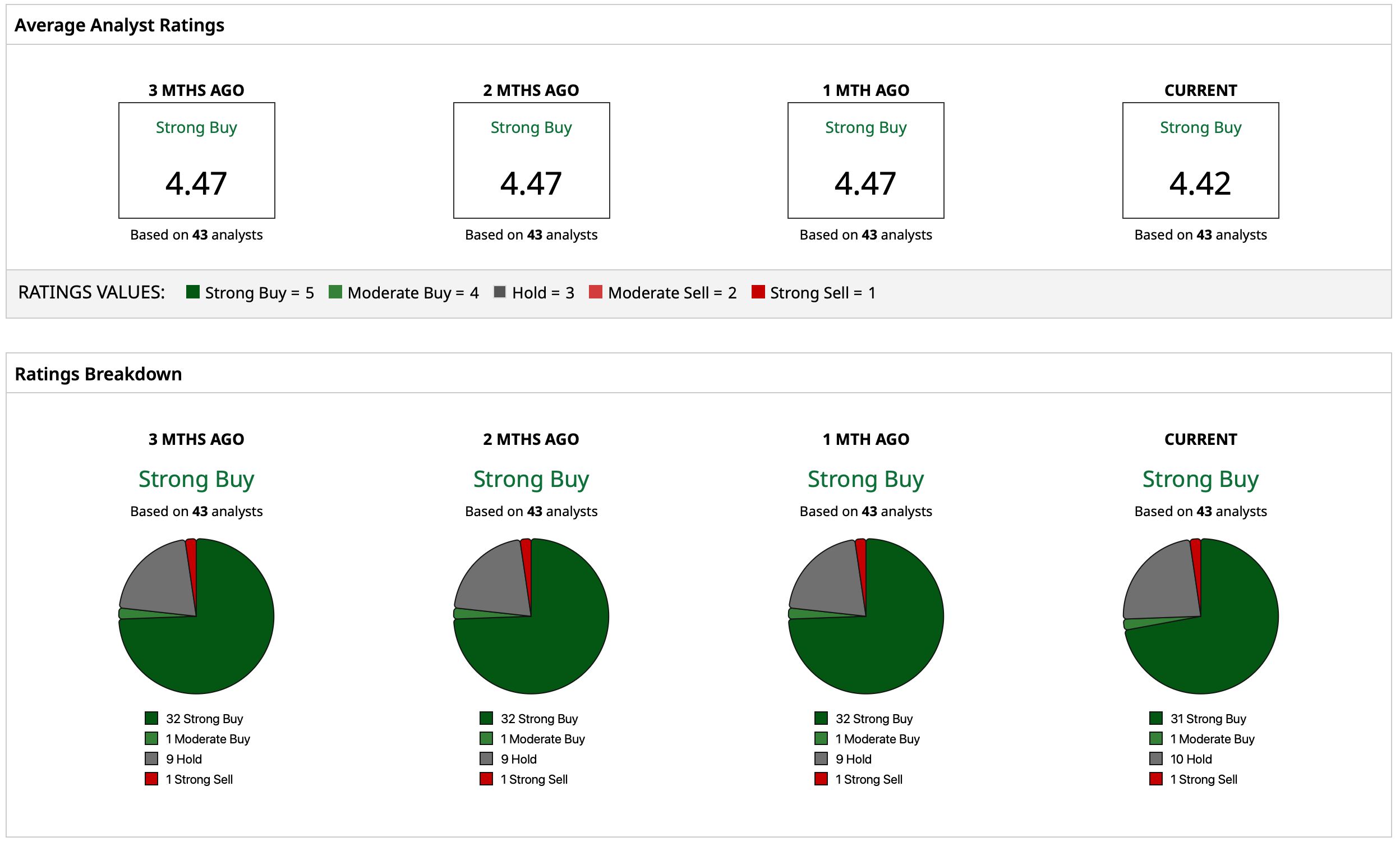
Thus, analysts have deemed ORCL stock to be a “Strong Buy” with a mean target price of $240.66, which denotes a potential upside of 72.4% from current levels. Out of 43 analysts covering the stock, 31 have a “Strong Buy” rating, one has a “Moderate Buy” rating, 10 have a “Hold” rating, and one has a “Strong Sell” rating.
 www.barchart.com
On the date of publication, Pathikrit Bose did not directly have a position in any of the securities mentioned in this article. All information and data in this article is solely for informational purposes. For more information please view the Barchart Disclosure Policy here.
More news from Barchart
If Taiwan Semi Raises Prices, It Could Be Bad News for Intel Stock. Here’s Why. Why Wedbush Is Betting Big on SK Hynix Stock After Earnings Lumentum Jumped on Reports Marvell Is in Late-Stage Talks to Acquire the Company. LITE Stock Is a Buy No Matter What. Regeneron Stock Just Hit a 2-Year High. Here's Why.