

Oct. 22 was one of the worst days of the year for chip stocks. The Philadelphia Semiconductor Index ($SOX) fell 6.7%, its biggest drop since June. Intel (INTC) and AMD (AMD) each lost more than 8% even though neither company had any news that day. Instead, the selloff was triggered by chip equipment maker Lam Research (LRCX) warning that the supply bottlenecks were limiting its shipments. Meta's (META) results also added to the pressure. Its heavy AI spending pushed free cash flow negative for the first time in more than a decade. Both these factors made investors nervous about the AI trade again.
Fast forward a week, on Oct. 29, Intel reported its earnings, and things went from bad to worse. The company beat its guidance, and its data center business grew 78%. However, it guided a weak Q4 outlook, and the stock crashed about 29% in a day, its worst day in over 50 years. This made a direct impact on AMD too. Intel warned about weak PC demand and tight supply. And since AMD also sells PC chips and is struggling to make enough server chips, that was enough to drive another selloff. AMD's stock fell almost 11% in a single trading session.
More Top Stocks Daily: Go behind Wall Street’s hottest headlines with Barchart’s Active Investor newsletter.
AMD reports earnings tomorrow, Nov. 3. It guided about $13 billion in Q3 revenue, which is a growth of 41% year-over-year (YoY) and 13% from the last quarter. So it has a higher bar to clear than Intel, which guided roughly flat and ended up beating its own guidance for the eighth straight quarter.
What Do Intel’s Problems Mean for AMD?
One of the issues Intel is facing is that it can't make enough Xeon server chips. I think this could be an opportunity for AMD, since customers may turn to its EPYC chips. But AMD has supply limits too. As I covered earlier, like Intel, AMD is nearly sold out of high-core chips, so it can't simply take every customer Intel can't serve.
There's a lot riding on AMD's earnings report. Investors will be interested to see its data center business growing. But we saw that Intel's data center had its best growth in 15 years and that wasn't enough to save the stock. What will matter more is its Q4 guidance, any comments from management on PC demand, and early Helios deployments. Helios, AMD's full AI server rack, was expected to begin shipping at the end of Q3. So investors will want an update on shipments and how fast the rollout is going.
About AMD Stock
Advanced Micro Devices is a semiconductor company that designs high-performance chips for data centers, PCs, and gaming. Its product portfolio includes EPYC server CPUs and Instinct AI GPUs, which drive its data center growth, along with Ryzen processors. Its EPYC server chips compete directly with Intel's Xeon, which is why Intel's warning hit AMD's stock too. Founded in 1969, the company is headquartered in Santa Clara, California.
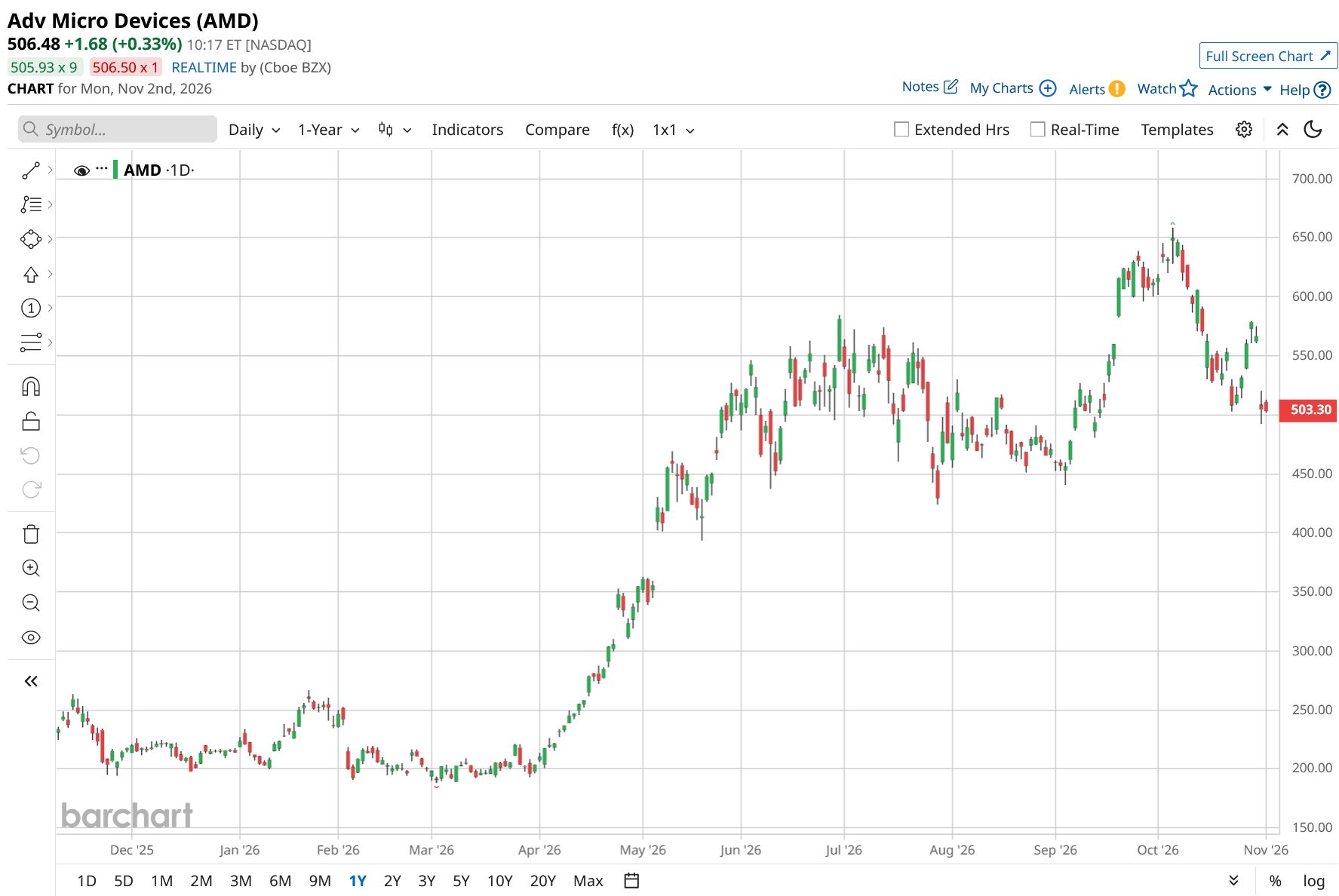
AMD stock is up about 97% over the past year as investors now see it as a serious challenger to Nvidia (NVDA) in AI chips. Large orders from OpenAI, Meta, and Anthropic, booming data center sales, rapid profit growth, and tight chip supply have lifted its prospects. Over the past six months, the stock has gained 40%. It reached a 52-week high of $658 in early October, but is down roughly 23% from that level.
 www.barchart.com
Growth Story Is Getting Bigger
Advanced Micro Devices reported its second-quarter fiscal 2026 earnings on Aug. 4. In the second quarter, the company’s data center revenue rose 107% year-over-year (YoY) to $6.7 billion, as its AMD EPYC processors and AMD Instinct GPUs continued to see strong demand. AMD’s total revenue rose 50% YoY to $11.54 billion, above the $11.28 billion Wall Street analysts expected. AMD also highlighted that data center operations account for 58% of its topline. Hence, while the client and gaming segment grew modestly, the data center segment more than made up for it.
Looking forward, the company expects revenue to be approximately $13 billion in Q3. Non-GAAP gross margin is expected to be 56%, with non-GAAP operating expenses to be approximately $3.65 billion. The company sees strong customer demand in server CPUs and expects revenue to grow more than 80% YoY in the second half of 2026 and more than 70% for the full year 2027.
What Do Analysts Expect for AMD Stock?
In October, Susquehanna raised the firm’s price target on AMD stock from $550 to $620 and kept a “Buy” rating. Ahead of semiconductor companies’ earnings reports, the firm expects most companies to slightly beat Q3 earnings expectations and provide stronger-than-expected guidance for Q4.
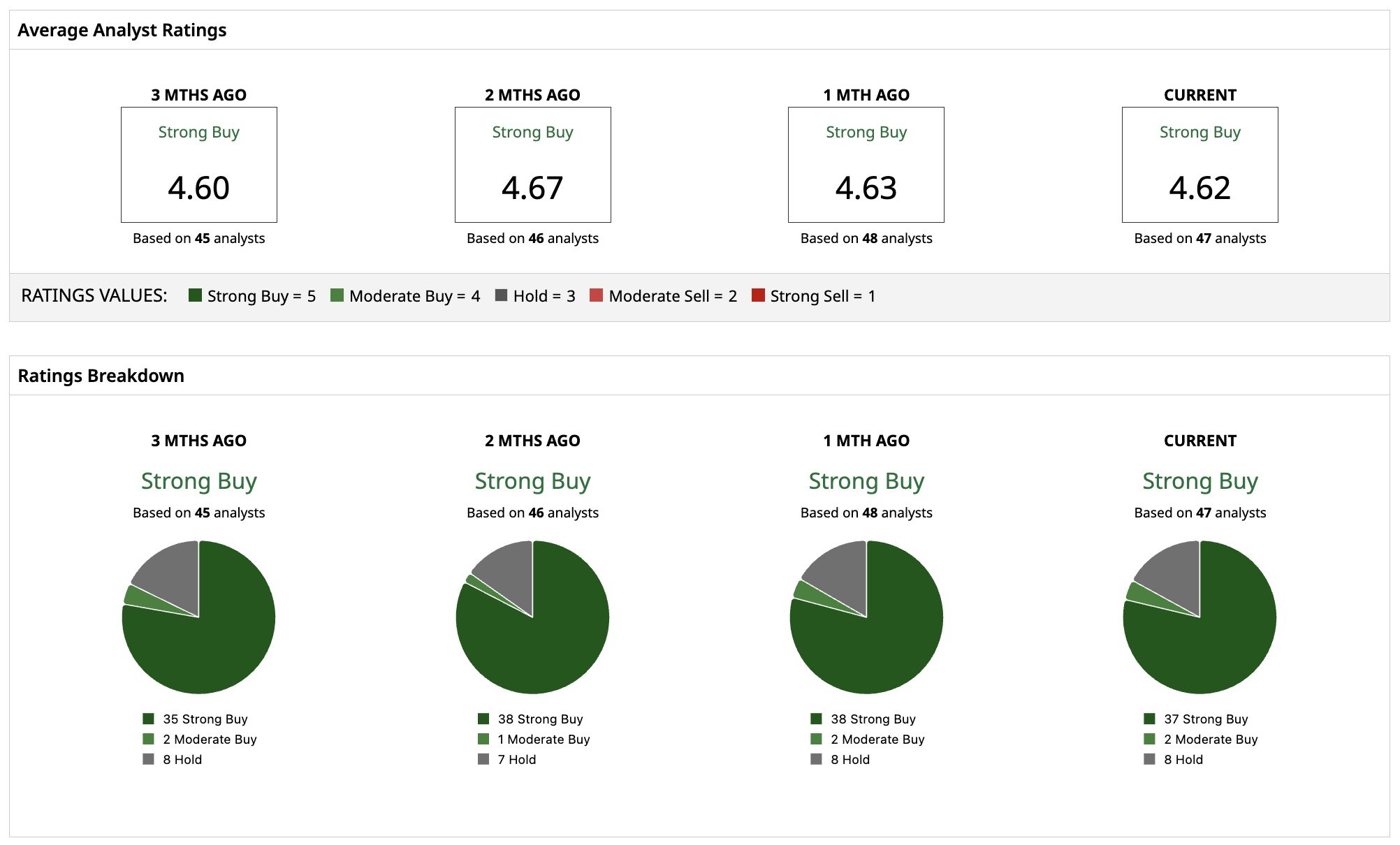
Chip giant AMD is a widely followed name on Wall Street, with analysts awarding it a consensus “Strong Buy” rating. Of the 47 analysts rating the stock, a majority of 37 analysts have given it a “Strong Buy” rating, two analysts rated it “Moderate Buy,” and eight analysts are taking the middle-of-the-road approach with a “Hold” rating. The mean price target of $656.12 represents a 30% upside from current levels.
 www.barchart.com
On the date of publication, Jabran Kundi did not directly have a position in any of the securities mentioned in this article. All information and data in this article is solely for informational purposes. For more information please view the Barchart Disclosure Policy here.
More news from Barchart
3 Cash Cow Stocks I Like Better Than Anthropic Heading into a Historic IPO Bill Ackman Isn’t Sweating Meta Platforms’ AI Spending. In Fact, He Says META Stock Is ‘Incredibly Undervalued.’ Dan Ives Thinks Apple’s New MacBook Pro Is a Positive Move with Q4 Earnings Almost Here Anthropic Takes Aim at Wall Street’s 1% Fee Machine With ‘Claude For Financial Advisors.’ Here’s What I Think as a Former Advisor.