

Alibaba Group (BABA) is no longer just the Chinese online shopping giant most investors remember. The company has been building a much bigger presence in cloud computing and artificial intelligence (AI), and now its chip business is getting its moment in the spotlight. T-Head, Alibaba’s homegrown chip design unit founded in 2018, develops data center processors and AI chips to support the company’s growing ambitions in AI computing.
Now, Alibaba wants to give this chip business its own stage. The company is moving ahead with plans to spin off T-Head through a proposed Hong Kong IPO after the exchange cleared the confidential listing application submitted on Sept. 11. While the offering could reportedly raise $2 billion to $3 billion, Alibaba has yet to disclose the deal’s size, valuation, or timing. T-Head is also expected to remain under Alibaba’s umbrella after the listing.
More Top Stocks Daily: Go behind Wall Street’s hottest headlines with Barchart’s Active Investor newsletter.
Until now, T-Head’s value has been tucked inside Alibaba Cloud, making it difficult for investors to figure out how much this chip business is really worth. A separate listing could finally put a number on it and potentially bring some of that hidden value into focus. The timing is hardly boring either, with U.S.-China chip tensions back in the headlines, growing demand for homegrown AI processors, and the recent Nvidia (NVDA)-related controversy adding more attention to the semiconductor space.
With T-Head preparing for a possible market debut, investors have another reason to revisit Alibaba. But is the potential IPO enough to make BABA stock worth a closer look? Let’s find out.
About Alibaba Stock
Headquartered in Hangzhou, China, Alibaba Group is a global technology conglomerate with a market capitalization of approximately $252.6 billion. Established in 1999 by Jack Ma and 17 other co-founders, the company initially focused on helping Chinese exporters connect with international buyers through its online wholesale marketplace.
Over the years, it has expanded into several areas of the digital economy. Its business portfolio includes Taobao and Tmall for China's retail market, Alibaba.com for wholesale trade, and AliExpress and Lazada for international shoppers.
The group also has operations in logistics, digital entertainment, and consumer services. On the enterprise side, Alibaba Cloud offers computing infrastructure and technology solutions, while its growing AI business focuses on advanced computing, large language models (LLMs), and AI-powered applications. With businesses serving both individual consumers and corporate clients, Alibaba has developed into one of China’s largest technology groups, extending well beyond its original e-commerce roots.
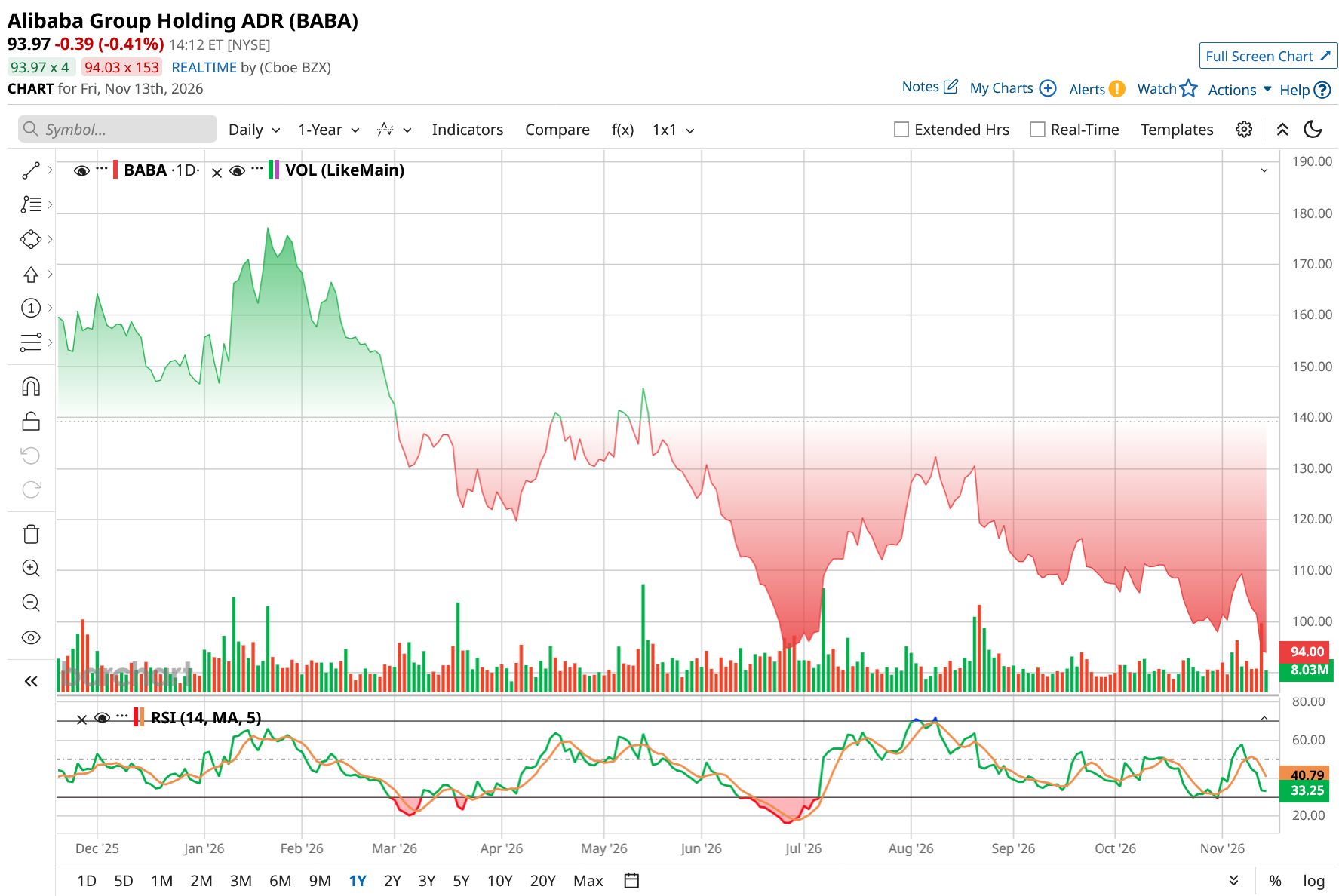
But Alibaba’s growing presence in AI has not translated into happy days for its shareholders. BABA stock fell 41% over the past 52 weeks and 36% year-to-date (YTD). It is also trading over 48% below its January 52-week high of $181.10. That’s quite a slide for a company trying to establish itself as a major player in the AI race.
Several factors have kept investors on edge, including fierce e-commerce competition in China, rising AI infrastructure costs, tighter U.S. chip export restrictions, and regulatory pressure across China’s e-commerce and cloud sectors.
The latest blow came on Thursday, when BABA stock dropped another 7% as Chinese AI stocks faced broader selling pressure. Investors were particularly concerned about tighter U.S. scrutiny of advanced Nvidia chips and the possibility that restrictions could limit Chinese cloud providers’ access to computing power. UOB Kay Hian analyst Julia Pan told Bloomberg that Chinese cloud companies had stockpiled chips since early 2026, but prolonged restrictions could still delay AI research and development. With earnings approaching, investors have another reason to stay cautious.
And the charts are not telling a happier story either. BABA stock is trading at $94.36, well below its key 9-day, 18-day, and 40-day moving averages, suggesting that the selling pressure is still very much in play. The 14-day RSI has slipped to around 34, down from overbought territory in August and getting closer to the oversold threshold of 30. Buyers have not found much reason to jump back in yet.
On valuation, BABA trades at just 15.3 times forward adjusted earnings, below the sector median. With profits expected to grow next fiscal year, the discount could catch investors’ attention.
 www.barchart.com
Taking a Closer Look at the Q1 Report
Alibaba Group delivered a mixed fiscal first-quarter performance on Aug. 20. While revenue growth remained healthy, supported by AI and cloud services, rising infrastructure spending put considerable pressure on profitability. Revenue increased 9% year-over-year (YoY) to $39.6 billion, reflecting steady demand for its enterprise technology offerings and growth in international commerce. However, intense competition continued to weigh on parts of its domestic retail business.
E-commerce remained Alibaba’s biggest revenue contributor, bringing in RMB 205.9 billion ($30.9 billion), up 4% YoY. China Quick Commerce, which includes Taobao Instant Commerce, Freshippo, and other on-demand delivery services, was a bright spot, with revenue jumping 45%. However, China E-commerce revenue declined 8%, showing that growth across its domestic businesses remained uneven.
Alibaba Cloud was another major growth engine, with external revenue surging 45%. AI-related product revenue also maintained its strong momentum, recording triple-digit growth for the 12th consecutive quarter. But all that AI enthusiasm came with a hefty price tag. Adjusted net income plunged 39% YoY to $3.1 billion, while non-GAAP earnings per ADS fell 42% annually to $1.26.
Capital expenditure climbed 75% to RMB 67.7 billion ($10 billion), compared with RMB 38.7 billion in the year-ago quarter. Alibaba attributed the increase to investments in AI infrastructure to keep up with growing customer demand. Higher spending reflected changing procurement cycles, additional CPU computing capacity in anticipation of wider AI agent adoption, and rising prices for various chip components.
Cash flow told a similar story. Free cash flow recorded an outflow of RMB 44.7 billion ($6.6 billion), compared with an outflow of RMB 18.8 billion in the same quarter last year. The deterioration was primarily driven by higher cloud infrastructure spending. Still, Alibaba had a financial cushion, ending June 30, 2026, with $69.9 billion in cash and other liquid investments.
Alibaba is set to report its Q2 results for the quarter ended Sept. 30, 2026, before the market opens on Thursday, Nov. 19. Analysts expect Q2 revenue to reach $40.4 billion, while EPS is projected to jump 254.6% YoY to $1.56. The earnings momentum is also expected to carry into the coming years, with fiscal 2027 EPS forecast to climb 82.4% annually to $5.89, followed by another 38.5% increase to $8.16 in fiscal 2028.
What Do Analysts Expect for BABA Stock?
Analysts largely see the proposed spin-off as a potential value-unlocking move for Alibaba. Jefferies analysts Thomas Chong and Zoey Zong believe taking T-Head public would allow the chip business to raise capital independently while giving investors a much clearer idea of what it is actually worth. It could also make Alibaba’s remaining business easier to evaluate, rather than having investors figure out T-Head’s contribution within the larger group.
Morgan Stanley analysts, meanwhile, see another advantage. They believe T-Head’s in-house chip capabilities could reduce Alibaba’s dependence on external suppliers, setting it apart from other Chinese hyperscalers that rely more heavily on outside chip providers.
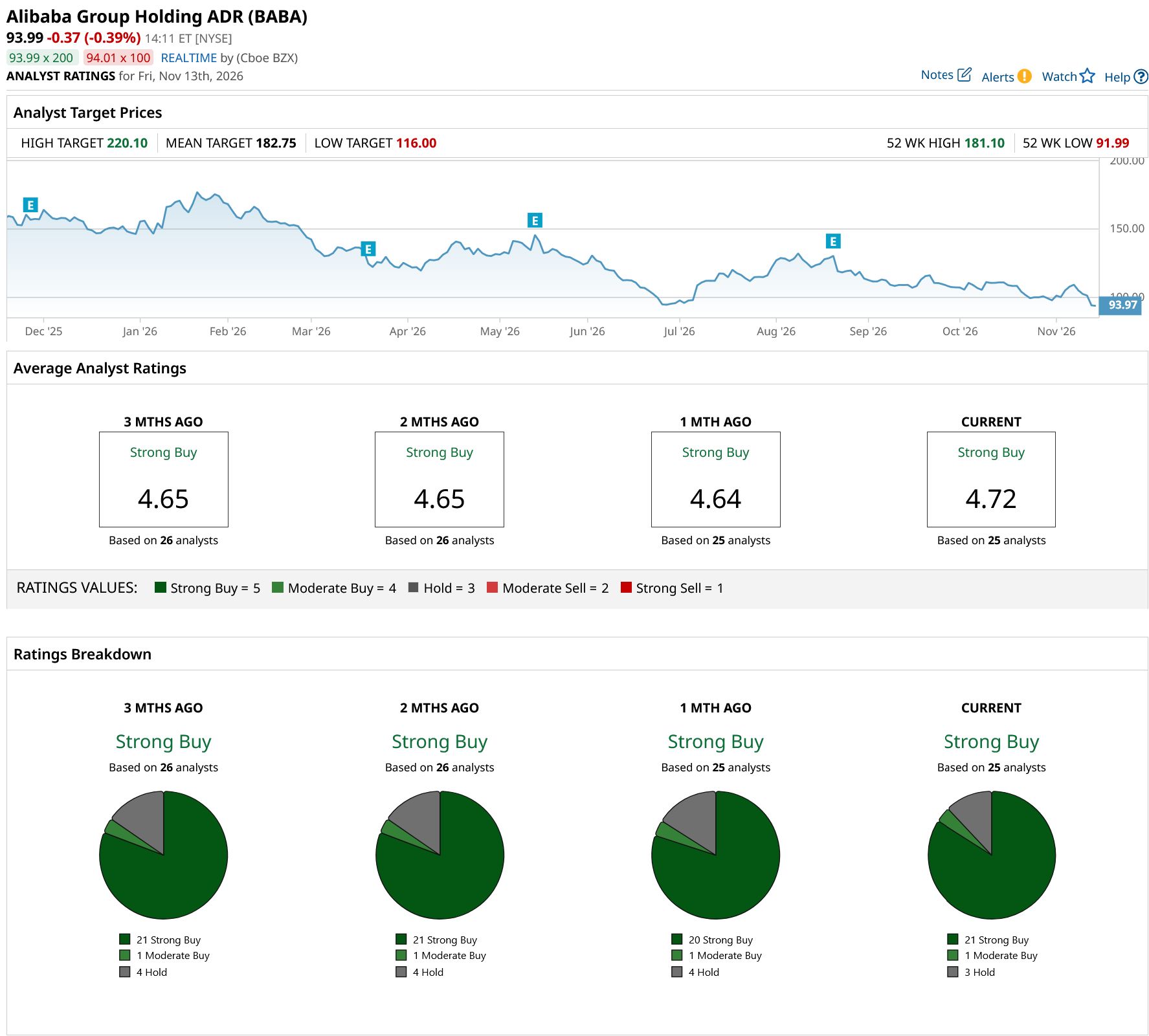
Overall, analysts are upbeat, with BABA stock currently rated a consensus “Strong Buy.” Of the 25 analysts covering the stock, 21 suggest a “Strong Buy,” one advises a “Moderate Buy,” and three recommend a “Hold” rating.
The mean price target of $182.75 suggests the stock could surge by 94% from the current price levels. The Street-high target of $220.10 represents a potential upside of 134%.
 www.barchart.com
On the date of publication, Sristi Suman Jayaswal did not directly have a position in any of the securities mentioned in this article. All information and data in this article is solely for informational purposes. For more information please view the Barchart Disclosure Policy here.
More news from Barchart
How to Play Alibaba Stock Ahead of Its T-Head Spinoff and IPO Nvidia is Extraordinarily Undervalued Ahead of its Earnings on Tuesday - Has NVDA Bottomed? Broadcom Stock Jumps as Nvidia’s Leadership Crisis Raises a Billion-Dollar Opportunity for Its AI Chip Business Dear VeriSign Stock Fans, Mark Your Calendars for December 10