

Nike (NKE) needs no introduction. From the basketball court to the neighborhood running track, the Swoosh has pretty much stamped its logo everywhere. It may be the king of the sportswear game, but its stock is hardly wearing a crown these days. Shares are hovering near levels last seen in 2014, as declining sales, sluggish product innovation, and fierce competition take a toll. Persistent inflation has made consumers more cautious, while Chinese rivals are eating into Nike’s once-dominant position in China. Its fiscal Q1 2027 report only added fuel to the fire, with falling revenue and another sharp decline in Greater China dragging sentiment down.
CEO Elliott Hill is trying to turn things around by trimming the workforce, reorganizing global operations, modernizing the supply chain, and rolling out the Pace transformation program, which targets $2.5 billion in cumulative savings through fiscal 2031. Still, Wall Street wants more than promises and cost-cutting headlines.
More Yield, Less Trap: Sign up free to get Barchart’s daily Dividend Investor newsletter straight to your inbox.
That’s why Nov. 17 deserves a spot on every Nike investor’s calendar. The Swoosh is finally bringing Wall Street back to the table for its first Investor Day in nine years, following its last gathering in October 2017. Plus, the event matters because Nike hasn’t laid out a fresh multiyear financial framework since 2021.
CEO Elliott Hill is expected to lay out a fresh five-year roadmap through fiscal 2031. After years of falling sales and a bruised stock price, investors want a game plan, some hard numbers, and a reason to believe the comeback is finally underway. More specifically, investors want answers on how Nike plans to revive demand beyond performance footwear, get China back on track, stabilize the Jordan Brand, and turn its cost-saving ambitions into measurable results.
Here’s what investors should watch ahead of Nike’s big Nov. 17 event.
About Nike Stock
Founded in 1964 by Bill Bowerman and Phil Knight as Blue Ribbon Sports, Nike has come a long way from its humble beginnings. The company adopted the Nike name in 1971 and has since turned itself into one of the biggest players in the global sportswear game.
Headquartered in Beaverton, Oregon, Nike designs, develops, markets, and sells athletic footwear, apparel, sports equipment, accessories, and consumer services. Its portfolio spans major brands like Nike, Jordan, and Converse, covering everything from performance sneakers and lifestyle apparel to bags, socks, and sports gear. It also runs digital fitness platforms and sport-focused experiences. With a market capitalization of approximately $56.4 billion, Nike remains a household name. But as investors are discovering, a famous logo does not always guarantee a winning stock.
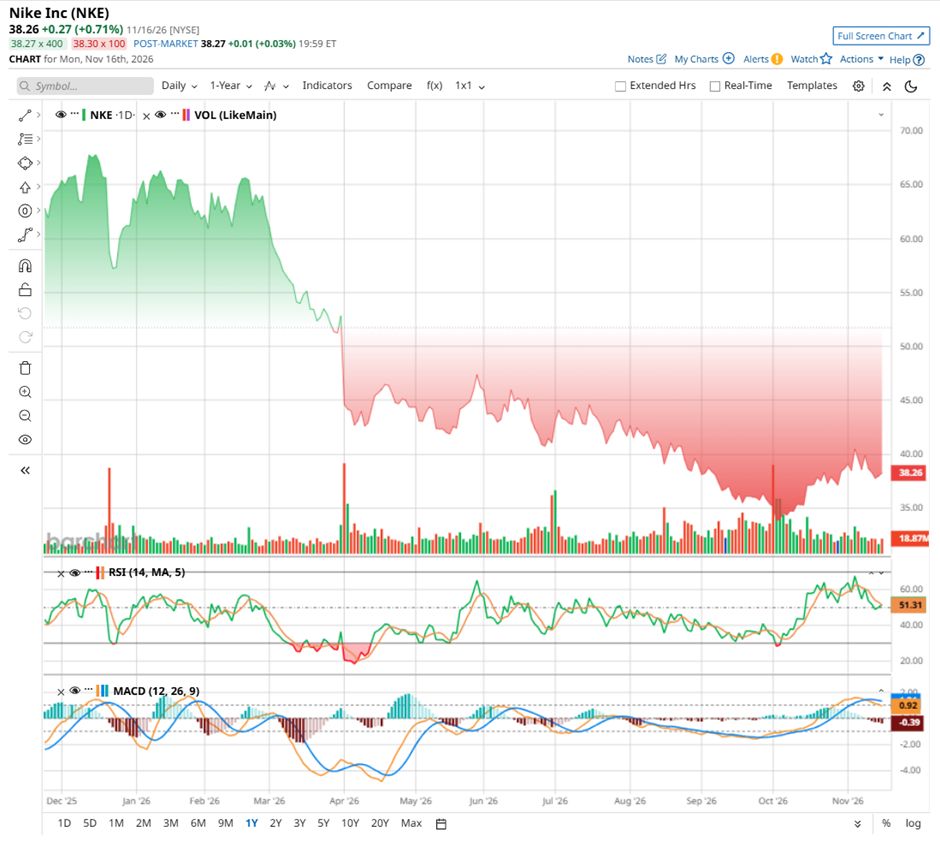
And that’s where things get a little less “Just Do It” and a lot more “Just What’s Going On?” NKE stock has plunged 40% over the past 52 weeks and is down roughly 41% on a year-to-date (YTD) basis. Plus, over the longer term, the picture is no better. The stock now trades nearly 79% below its November 2021 all-time high of $179.10. For a brand that once seemed almost unstoppable, that’s quite a fall from the podium.
Technically, the picture is mixed rather than outright disastrous. The 14-day RSI is hovering around 51, suggesting neutral momentum—neither overbought nor oversold. However, the MACD oscillator is flashing a bearish signal, with the MACD line sitting below its signal line and the histogram showing negative red bars. That points to lingering downside momentum.
 www.barchart.com
Nike’s valuation is a bit of a mixed bag. NKE stock currently trades at 29.7 times forward adjusted earnings and 1.32 times forward sales, both at a premium to sector peers. So, calling it a screaming bargain would be a stretch. That said, the stock is trading below its own historical valuation levels. At its recent lows, it looked considerably cheaper, giving bargain hunters and value investors a reason to take another look.
Nike has kept its shareholders happy, paying dividends for 36 years and increasing them for 24 consecutive years, putting it on the path toward “Dividend Aristocrat” status. With the share price tumbling from its November 2021 peak, the yield has climbed considerably. It nearly touched 5% recently before easing to around 4.3% as the stock recovered from its 2026 lows. That’s still more than four times the State Street SPDR S&P 500 ETF Trust’s (SPY) 1% yield. Nike currently offers a forward annual dividend of $1.64 per share.
But generosity has its limits. Nike’s payout ratio stands at a hefty 79%, meaning a large chunk of its earnings is already committed to dividends. Incoming CFO David Denton reiterated during the fiscal Q1 2027 earnings call that the dividend remains a significant capital allocation priority, emphasizing “discipline” in spending. That’s reassuring, but with earnings under pressure and cash generation looking thin, investors should remember that a juicy yield does not automatically mean a safe dividend. Nike has a long track record to protect, and the turnaround needs to start pulling its weight.
A Snapshot of Nike’s Q1 Earnings Report
Nike’s fiscal 2027 first-quarter results, reported in October, offered investors plenty of reasons to hit the brakes. While earnings managed to beat Wall Street’s expectations, declining sales, continued weakness in China, and pressure across several key businesses painted a less-than-encouraging picture. The sportswear giant reported adjusted EPS of $0.48, down 2% year-over-year (YoY), while revenue slipped 4.3% to $11.2 billion, missing analysts' estimates. Although its Performance business delivered high-single-digit growth, that wasn’t enough to offset softness in Sportswear, Jordan Brand, and Greater China.
Looking at the revenue breakdown, the NIKE Brand brought in $10.95 billion, down 4% YoY. Wholesale revenue edged down 1% to $6.8 billion, with growth in North America providing some cushion against weakness in Greater China. However, its direct-to-consumer business had a tougher quarter. NIKE Direct revenue dropped 8% to $4.1 billion, or 9% on a currency-neutral basis. Digital sales fell 13%, while revenue from company-owned stores declined 5%. Converse was another sore spot, with revenue plunging 28% to $263 million as every geographic region declined.
Geographically, North America remained Nike’s biggest market, generating $5.1 billion in revenue, up just 2%. Running, Global Football, and Basketball helped support growth in the region. Europe, the Middle East, and Africa (EMEA) generated $3.2 billion, down 5%. Greater China was arguably the biggest headache, with reported revenue falling 22% to $1.2 billion and dropping 26% on a currency-neutral basis. Meanwhile, Asia Pacific and Latin America revenue slipped 2% to $1.5 billion, although it remained flat after adjusting for currency movements. So, Nike is getting little help from international markets to offset sluggish growth elsewhere.
Management is now turning to an operational reset called Pace, aimed at strengthening its Sport Offense, modernizing the supply chain, and simplifying its organizational structure. The company also plans to establish a new campus in Bengaluru, India, while reorganizing operations across three geographies. Pace is expected to deliver approximately $2.5 billion in cumulative savings through fiscal 2031, although the restructuring won’t come free. Nike anticipates around $1 billion in cumulative pretax charges over the program’s lifetime, with roughly $300 million in savings expected in fiscal 2027.
Nike’s cash flow position also raises a few questions about its financial flexibility. In fiscal Q1 2027, the company generated just $135 million in operating cash flow, against capital expenditures of $199 million. Dividends, meanwhile, accounted for a much larger $610 million outflow, putting additional pressure on its cash generation. Share buybacks have largely taken a back seat, too. The company ended the quarter with $6.9 billion in cash and equivalents, along with another $1.5 billion in short-term investments. While that provides some liquidity, the gap between cash generated and shareholder payouts is worth watching.
Unfortunately, investors may have to be patient before seeing meaningful improvement. Management expects full-year fiscal 2027 revenue to decline in the high-single-digit range, with efforts to reduce excess supply in Sportswear, Jordan Brand, and Greater China weighing on sales through the remainder of the year and into fiscal 2028. Adjusted EPS is projected between $1.15 and $1.35, excluding approximately $0.15 per share in Pace-related restructuring costs. With sales still struggling and the turnaround taking time, Nike’s near-term financial outlook leaves little room for celebration.
Meanwhile, analysts tracking the athletic apparel brand don’t expect Nike to sprint back to growth anytime soon. Analysts see Q2 fiscal 2027 revenue slipping to $11.1 billion, while EPS is expected to tumble 35.9% YoY to $0.34. For the full fiscal year, revenue is projected to fall to $42.8 billion, with EPS declining another 21.5% YoY to $1.24. There may finally be some breathing room in fiscal 2028, when EPS is expected to recover 18.6% annually to $1.47.
Ahead of Investor Day, Nike unveiled a fresh product pipeline for 2027–2028, including revamped Nike Free training shoes, expanded sensory-focused Nike Mind footwear, and updates to its Vaporfly and Vomero running lines. It is also reshaping Nike Training around three pillars—Prime, Train, and Recover—while betting on athlete-focused innovation and new styles to move beyond its over-reliance on classic sneaker franchises and reignite consumer demand.
What Do Analysts Expect for NKE Stock?
Wall Street is keeping its expectations measured ahead of Nike’s Investor Day. Cantor Fitzgerald reiterated its “Neutral” rating and $38 price target, forecasting 1.5% revenue growth in fiscal 2028 and low-single-digit growth in the second half of fiscal 2028 and 2029.
It expects Sportswear and Jordan sales to remain under pressure through 2028, but Running is a bright spot, delivering double-digit growth for six straight quarters and adding roughly $1 billion over five quarters. Cantor sees FY2029 EPS at $2.25, with a bull-case scenario of $3 by FY2031.
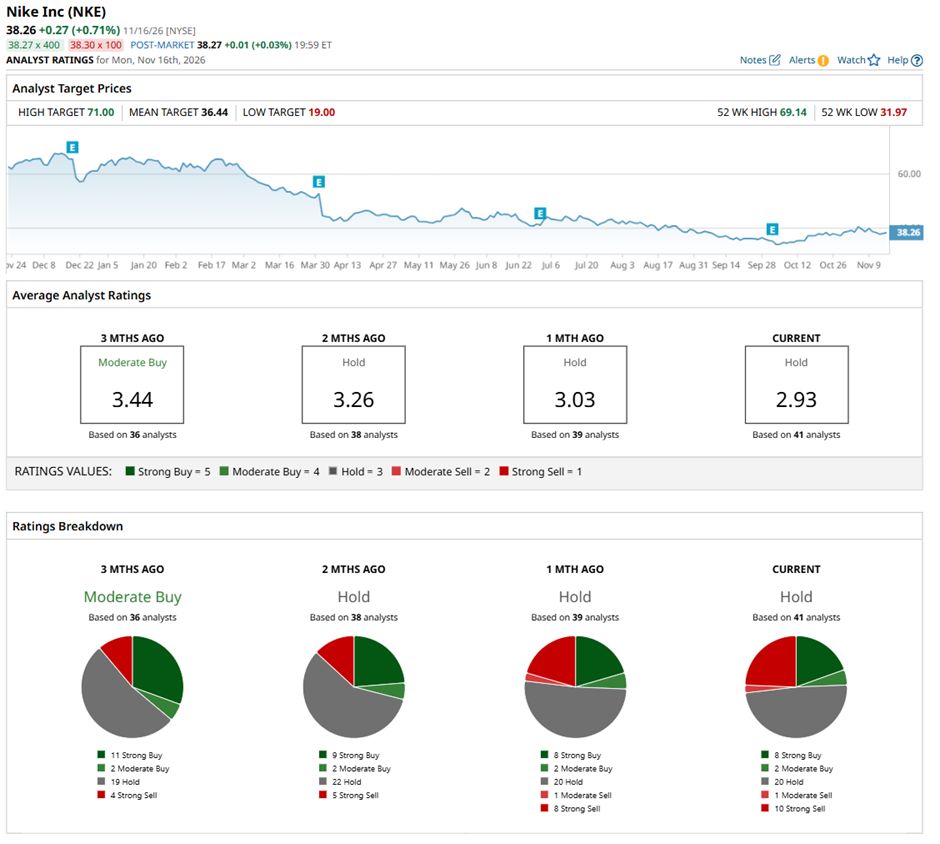
Wall Street is not on the same page about Nike. NKE stock currently carries a consensus “Hold” rating, down from the “Moderate Buy” rating three months ago. Currently, of the 41 analysts covering NKE, eight have a “Strong Buy” rating, two recommend a “Moderate Buy,” 20 advise a “Hold,” one has a “Moderate Sell,” and 10 analysts have a “Strong Sell” rating.
On the price target front, some on Wall Street still believe Nike has plenty of room to bounce back if its turnaround gains traction. The average estimate stands at $36.44, slightly below where the stock currently trades. However, the most bullish analyst has a $71 price target, suggesting a potential upside of 85.6%.
 www.barchart.com
On the date of publication, Sristi Suman Jayaswal did not directly have a position in any of the securities mentioned in this article. All information and data in this article is solely for informational purposes. For more information please view the Barchart Disclosure Policy here.
More news from Barchart
Dear Nike Stock Fans, Mark Your Calendars for November 17 This Insurance Stock Just Raised Its Dividend by Roughly 5% IBM Leads 3 Buy-Rated Tech Dividend Stocks as AI Valuations Come Under Pressure Dear Costco Stock Fans, Mark Your Calendars for December 4