


Wall Street has found another reason to celebrate. Nvidia (NVDA) shares surged following the announcement that co-founder Jensen Huang would return as chief executive officer, reversing a decision that had rattled investors just days earlier. President Donald Trump had publicly encouraged Nvidia's board to reconsider its decision, while prominent investors, including Bill Ackman, questioned how the board handled Huang's departure. The announcement helped ignite a powerful rally in Nvidia shares and lifted sentiment across the technology sector.
Nvidia's influence extends well beyond its shareholders, as it is one of the largest components of both the S&P 500 and Nasdaq-100 indexes; substantial price movements in Nvidia can have an outsized impact on the broader stock market. Because these indexes are weighted by market capitalization, the largest companies exert considerably more influence than smaller constituents. Consequently, a powerful rally in Nvidia and other technology heavyweights can lift the major indexes even when participation among the remaining stocks is less impressive.
More Top Stocks Daily: Go behind Wall Street’s hottest headlines with Barchart’s Active Investor newsletter.
However, investors should remember an important distinction: Market sentiment can change overnight. The economic conditions influencing financial markets generally take longer to change. While Nvidia's leadership uncertainty has diminished, several broader economic and market conditions deserve careful examination before investors conclude that the recent correction is behind us.
Nvidia's Recovery Doesn't Erase the Decline
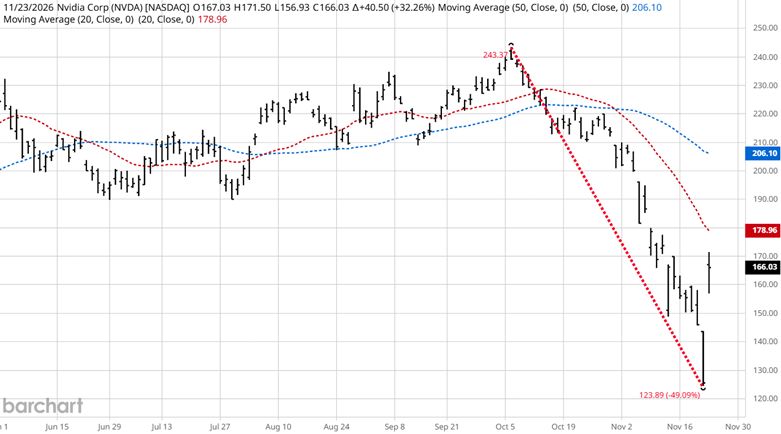
Nvidia's stock reached $243.37 in early October before plunging to $123.89 in November, a staggering 49.09% decline. For investors holding shares throughout that period, the financial damage was substantial. Monday's rally carried shares to approximately $166, an impressive recovery of nearly 34% from the recent low. However, Nvidia remains approximately 32% below its October high.
Technically, the stock also remains below its declining 20-day moving average near $179 and its 50-day moving average near $206. These observations don't suggest Nvidia cannot recover further. They remind investors that a powerful rally and a confirmed trend reversal are not necessarily the same thing.
Source: Barchart
The Broader Stock Market Has Experienced a Correction
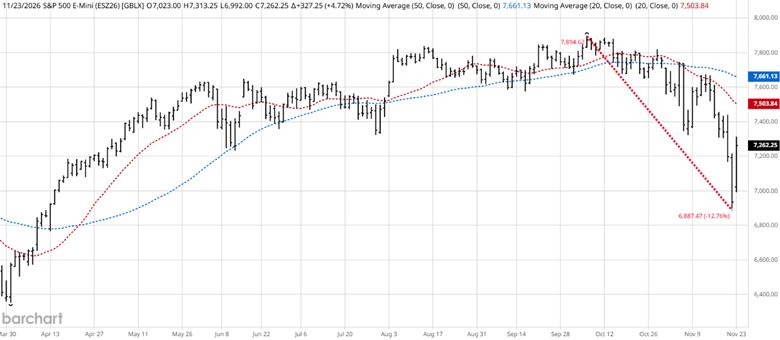
Nvidia isn't the only market experiencing significant price swings. The December E-mini S&P 500 futures contract declined from its October high of 7,897.50 to Friday's low near 6,898.00, representing a correction of approximately 12.66%. Monday's powerful rebound lifted the contract above 7,300, but prices remain below both the 20-day and 50-day moving averages.
Corrections frequently produce sharp rallies as short sellers cover positions and investors search for bargains. Some develop into sustainable recoveries, while others encounter renewed selling pressure. Rather than attempting to predict which outcome follows, investors should examine the economic environment influencing the broader market.
Source: Barchart
A Stronger U.S. Dollar Creates Additional Headwinds
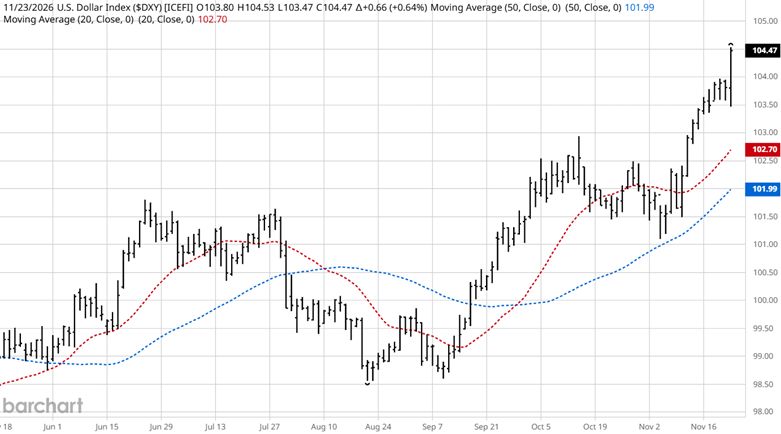
The U.S. Dollar Index ($DXY) continues to demonstrate strength, trading near 104.50 and remaining above its rising 20-day and 50-day moving averages. A strengthening dollar has implications extending well beyond currency markets, particularly for foreign investors and multinational corporations.
Foreign investors must exchange their domestic currencies for dollars to purchase U.S. stocks and bonds. As the dollar strengthens, these investments become more expensive in their local currencies, potentially discouraging some foreign purchases. Commodities priced in U.S. dollars can experience similar pressures, as higher local-currency costs may reduce purchasing power among international buyers. Multinational corporations may also encounter challenges when translating overseas earnings into dollars or competing for international business, even with hedging strategies.
Of course, a strengthening dollar can attract foreign capital when investors anticipate additional currency appreciation. Nevertheless, its potential influence on global investment flows deserves attention, especially when stock valuations are already experiencing increased volatility.
Source: Barchart
Treasury Bill Yields Are Sending Another Message
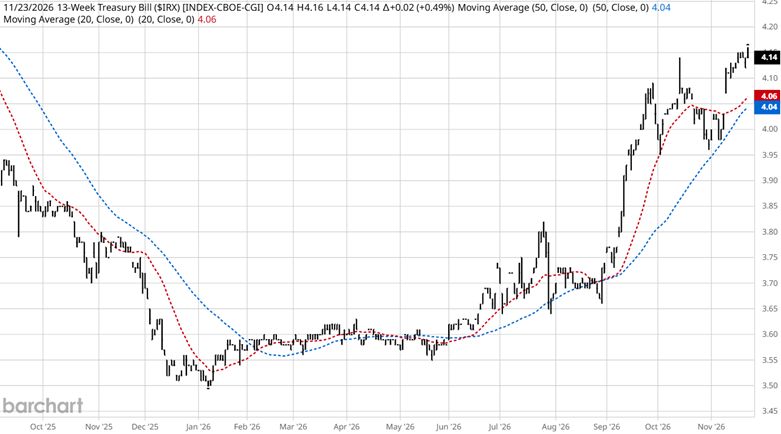
The yield on the 13-week Treasury bill, represented by the CBOE $IRX index, has climbed from approximately 3.50% in January to 4.14% today. The yield is trading above its 20-day and 50-day moving averages, both of which are trending higher. Rising short-term yields can increase competition for investment capital by making interest-bearing securities more attractive relative to riskier assets. Higher borrowing costs can also influence corporate financing decisions, particularly for businesses requiring substantial capital expenditures, such as those participating in the rapidly expanding artificial intelligence industry.
While Treasury bill yields respond to several influences beyond Federal Reserve policy, their upward trend adds another consideration for equity investors. Combined with a strengthening U.S. dollar and expectations for additional interest rate increases, these developments suggest investors should examine the broader monetary environment before assuming the recent equity rally signals an end to the correction.
Source: Barchart
Federal Reserve Expectations Point Toward Higher Rates
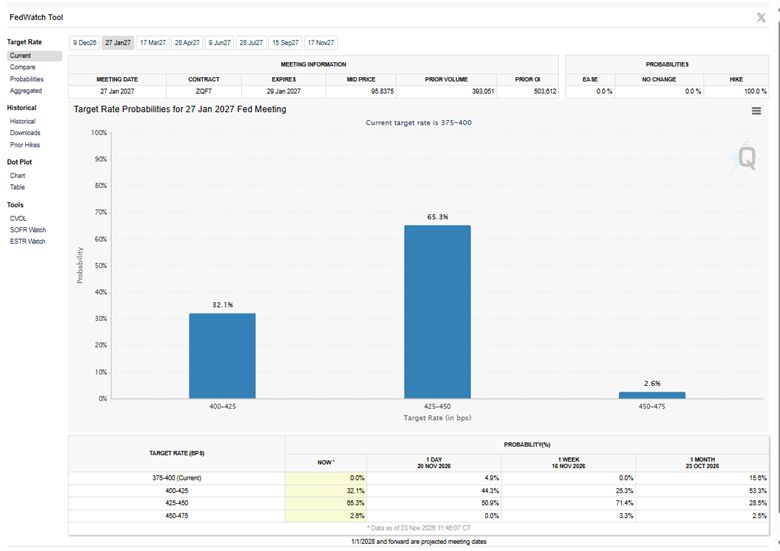
Investors anticipating easier monetary policy may need to reconsider their expectations. According to the CME FedWatch Tool on November 23, futures markets are pricing additional Federal Reserve rate increases, with expectations centered on 25-basis-point hikes in December and January. For the January 27, 2027 meeting, the highest probability, approximately 65.3%, is assigned to a federal funds target range of 4.25%–4.50%. Another 32.1% probability is assigned to a 4.00%–4.25% range.
These probabilities reflect market expectations rather than guaranteed Federal Reserve decisions. Nevertheless, they suggest monetary conditions could become more restrictive rather than more accommodative. That possibility warrants attention as investors evaluate equity valuations, financing costs, and the sustainability of a market recovery.
Source: CME Group
In Closing...
Nvidia's leadership announcement has provided investors with a legitimate reason for renewed optimism. However, the stock's dramatic recovery should not overshadow the substantial losses experienced during the preceding decline. Meanwhile, the broader stock market has entered correction territory, the U.S. dollar continues strengthening, short-term Treasury yields are rising, and financial markets anticipate additional Federal Reserve rate hikes.
None of these developments guarantees another market decline, nor do they suggest investors should automatically sell their holdings. They do suggest that due diligence remains essential, particularly when a powerful rally encourages investors to believe the worst is behind them. Market sentiment can change overnight, but the economic conditions influencing financial markets generally take longer to change. Investors who recognize that distinction may be better prepared to navigate whatever comes next.
On the date of publication, Don Dawson did not directly have a position in any of the securities mentioned in this article. All information and data in this article is solely for informational purposes. For more information please view the Barchart Disclosure Policy here.
More news from Barchart
Nvidia's Stunning Comeback: Has Wall Street Forgotten the Bigger Risks? U.S. Futures Rally as Tech Stocks Bounce After Brutal Selloff; PCE Inflation Data Awaited Tech and AI Sentiment, Thanksgiving and Other Key Things to Watch this Week Nasdaq Futures Plunge as AI Selloff Rolls On