


Investing sure has changed. Modern stock markets are increasingly driven by algorithmic flows, passive indexing, and sudden overnight resets. If you’re new to investing, you probably think it has always been like this. It hasn’t.
When trillions of dollars move in lockstep on a headline before the opening bell, traditional "set-it-and-forget-it" ways of gaining exposure to the stock market’s great potential for profits leaves your portfolio exposed to “air pockets” of risk you cannot trade out of in time.
Can’t Get Enough Options?: Join the list for Barchart’s daily unusual options report, delivered free.
Just think back to the last time you owned a stock when it announced earnings. And even when the company had a good report, the market took it down anyway. The more we play in the same sandbox of this increasingly mechanical stock market, the more we realize that any way to try to “have our cake and eat it too” as investors is worth learning about.
So, for investors who want to stay invested without leaving their downside risk wide open, the option collar is one of the most practical tools available. It is a straightforward framework for playing offense and defense at the same time (my mantra).
Once you understand how the basics work, it is like going to an upscale salad bar. You can custom-design your plate to be just about whatever you want it to be – and apply this approach to most stocks and ETFs too.
What Is an Option Collar?
An option collar is a risk-defined hedging strategy that pairs directly with any optionable stock or ETF you already own in blocks of 100 shares. It combines three pieces into a single, self-contained position:
Own 100 shares of the underlying stock or ETF. Buy 1 out-of-the-money (OTM) put option to establish a hard price floor below the current share price. That means the put option strike price is below the current stock price. So the put option protects you if the stock dives on you. Sell 1 out-of-the-money (OTM) call option with the same expiration date to help pay for the protective put (this also caps your upside).Think of a collared stock as its own mini-portfolio within your broader portfolio. Instead of hoping a stop-loss order gets filled cleanly during a gap down, you know your exact worst-case exit price and your maximum upside target the moment you enter the trade.
Stop! In The Name Of Profits.
Full disclosure: I have never used a stop-loss order. Because I do not think they stop losses.
They only stop us from realizing how vulnerable any position really is. If a stock closes at $100 and gaps lower overnight to open at $85, our $98 “stop loss” won’t actually allow us to sell the stock at $98. We’re either out at $85, or maybe not at all, depending on the parameters of the stop order.
So to me, a put option or option collar gives me the certainty many investors think they have with stops.
Options work OK in a placid market. But when volatility spikes as we saw recently, they really jump into action – to keep profit opportunities open while slamming the door on losses, exactly as we draw up and execute the collar strategy.
Buying protective puts outright during a sell-off is like buying flood insurance when it is already raining. Volatility surges, and downside protection becomes prohibitively expensive. A collar solves that cost problem by turning high volatility to your advantage.
When markets are choppy and uncertainty rises, option premiums expand on both sides of the chain. Selling the covered call allows you to harvest that elevated volatility and use the proceeds to subsidize, or sometimes completely cover, the cost of your protective put.
In effect, you trade away extreme upside gains in exchange for affordable, contractual downside protection. And, as I’ve written here many times before, there’s no rule against buying more stock or even call options, if and when it hits your call strike price, the point at which your profits on the collar are capped.
The Basic Strategy: Timing, Strikes, and Time Frames
I’m a technician, and so the charts guide me to which investments might make good collars. Then, I just need to confirm that the option pricing and liquidity is solid.
When do you put on a collar? Here’s one recent, basic example, using the popular Invesco QQQ Shares (QQQ), from one of my accounts.
Importantly, it all starts with: “What’s my motivation?” Not so much like I’m in an improv class, but more along the lines of “what defines winning and losing on this trade,” which is a question we should ask ourselves any time we put money to work.
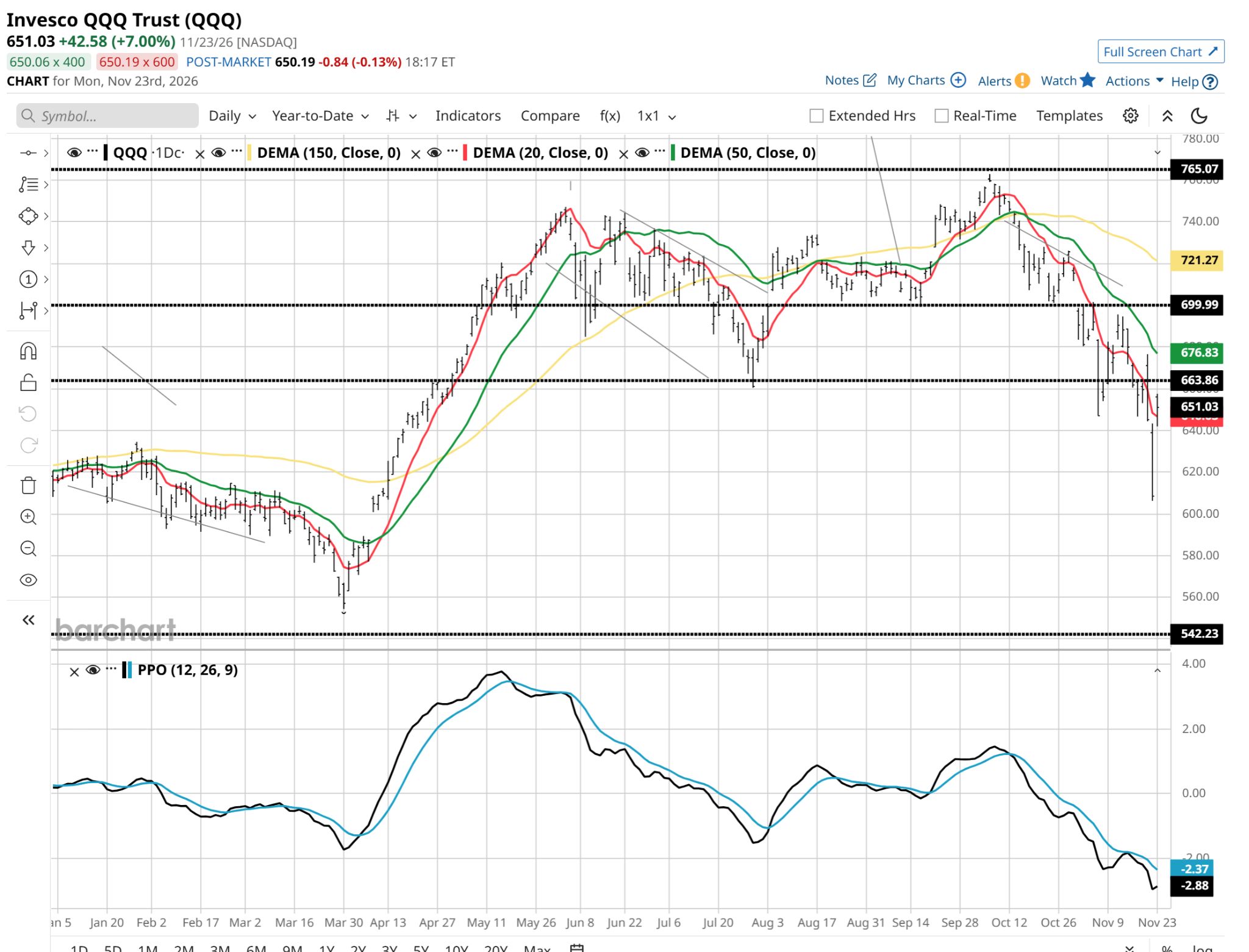 QQQ daily YTD.
In this case, I saw a QQQ chart that was on the verge of truly crashing. And it might have, if not for the, ahem, deus ex machina events of Monday.
But since markets are more unpredictable than ever, “buying the dip” as I was here, I wanted to do it with some protection. And I was willing to give up some upside beyond a certain higher price.
The key here: if the market goes up, I make money up to a point. If it goes down, I limit my losses. And if it goes nowhere for a couple of months, I’m likely to make or lose a little, and keep the shares I own in place. To collar them again, most likely.
(In what I’d consider the “201” version of this article versus this 101 take, if the stock did start to fall apart, I could buy more put options to accentuate the downside profits. Another article for another day.)
Selecting Strikes and Time Frames
Time frame: A 60- to 120-day window (roughly two to four months out) generally hits the sweet spot. It gives your thesis room to play out while letting time decay work steadily in favor of the call you sold. Put strike (your floor): Choose a strike that reflects the maximum drawdown you are willing to tolerate. For me, typically 5% to 10% below the current share price, ideally tucked just beneath a logical technical support level. That said, pricing can be dicey, so sometimes I end up placing the put option just below the current price. The puts cost more, but that gets me to my desired 5-10% downside worst-case. Call strike (your ceiling): Pick an upside price where you would genuinely be satisfied taking profits anyway. For me that’s often 10% to 15% above the current price, near overhead resistance.A quick example: Suppose you buy 100 shares of a stock at $177; buy a 3-month $165 put; and sell a 3-month $205 call that brings in enough credit to heavily offset the put's cost. Regardless of what happens over the next 90 days, your downside is locked at $165 (a roughly 6.8% max loss before net option cost), while you still participate in gains all the way up to $205 (+15.8%).
How to Manage the Trade
Once a collar is on, there’s an infinite number of ways you can go with it. Again, it all comes back to objectives, and will be influenced by the price movement the stock exhibits after you put the collar on. Or, you can just do nothing, and wait until expiration, unless you are forced to sell the stock (“called away”).
If the stock drifts sideways or grinds modestly higher, you can simply let time decay do the heavy lifting. If the stock approaches your call strike early and you have captured most of the available profit, you can close both option legs simultaneously (selling the put back and buying back the call) to lock in the net gain or reset a new collar at higher strikes.
That's 101. The 201 involves managing the legs individually (an active approach, which is more often what I do personally). While more detailed, this tactic can be summarized as:
If the stock drops sharply shortly after entry, your short call loses value quickly while your protective put gains value. In that case, you can buy back the cheap call for a profit and roll it down to a lower strike closer to the current share price, collecting additional premium to further reduce your cost basis while keeping your original put floor intact.
A critical warning on adding size: Some active traders are tempted to buy extra put contracts on top of an existing collar when a stock starts sliding to amplify downside profits. Just keep in mind that adding more put contracts fundamentally changes your risk on the trade. When you have more invested, there’s more to lose if the stock rises.
Once your put contracts outnumber your 100-share lots, you are no longer just hedging. You are making a leveraged directional bet. If the stock stages a sudden, violent reversal higher, you can lose 100% of the extra premium paid for those unbacked puts.
That’s what happened to any QQQ or Nvidia (NVDA) collars, as well as many others, on Monday.
When to Skip a Collar
Skip the collar strategy in favor of other tactics in the following situations:
Low-volatility environments: When implied volatility is compressed, call premiums shrink to pennies. Selling a call won't meaningfully subsidize your put, leaving you with expensive insurance and a needlessly capped upside. Clean, steady uptrends: When broad market breadth is strong and a stock is trending smoothly above rising moving averages without major event risk, capping your upside clips your biggest winners. Actively managing position size to limit risk is often the better move. Illiquid option chains: If a stock or niche ETF has wide bid-ask spreads and low open interest, the “slippage” that occurs from entering and exiting two separate option legs will quietly erode your return. When cash or fixed income is simpler: If your primary goal is capital preservation during a broad market downturn, engineering collars across a dozen positions may produce unnecessary friction. Raising cash or rotating into short-term, laddered fixed income often achieves a cleaner defensive posture with zero option drag.Option collars can be a very timely tool, especially in markets like the current one. Unpredictable environments, with huge volatility, favor those who can master the options markets. But as with anything, the key is to take your time, start small, and move gradually up the learning curve.
Rob Isbitts created the ROAR Score, based on his 40+ years of technical analysis experience. ROAR helps DIY investors manage risk and create their own portfolios. For Rob's written research, check out ETFYourself.com.
On the date of publication, Rob Isbitts did not directly have a position in any of the securities mentioned in this article. All information and data in this article is solely for informational purposes. For more information please view the Barchart Disclosure Policy here.
More news from Barchart
Use This Options Game Plan to Play Offense & Defense at the Same Time in a High-Volatility Market Top Iron Condor Setups for November 25th (Screener Results) Investors Buy Unusually Large LEAP Options in Southeastern Utility, Southern Company Why Options Data Says You Should Approach Beaten-Down Sea Ltd (SE) Stock with Caution, Not a Contrarian Attitude