


Dividend stocks provide something growth stocks cannot: a steady stream of income that rewards investors as they wait for growth stocks to blossom. In volatile markets, this regular income serves as a comforting cushion when share prices dip. Procter & Gamble (PG), Coca-Cola (KO), and McDonald's (MCD) stand out not for spectacular yields but for powerful brands, resilient businesses, and an impressive track record of dividend growth, making them compelling choices for long-term income seekers.
#1. Procter & Gamble (PG): Everyday Products, Durable Income
P&G fills homes with everyday essentials, from Tide and Pampers to Gillette and Oral-B. Even when wallets shrink, families still spend money on detergent, diapers, and personal care staples. Its broadly diversified portfolio shields the company from relying on any one product, while well-established brands and vast distribution networks defend shelf space. Still, competition from store brands and rising costs remain challenges P&G must deal with.
More Yield, Less Trap: Sign up free to get Barchart’s daily Dividend Investor newsletter straight to your inbox.
P&G offers a forward dividend yield of 2.59%, outpacing both the market and consumer staples average. Boasting an impressive 71-year streak of dividend hikes, this Dividend King ranks as a top dividend stock for investors seeking reliable income growth. While its forward payout ratio of 60% leans a bit high, it remains sustainable as long as earnings keep climbing.
In the first quarter of fiscal 2027, P&G’s net sales climbed to $23.3 billion, up 4%, with organic sales rising in line. Management said this growth came more from consumers buying additional products than from price hikes. However, core earnings per share rose only 1% to $2.00, as higher operating costs offset much of the sales momentum.
P&G kept its full-year core EPS growth forecast at flat to 3% and expects free-cash-flow productivity between 85% and 90%. The company also plans to pay over $10 billion in dividends this year.
Although costs continue to pose challenges, P&G’s scale remains its most powerful asset. The company can distribute research, advertising, and manufacturing expenses across vast sales volumes, which smaller competitors may struggle to match. Its challenge is converting that advantage into enough earnings growth to cover inflation and keep raising the dividend.
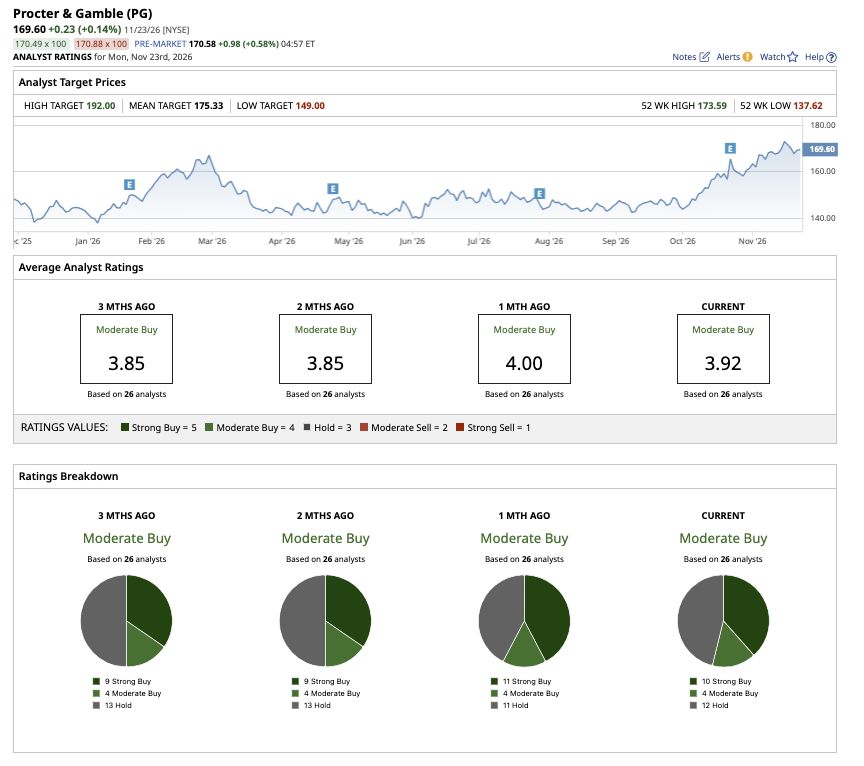
On Wall Street, Procter & Gamble stock is rated a “Moderate Buy.” Of the 26 analysts who cover the stock, 10 rate it as "Strong Buy," four as "Moderate Buy," and 12 as "Hold."
 www.barchart.com
#2. Coca-Cola (KO): A Global Brand With Pricing Power
Coca-Cola’s resilience comes from its beverage portfolio and extensive global supply chain. Its portfolio extends well beyond its namesake soft drink, covering categories such as bottled water, sports beverages, coffee, and tea. However, brand loyalty is not a given, as consumers can switch brands, and affordability matters in emerging markets. Pricing power only helps when it does not push customers away.
KO offers a forward dividend yield of 2.2%, comfortably above the broader market average. With 65 consecutive years of dividend increases, Coca-Cola has earned its place among the elite Dividend Kings. Although its forward payout ratio of 63% is relatively high, the dividend is still manageable as long as earnings and cash flow continue to grow.
In the third quarter, the company’s revenue rose 7% to $13.4 billion. Organic revenue also increased 7%, and global unit-case volume was up 5%. Comparable EPS climbed 11% to $0.91. Management pointed to strong results in India, China, Mexico, and Brazil. Price and mix added 1% to organic growth, as higher prices were partly offset by less favorable product and market mix.
Management raised its 2026 outlook, now expecting at least 5% organic revenue growth and at least 9% comparable currency-neutral EPS growth. Executives also noted higher logistics and transportation costs. The company needs to keep investing to protect market share, drive demand, and support bottling partners. The recent quarter was positive, but ongoing volume growth is still key. Coca-Cola’s impressive legacy and worldwide presence are undeniable strengths, but the company must keep evolving its portfolio to keep pace with changing consumer tastes.
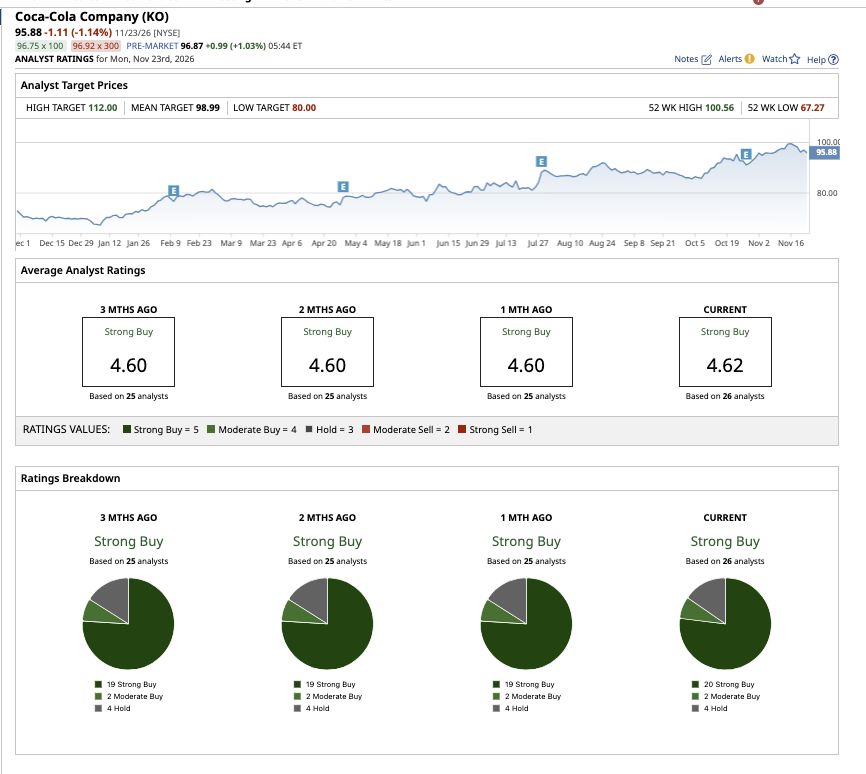
Overall, Wall Street is bullish on KO stock, rating it a “Strong Buy.” Of the 26 analysts who cover KO, 20 rate it a “Strong Buy,” two as a “Moderate Buy,” and four as a “Hold.”
 www.barchart.com
#3. McDonald's (MCD): A Business Model Built for Consistent Cash Flow
McDonald’s relies heavily on franchisees, earning royalties and rent without carrying the full operating costs of every restaurant. But franchisees must make money, and customers must keep visiting. In the third quarter, McDonald's kept its momentum going as comparable sales jumped 1.5% and systemwide sales surged 4%, topping $38 billion. Operating income jumped 7%, and diluted EPS rose 10% to $3.51. While U.S. comparable sales dipped 0.2%, international markets grew 1.4%, and developmental licensed markets soared 4.2%. Management said September's better U.S. results came from appealing digital deals and value-focused meals. Loyalty-member sales passed $11 billion, and Extra Value Meal unit sales grew 7% from last year, showing the company's ability to attract and retain customers.
McDonald’s forward dividend yield stands at a healthy 2.73%, leading the pack among these three stocks. With a forward dividend payout ratio of 61.1%, the company smartly reserves the rest of its earnings for reinvestment and future growth. McDonald’s franchise model shields it from many day-to-day restaurant costs, yet the company’s success remains tied to the health of its franchisees and the flow of customers through its doors. Rising food and labor costs, weak sales, or heavy discounting could pressure margins and affect the company’s ability to sustain dividend growth.
With an unbroken streak of 51 years of dividend increases, McDonald’s has proven its dedication to rewarding shareholders. Yet, keeping this momentum alive will require stronger sales, especially in the U.S., and steady earnings growth.
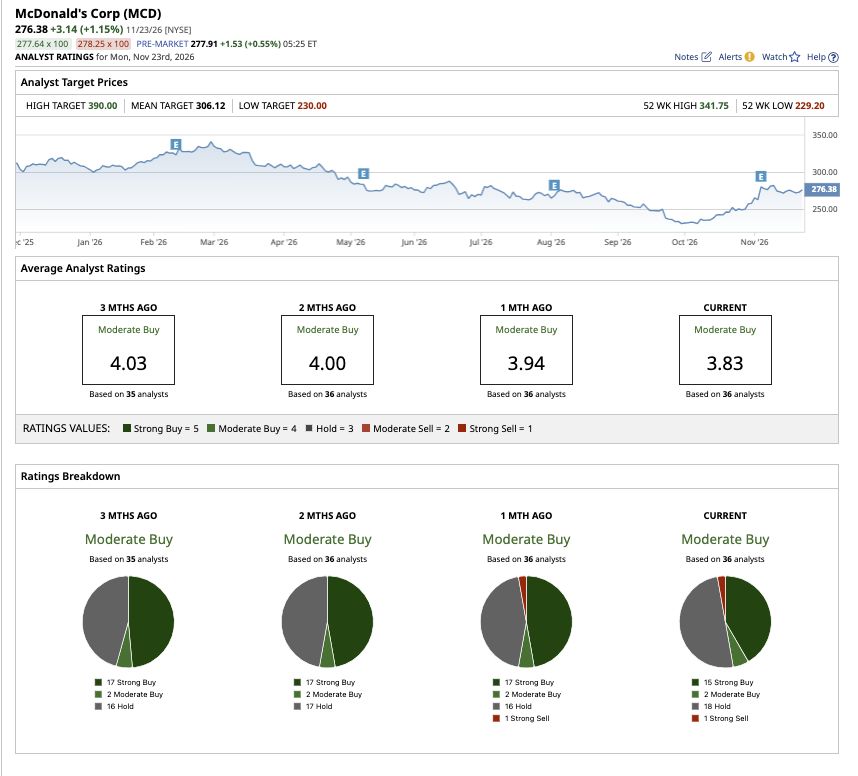
Overall, Wall Street rates MCD stock a “Moderate Buy.” Of the 36 analysts who cover MCD, 15 rate it a “Strong Buy,” two as a “Moderate Buy,” 18 as a “Hold,” and one as a “Strong Sell.”
 www.barchart.com
On the date of publication, Sushree Mohanty did not directly have a position in any of the securities mentioned in this article. All information and data in this article is solely for informational purposes. For more information please view the Barchart Disclosure Policy here.
More news from Barchart
Use This Options Game Plan to Play Offense & Defense at the Same Time in a High-Volatility Market 3 Top Dividend Stocks to Buy and Hold for Decades Why It’s Time to Load Up On Seagate Stock Top Iron Condor Setups for November 25th (Screener Results)