


China’s benchmark CSI 300 index entered a bear market on Thursday after declining for 10 straight weeks, according to LSEG data cited by CNBC.
Bloomberg linked the drop to fading stimulus hopes, weak earnings and worries over the global artificial intelligence (AI) trade. Meanwhile, stock markets in South Korea, Japan and Taiwan also fell.
China’s Stocks Slide Into Bear Market
The CSI 300 stood at 4,060.19 at Thursday’s morning break, about 20% below its June peak. The index was also down 13.94% from its January 1 level.
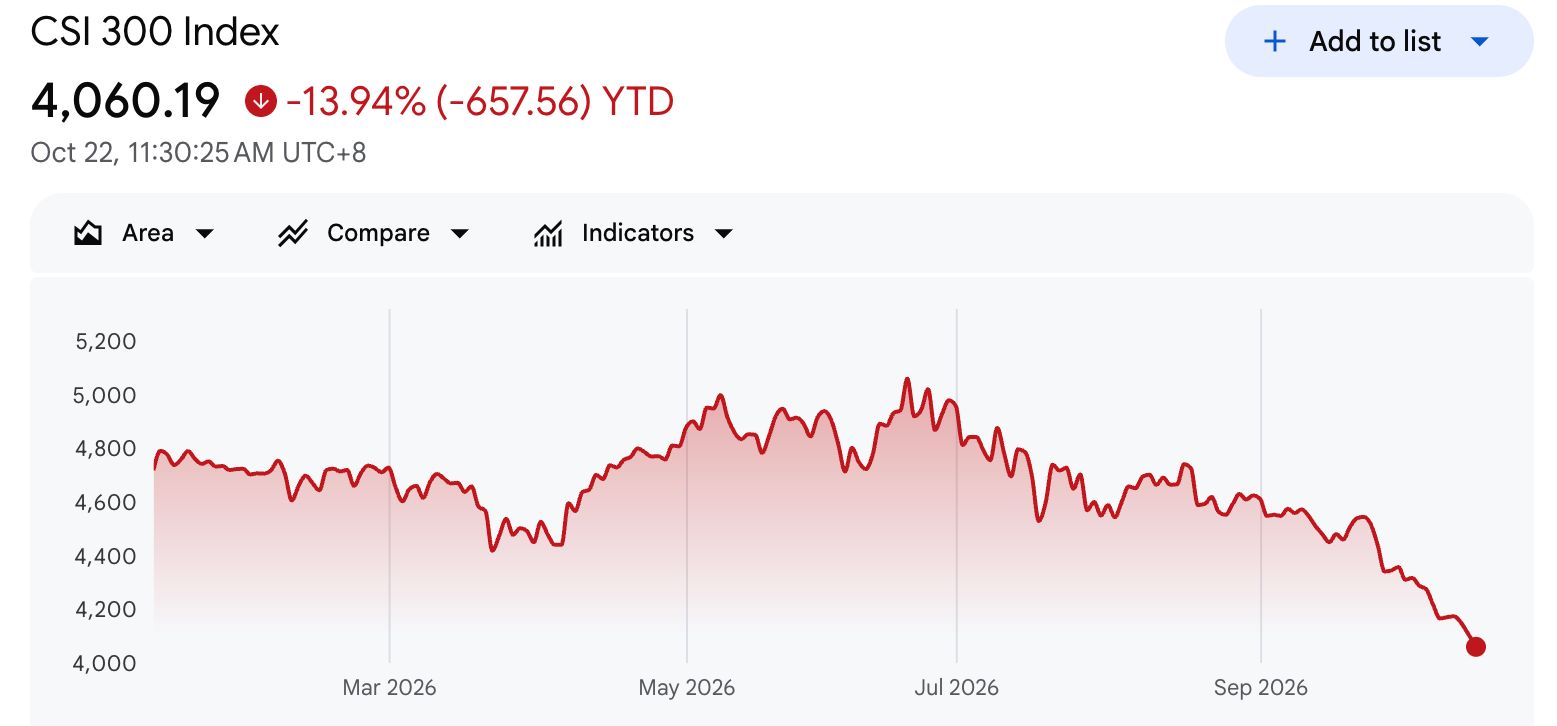 CSI 300 Performance. Source: Google Finance
Follow us on X to get the latest news as it happens
Despite the slide, policymakers have offered little new support so far. On Tuesday, China held its one-year loan prime rate (LPR) at 3.0% and the five-year LPR at 3.5%. Both rates have now stayed unchanged for 17 straight months.
Analysts at Maybank said stable headline growth makes new fiscal and monetary stimulus less urgent, Reuters reported. That growth reached 4.5% in the third quarter, beating forecasts. BeInCrypto previously reported that the losing streak has continued despite the stronger data.
State-backed buying has also been smaller than earlier state selling. Central Huijin leads China’s market stabilization efforts. It raised $231 billion through exchange-traded fund (ETF) sales in the first half.
Since purchases resumed in July, it has reinvested only about $43 billion, Bloomberg Intelligence analysts estimate. That leaves roughly $188 billion available. However, the analysts warned that state buying alone may not deliver a lasting recovery.
Selling Spreads From Seoul to Taipei
The pressure extended beyond the mainland on Thursday. South Korea’s KOSPI fell 2.56% by midday to 5,588.94, down from its previous close of 5,735.66.
Japan’s Nikkei 225 traded 1.65% below Wednesday’s close by early afternoon, at 63,554.76. Similarly, Taiwan’s TAIEX slid 1.15% from its prior close to 46,346.92 in late-morning trade.
Hong Kong also lost ground. A gauge of major Chinese companies listed in the city fell as much as 2.9% on Thursday.
The Hang Seng Tech Index had already touched a two-year low on Tuesday as AI hardware stocks fell. On Wednesday, Tencent slipped below HK$400, and CATL dropped on weaker profit growth and fierce competition.
Sovereign Funds Step Back Into China
In contrast, some long-term investors have increased their exposure to China this year. Sovereign wealth funds put $14.2 billion into mainland China and Hong Kong through September. The figure comes from Global SWF data shared with CNBC.
That total was nearly triple the $4.9 billion these funds invested in all of 2025. Saudi Arabia’s Public Investment Fund led with $6 billion. Together, 4 Gulf funds made up nearly 70% of the inflows.
The deals included a minority stake in Luckin Coffee and Alibaba’s $10.2 billion share sale. Andrew Wang, who leads consumer investments in Mubadala’s private equity arm, pointed to the market’s valuations.
“Valuations are lower than they’ve been in years. I think this will be a really good vintage for investors in China,” he said.
Still, China remains a small destination for sovereign capital. The US attracted $132.4 billion in sovereign investment over the same nine months, according to Global SWF. Europe and the UK drew $44.6 billion.
Subscribe to our YouTube channel to watch leaders and journalists provide expert insights
https://youtu.be/oF1yRVmNudARead the Original story China’s Stocks Enter Bear Market as Selling Spreads Across Asia by Kamina Bashir at beincrypto.com