

Solana is moving closer to traditional financial markets following a major announcement from the Depository Trust & Clearing Corporation (DTCC).
As institutional interest in Solana continues expanding, the Wall Street infrastructure giant has revealed plans to connect its tokenization service to the blockchain, potentially bringing regulated securities onto the network in 2027.
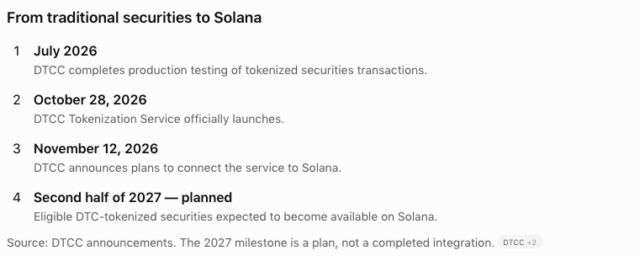
The announcement, published on November 12, marks another significant development in the growing relationship between cryptocurrency infrastructure and traditional finance.
DTCC plans to make eligible assets held by its subsidiary, The Depository Trust Company (DTC), available in tokenized form on Solana during the second half of 2027.
For Solana, the development could strengthen its position in the emerging market for tokenized real-world assets.
DTCC Plans To Bring Regulated Securities To Solana
According to the official DTCC announcement , the company intends to integrate Solana into its existing Tokenization Service.
The service launched on October 28, enabling eligible securities held at DTC to be represented digitally while maintaining the ownership rights and investor protections associated with traditional financial assets.
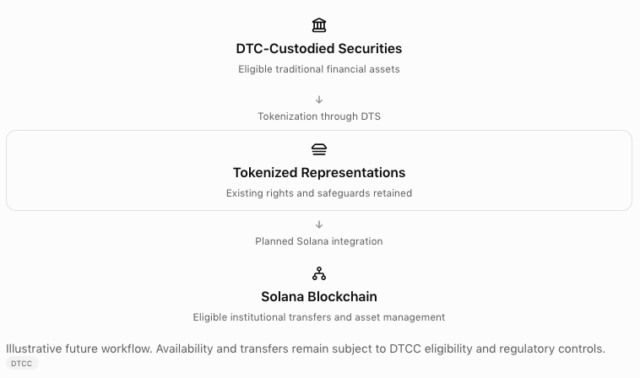
Its planned expansion to Solana could allow participating institutions to convert eligible securities into blockchain-based representations and manage their lifecycle through the network.
The announcement is particularly notable because DTCC operates at the center of the US financial system.
In 2025, its subsidiaries processed securities transactions valued at approximately $4.7 quadrillion, while DTC provided custody and asset servicing for securities valued at $114 trillion.
These figures demonstrate the scale of DTCC’s existing operations, although they do not represent assets committed to Solana.
Frank La Salla, DTCC’s president and CEO, described the initiative as an effort to expand institutional access to regulated tokenized assets while preserving established market protections.
Meanwhile, Brian Steele, president of DTCC Clearing & Securities Services, emphasized that tokenized securities available through the service would retain their existing ownership rights and regulatory safeguards.
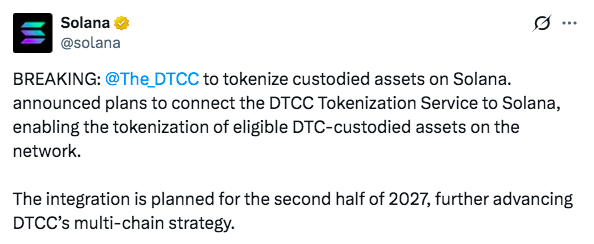
The integration is expected in the second half of 2027, meaning the announcement represents a future expansion rather than an immediate transfer of Wall Street securities onto Solana.
Why Wall Street’s Tokenization Plans Matter For SOL
Tokenization allows traditional assets, including eligible stocks, exchange-traded funds, and government securities, to be represented on blockchain networks.
Supporters believe this technology could improve settlement efficiency, simplify collateral transfers, and enable more flexible asset management.
For Solana, attracting regulated financial infrastructure could be an important step toward broader institutional adoption.
The blockchain is already known for relatively low transaction costs and fast processing, characteristics that could support applications requiring frequent asset transfers.
The Solana Foundation has also emphasized the network’s growing role in institutional finance.
Nick Ducoff, the foundation’s general manager of institutional business, said the planned DTCC connection would bring established financial infrastructure closer to an ecosystem already supporting real-world financial activity.
We believe the most important development is not simply the possibility of additional tokenized assets, but the credibility that participation by a major financial infrastructure provider could bring to Solana.
This could encourage more financial institutions to examine the network for settlement, collateral management, and tokenized investment products.
However, the potential implications for SOL’s price require careful consideration.
Although transactions on Solana generally use SOL for network fees, greater tokenized asset activity does not automatically translate into a proportional increase in demand for the cryptocurrency.
Institutional adoption would need to generate sustained network activity, liquidity, and demand for SOL to create a meaningful longer-term market effect.
Could Tokenized Assets Become Solana’s Next Growth Driver?
The real-world asset market has become an increasingly important area of blockchain development.
Rather than focusing exclusively on cryptocurrency trading, financial institutions are exploring how blockchain infrastructure can support traditional investment products.
DTCC’s tokenization service could eventually connect these two markets more directly.
The service initially launched with integrations involving the Canton Network and DTCC’s private Besu network. Adding Solana would expand the range of blockchain environments available to eligible participants.
This multi-network strategy is important because it suggests institutions may prefer interoperability rather than relying on a single blockchain.
Solana could benefit from being included among the networks selected to support regulated financial activity.
Nevertheless, several questions remain unanswered.
DTCC has not disclosed how much value could eventually be tokenized on Solana, which institutions will use the integration, or the exact securities that will become available.
Participation will also remain subject to the service’s regulatory and operational requirements.
For investors following Solana ecosystem growth , these details will be important indicators of whether the announcement translates into measurable adoption.
The next milestones will include technical integration progress, announcements from participating institutions, and the eventual availability of eligible tokenized assets.
While the integration remains scheduled for 2027, the announcement reinforces a broader trend: major financial infrastructure providers are increasingly exploring public blockchain networks.
For Solana, that could prove more important over the long term than any immediate reaction in SOL’s price.