


Corning Incorporated GLW and Bandwidth Inc. BAND are key technology firms in the smartphone and communications value chain. Corning is a leading innovator in the glass substrate industry. In addition to being a pioneer in Gorilla Glass technology, the company manufactures specialty materials, including various formulations for glass, glass ceramics and fluoride crystals for specific industrial and commercial applications. It also manufactures optical fibers, glass substrates for LCD and PC displays, automotive glass solutions and various laboratory equipment.
On the other hand, Bandwidth operates as a Communications Platform-as-a-Service (CPaaS) provider, offering software application programming interfaces for voice and messaging services. It is the only API platform provider that owns a Tier 1 network with enhanced network capacity, primarily catering to business enterprises.
With domain-specific expertise in core areas, both Corning and Bandwidth are well-positioned in the tech-adjacent manufacturing landscape and have the means to cater to the evolving demands of business enterprises. Let us delve a little deeper into the companies’ competitive dynamics to understand which of the two is relatively better placed in the industry.
The Case for GLW
Corning is benefiting from improved demand and the commercialization of its innovations. Its capabilities are becoming increasingly vital to diverse industries. The fiber optic solutions business is likely to be the key growth driver for GLW, aided by the increasing use of mobile devices that require efficient data transfer and networking systems. Supporting this trend is the proliferation of clouds, resulting in increased storage and even virtual computing.
Since both consumers and enterprises are using networks more extensively, and the generated data is increasingly being used to train AI models, there is a solid demand for Corning’s innovative optical connectivity products for generative AI applications.
GLW’s operating structure has been reorganized to align executive management and business teams around five Market-Access Platforms to unlock opportunities for valuable synergies. These include Mobile Consumer Electronics, Optical Communications, Automotive, Life Sciences and Display. Corning has a leadership position in each of these markets, which, along with focused marketing efforts, has proved conducive to growth. In addition, the reorganization has increased efficiency by creating the opportunity to reuse assets and capabilities developed for customers in one market ecosystem to serve customers in another.
However, end market diversification is limited within the Display and Optical segments, which account for more than half of total revenues. Since the Display Technologies and Specialty Materials segments are primarily dependent on consumer spending, particularly on LCD TVs and mobile PCs, this narrows down the market. Building a significant market position in China amid a bitter U.S.-China trade relationship with heightened risk of the imposition of tariffs can adversely impact its operations.
The Case for BAND
Bandwidth is benefiting from several favorable industry trends that are strengthening its growth prospects. The transition from legacy telephony systems to cloud-based communications continues to serve as a major growth catalyst. Enterprises are increasingly adopting cloud-native communication solutions to improve customer engagement and operational efficiency. Bandwidth's CPaaS offerings enable businesses to integrate voice, messaging and emergency services directly into their applications. The ongoing digital transformation across industries is expected to drive sustained demand for these solutions.
Bandwidth is increasingly positioned as a core infrastructure provider for AI-driven enterprise communications, with its Maestro orchestration platform enabling integration of voice AI into real-time workflows. Customers are deploying AI in production environments, increasing interaction volume and expanding revenue per interaction. The company’s role in enabling governed workflows allows it to capture incremental usage as enterprises scale AI applications. As AI-driven customer engagement becomes more prevalent, Bandwidth is likely to see increased demand for its platform and network services.
However, Bandwidth operates in a highly competitive CPaaS market where larger competitors have broader global reach and established enterprise relationships. These competitors can bundle services and respond quickly to technological shifts, which can limit Bandwidth’s pricing power and customer acquisition. While the company is expanding internationally, competitors remain ahead in global scale, which could constrain market share gains over time. Bandwidth’s pricing and billing systems remain complex and rely on third-party components. This complexity can lead to inconsistencies and challenges in implementation, particularly as usage scales across multiple services and geographies. The need to align pricing with competitive offerings and evolving market dynamics adds further difficulty, which can adversely impact margins and customer experience.
How Do Zacks Estimates Compare for GLW & BAND?
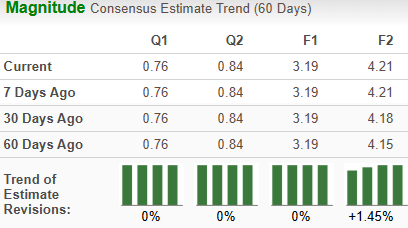
The Zacks Consensus Estimate for Corning’s 2026 sales implies a year-over-year rise of 13.9%, while that for EPS indicates growth of 26.6%. EPS estimates have remained static at $3.19 per share over the past 60 days.
Image Source: Zacks Investment Research
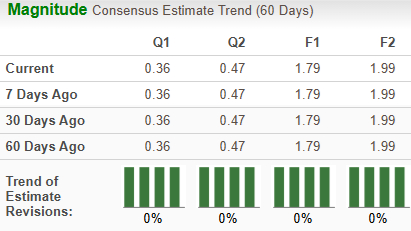
The Zacks Consensus Estimate for Bandwidth’s 2026 sales suggests year-over-year growth of 18.3%, while that for EPS implies a rise of 25.2%. The EPS estimates have remained stable at $1.79 over the past 60 days.
Image Source: Zacks Investment Research
Price Performance & Valuation of GLW & BAND
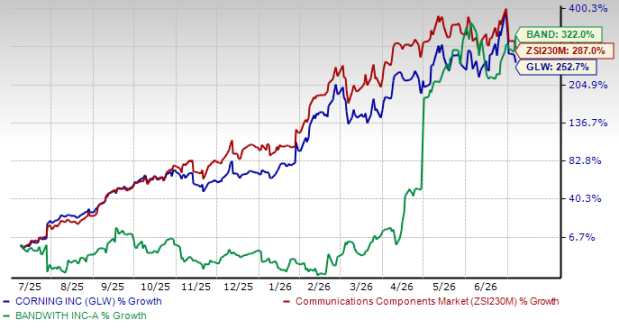
Over the past year, Corning has surged 252.7% compared with the industry’s growth of 287%. Bandwidth has gained 322% over the same period.
Image Source: Zacks Investment Research
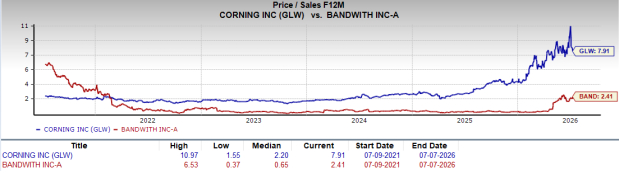
Corning looks more expensive compared to Bandwidth from a valuation standpoint. Going by the price/sales ratio, Corning’s shares currently trade at 7.91 forward sales, significantly higher than 2.41 for Bandwidth.
Image Source: Zacks Investment Research
GLW or BAND: Which is a Better Pick?
Corning carries a Zacks Rank #2 (Buy) while Bandwidth carries a Zacks Rank #3 (Hold). You can see the complete list of today’s Zacks #1 Rank (Strong Buy) stocks here.
Both companies expect their sales and earnings to improve in 2026. In terms of price performance, Bandwidth has outperformed Corning and is trading relatively cheaply compared with the latter. However, with exposure to long-term trends (data centers, telecom infrastructure and advanced glass) and a solid Zacks Rank, GLW currently appears to be a better investment option at the moment.
Beyond Nvidia: AI's Second Wave Is Here
The AI revolution has already minted millionaires. But the stocks everyone knows about aren't likely to keep delivering the biggest profits. AI’s second wave is moving from infrastructure to implementation and these companies are at the forefront of this transition, positioned to become what Amazon and Google were to the internet era.
See Stocks Now >>Want the latest recommendations from Zacks Investment Research? Today, you can download 7 Best Stocks for the Next 30 Days. Click to get this free report
Corning Incorporated (GLW): Free Stock Analysis Report
Bandwidth Inc. (BAND): Free Stock Analysis Report
This article originally published on Zacks Investment Research (zacks.com).