

Delta Air Lines, Inc. DAL used its second-quarter 2026 earnings call to deliver a clear message. Pricing discipline, diversified revenues and measured capacity are helping offset a sharp fuel headwind. Management framed the quarter less as a beat and more as proof that the model is holding up.
That mattered because Delta reaffirmed its full-year earnings and free cash flow outlook even after absorbing what executives described as the highest quarterly fuel cost in company history. The call also gave investors a firmer read on industry pricing, corporate demand and 2027 setup.
DAL Leans on Revenue Durability
Chief executive officer Ed Bastian said Delta’s diversified model is gaining strength as customers keep prioritizing travel and premium experiences. He tied that resilience to loyalty, corporate share, international exposure, cargo and maintenance revenues rather than to fare increases alone.
The company reported adjusted earnings of $1.56 per share, which surpassed the Zacks Consensus Estimate of $1.51. Revenues rose 13.9% year over year to $17.67 billion, which missed the Zacks Consensus Estimate of $17.76 billion by 0.53%.
Delta Air Lines, Inc. Price, Consensus and EPS Surprise
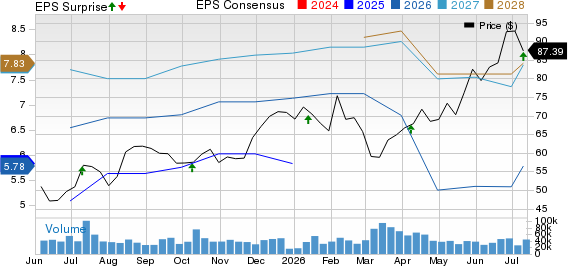
Delta Air Lines, Inc. price-consensus-eps-surprise-chart | Delta Air Lines, Inc. Quote
Management emphasized that this performance came on roughly 1% capacity growth, reinforcing the idea that yield and mix, not aggressive expansion, are driving the current earnings profile.
Delta Keeps Full-Year Targets Intact
The clearest signal from the call was unchanged full-year guidance. Delta reaffirmed 2026 adjusted EPS of $6.50 to $7.50, free cash flow of $3 billion to $4 billion.
For the September quarter, management guided to mid-teens revenue growth, an operating margin of 11% to 13% and EPS of $2 to $2.50. Chief financial officer Erik Snell said that the outlook assumes an all-in fuel price of about $3.15 per gallon, including a refinery benefit of $0.05 per gallon.
Snell also said nonfuel unit cost performance should improve modestly in the third quarter and progress further in the December quarter, which he positioned as a step back toward Delta’s long-term low-single-digit CASM-ex framework.
DAL Sees Structural Change in Pricing
Bastian was especially direct in Q&A on the industry backdrop. In response to a Deutsche Bank question, he argued that higher fuel, labor, airport and aircraft costs have forced structural changes across U.S. airlines, reducing the old low-cost carrier playbook’s ability to pressure fares.
He said Delta believes current revenue momentum can persist even if fuel moderates because fares still lag cumulative inflation since COVID, and much of the industry remains below its cost of capital. That was one of the clearest indications on the call that management sees the pricing environment as more durable than cyclical.
Joe Esposito, executive vice president and chief commercial officer, reinforced that point by saying Delta exited the quarter with a materially stronger TRASM run rate than it entered, as newer, higher-priced bookings replaced earlier sales made before the fuel recapture push took hold.
Delta Finds Strength Beyond Main Cabin
Esposito said broad demand strength remained intact across customer groups, with premium revenues up 17%, loyalty and related revenues up 19%, cargo up 39% and MRO revenues up 32% in the quarter. American Express remuneration rose 16% to $2.4 billion.
In prepared remarks and Q&A, management highlighted an improving balance between premium and main cabin trends. Esposito told Goldman Sachs that the main cabin unit revenues outperformed premium in the quarter as industry discount capacity came out, while premium demand still produced high-single-digit unit revenue growth.
Corporate sales also drew attention. Esposito said every sector posted double-digit growth, and he told Goldman Sachs that most of the roughly 20% increase reflected fare strength rather than a major volume rebound, leaving room for upside if volumes improve further.
DAL Uses Balance Sheet and Fleet as Offense
Delta ended the quarter with adjusted net debt of $13.6 billion and liquidity of $7.7 billion, while first-half operating cash flow reached $4.1 billion and free cash flow totaled $1.4 billion. Debt reduction remained a stated priority even as the company raised its dividend by 15%.
Management also tied future margin expansion to fleet upgauging, operational resilience and international growth. Bastian said Delta expects to return to a more normal 2% to 3% capacity growth rate in the fourth quarter, with growth centered on larger-gauge aircraft and selective international opportunities.
On execution, chief operating officer Dan Janki pointed to better baggage handling, stronger fleet reliability and further runway in TechOps. He said MRO revenues are still on track for roughly $1.2 billion this year, up nearly 50% from last year, with low-double-digit margins.
Delta’s Tone Stays Firm on the Back Half
The call’s tone was confident but disciplined. Management did not present the quarter as a peak condition. Instead, executives repeatedly pointed to modest capacity, better unit revenue trends, cost normalization and stronger cash generation as the foundation for second-half earnings growth.
That framing left investors with a company focused on preserving pricing, expanding high-margin revenue streams and keeping leverage moving lower while still investing in product, technology and operations.
Zacks Signals for DAL
DAL carries a Zacks Rank #3 (Hold), along with a Value Score of A, Growth Score of C, Momentum Score of A and VGM Score of A. Within the Zacks framework, stronger Style Scores indicate more favorable value, growth or momentum characteristics, while the VGM score reflects a blended view across all three. You can see the complete list of today’s Zacks #1 Rank (Strong Buy) stocks here.
A Zacks Rank #3 does not carry the same upside signal as a Zacks Rank #1 (Strong Buy) or 2 (Buy), even with strong Style Scores. The current mix points to attractive value and momentum traits, but the Zacks Rank can change as earnings estimate revisions adjust after the quarter.
Research Chief Names "Single Best Pick to Double"
From thousands of stocks, 5 Zacks experts each have chosen their favorite to skyrocket +100% or more in months to come. From those 5, Director of Research Sheraz Mian hand-picks one to have the most explosive upside of all.
This company targets millennial and Gen Z audiences, generating nearly $1 billion in revenue last quarter alone. A recent pullback makes now an ideal time to jump aboard. Of course, all our elite picks aren’t winners but this one could far surpass earlier Zacks’ Stocks Set to Double like Nano-X Imaging which shot up +129.6% in little more than 9 months.
Free: See Our Top Stock And 4 Runners UpWant the latest recommendations from Zacks Investment Research? Today, you can download 7 Best Stocks for the Next 30 Days. Click to get this free report
Delta Air Lines, Inc. (DAL): Free Stock Analysis Report
This article originally published on Zacks Investment Research (zacks.com).