


Flex Ltd. FLEX and Jabil Inc. JBL are among the leading electronics manufacturing services (EMS) providers, benefiting from rising investments in AI infrastructure, cloud computing and data center expansion. Both companies delivered strong financial performances in their latest reported quarters, supported by robust customer demand, disciplined execution and expanding opportunities across high-growth end markets.
Each company is pursuing a distinct growth strategy, with Flex emphasizing its planned Cloud and Power Infrastructure spin-off and Jabil continuing to leverage its diversified business model and accelerating AI-related momentum.
Let’s analyze their fundamentals, growth opportunities, market challenges and valuation to assess which one presents a stronger investment opportunity.
The Case for FLEX
Flex is gaining from strong momentum in its Cloud and Power Infrastructure (CPI) business, supported by substantial new business wins with hyperscaler and data center customers, including Google. These engagements extend beyond individual product manufacturing to include power infrastructure, thermal systems and complex hardware manufacturing deployed across the company’s global footprint. The company has already begun capital deployment for these projects and expects CPI revenue to grow 65% to 75% in fiscal 2027, followed by growth of more than 80% in fiscal 2028. Management also stated that demand is supported by multiple hyperscalers, neoclouds, colocation providers and utilities, providing a diversified customer base and multi-year growth visibility.
The company's transformation and portfolio optimization bode well, highlighted by the planned spin-off of its Cloud and Power Infrastructure business into a separate publicly traded company. Management believes the business has achieved the scale, growth profile and strategic importance to operate independently, while enabling both companies to sharpen their focus and align capital allocation with their respective priorities. Following the spin, Flex intends to concentrate on advanced manufacturing opportunities across diversified end markets, with increased investments in higher-growth industries such as healthcare, robotics, warehouse automation and networking, while continuing to optimize its portfolio for stronger cash flow generation and shareholder returns.
Apart from these, the company is also gaining from disciplined execution and operational efficiency, which contributed to strong financial performance during fiscal 2026. Fourth-quarter revenue increased 17% year over year, while adjusted gross margin reached a record 9.9% and adjusted operating margin improved to a company record of 6.7%. In fiscal 2026, revenue rose 8%, supported by continued growth in cloud, power and industrial businesses. The company also delivered record adjusted gross and operating margins, driven by a favorable product mix and ongoing operational improvements.
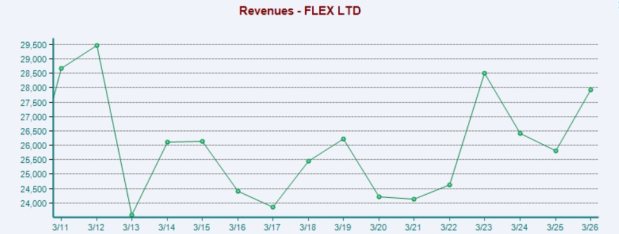
For the first quarter of fiscal 2027, the company expects net sales in the range of $7.35 billion to $7.65 billion, representing growth of approximately 14% at the midpoint of the guidance.For fiscal 2027, the company expects net sales to range between $32.3 billion and $33.8 billion, representing growth of approximately 18% at the midpoint of the guidance. Adjusted operating margin is projected to be between 7% and 7.1%, while adjusted EPS is expected to range from $4.21 to $4.51, implying growth of 32% at the midpoint.
Image Source: Zacks Investment Research
However, Flex is facing continued softness in certain end markets, particularly within its lifestyle business. Full-year ITS revenue declined 2% year over year due to persistent weakness in lifestyle, although this was partly offset by growth in communications. Management also expects fiscal 2027 ITS revenue to range from flat to low single-digit growth, as continued softness and the company’s deliberate deemphasis of lower-value lifestyle markets are expected to offset strength in communications.
The company is experiencing margin pressure within its Cloud and Power Infrastructure business due to ongoing investments and program ramp costs. During fiscal 2026, CPI adjusted operating margin declined 100 basis points year over year as incremental infrastructure investments in critical power and cloud ramp costs weighed on profitability. Management indicated that these investments temporarily reduced margins, although the company expects to recover these impacts as capacity utilization improves in the coming years.
The Case for JBL
Jabil is gaining from sustained strength in AI infrastructure demand, which continues to support growth across its Intelligent Infrastructure business. The company increased its fiscal 2026 AI-related revenue outlook to approximately $13.6 billion, up $500 million from its March forecast and significantly higher than fiscal 2025 levels. This growth is being driven by strong customer demand, disciplined execution and capabilities spanning compute, storage, networking, optics, power, cooling and rack-level integration. The company also secured its third hyperscale customer during the quarter, creating additional opportunities to expand customer relationships across the data center ecosystem.
The company is also benefiting from improving momentum across multiple end markets, supported by stronger-than-expected demand in automotive, renewables and Connected Living. The company raised its fiscal 2026 automotive revenue outlook to approximately $4.4 billion as stronger export demand from China, industry consolidation and growth in powertrain-agnostic platforms exceeded previous expectations. Renewables also continued to improve, benefiting from safe harbor projects, AI and data center-related power demand, and a shift toward commercial projects. Meanwhile, Connected Living and Digital Commerce outperformed the company's cautious assumptions, prompting higher revenue expectations for both businesses.
Jabil's diversified business model, combined with disciplined execution, enabled the company to deliver strong financial performance during the third quarter. The company delivered revenue, margins, earnings per share and free cash flow above expectations, while Intelligent Infrastructure continued to post broad-based growth across capital equipment, cloud and data center infrastructure, and networking and communications. Management also raised its fiscal 2026 outlook to approximately $35 billion in revenue, core operating margin of about 5.8%, core EPS of approximately $12.70 and adjusted free cash flow exceeding $1.4 billion.
Moreover, the company is gaining from ongoing capacity expansion and strategic initiatives that support long-term AI infrastructure demand. The company expects AI-related revenue growth in fiscal 2027 to be similar in percentage terms to fiscal 2026, despite a much larger revenue base, supported by new capacity coming online in North Carolina, Memphis, India and other locations. It also announced an AI infrastructure initiative with Adani Enterprises to establish a large-scale manufacturing platform in India focused on AI racks, servers, storage systems, networking equipment and supporting infrastructure. While management views this as a longer-term opportunity, it believes the initiative strengthens its position in a market expected to become increasingly important for AI infrastructure demand.
However, JBL continues to face some near-term challenges despite the positive outlook. Management remains cautious about demand volatility in the automotive market, even after stronger-than-expected performance during the quarter. The company also noted that component availability, portfolio mix, customer ramp timing and supply chain constraints, including shortages in certain memory and high-density components, remain a concern.
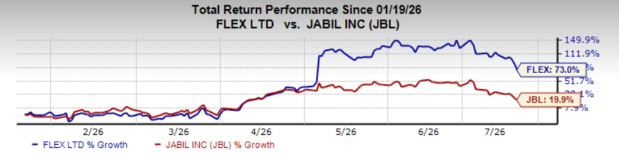
FLEX vs. JBL Share Price Performance
Over the past six months, FLEX shares have gained 73%, while Jabil has soared 19.9%.
Image Source: Zacks Investment Research
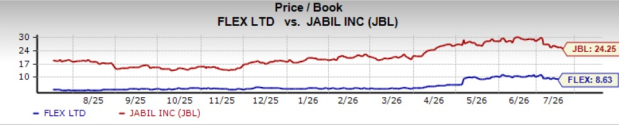
Valuation for FLEX & JBL
In terms of Price/Book, FLEX shares are trading at 8.63X, lower than JBL’s 24.25X.
Image Source: Zacks Investment Research
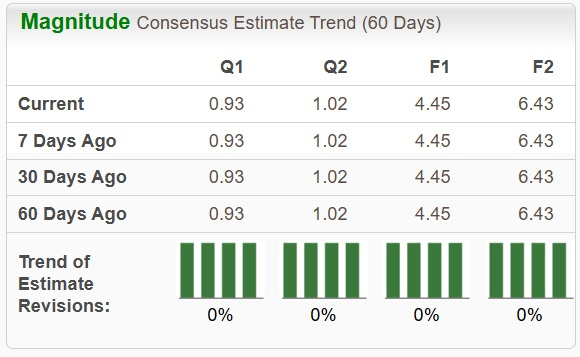
How Do Estimates Compare for FLEX & JBL?
Analysts have not revised their earnings estimates for FLEX’s bottom line for the current year.
Image Source: Zacks Investment Research
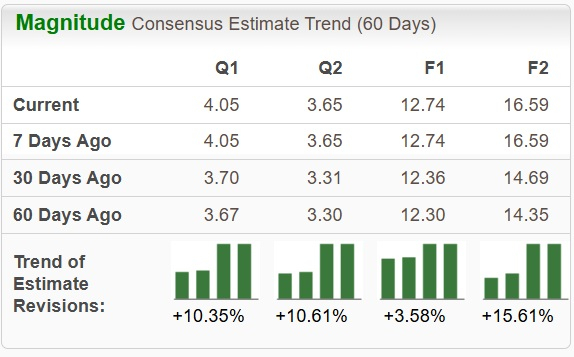
For JBL, there have been upward revisions for the current year.
Image Source: Zacks Investment Research
FLEX or JBL: Which Stock to Bet On?
While JBL sports a Zacks Rank #1 (Strong Buy) at present, FLEX has a Zacks Rank #3 (Hold). Consequently, in terms of Zacks Rank, JBL seems to be a better pick at the moment.
You can see the complete list of today’s Zacks #1 Rank stocks here.
7 Best Stocks for the Next 30 Days
Just released: Experts distill 7 elite stocks from the current list of 220 Zacks Rank #1 Strong Buys. They deem these tickers "Most Likely for Early Price Pops."
Since 1988, the full list has beaten the market more than 2X over with an average gain of +23.9% per year. So be sure to give these hand picked 7 your immediate attention.
See them now >>Want the latest recommendations from Zacks Investment Research? Today, you can download 7 Best Stocks for the Next 30 Days. Click to get this free report
Jabil, Inc. (JBL): Free Stock Analysis Report
Flex Ltd. (FLEX): Free Stock Analysis Report
This article originally published on Zacks Investment Research (zacks.com).