


Carvana Co. CVNA and Sonic Automotive, Inc. SAH are both automotive retailers in the United States. Carvana has transformed car buying with a convenient online experience, letting customers browse used cars from home and choose home delivery or pickup at its iconic car vending machines. Carvana’s end-to-end online business model covers every aspect of used-car retailing, including sales, financing, logistics, inspection and repair centers, as well as software development.
Sonic pursues an omnichannel model and sells new and used cars and light trucks. It offers warranties, service contracts, vehicle financing and insurance. Further, it provides maintenance and repair services, and sells replacement parts and aftermarket automotive products.
Let’s dig deeper and compare the fundamentals of these two auto retailers to determine which is the better investment choice now.
The Case for CVNA Stock
The ADESA U.S. acquisition continues to deepen Carvana’s logistics, auction and reconditioning network. As of the first quarter of 2026, Carvana had 16 ADESA integrated sites alongside its inspection and reconditioning centers, and it expects to integrate another 6 to 8 ADESA sites during 2026. The company is also expanding ADESA Clear as its digital wholesale platform. These initiatives increase inventory mobility and expand production options, which can support volume growth while keeping reconditioning buildouts more capital efficient.
ADESA recently announced the launch of ADESA Timed, an enhancement to its digital wholesale platform that enables financial institutions, fleets, rental companies and dealer groups to sell inventory through self-service timed digital auctions using the same technology and tools as ADESA Clear.
The e-commerce platform expects a sequential increase in retail units sold in the second quarter of 2026, and it remains on track to deliver growth in retail units for full-year 2026. Retail units sold rose 40% year over year in the first quarter of 2026 to a record 187,393 units, marking another quarter of outsized growth. The market remains highly fragmented, with Carvana’s share still small. This suggests that there is ample room for the company to expand, especially as more consumers gravitate toward online car buying. In the longer term, the company continues to target selling three million cars per year in the 2030 to 2035 time frame.
SG&A leverage remains visible as volume rises, and the company reported reductions in non-GAAP SG&A expense per retail unit sold versus last year. Carvana posted adjusted EBITDA of $672 million in the first quarter of 2026, a company record compared with $488 million in the year-ago period. Looking to the second quarter of 2026, it expects a sequential increase in adjusted EBITDA, and it reiterated its longer-term goal of reaching a 13.5% adjusted EBITDA margin as scale increases and fixed costs are leveraged.
However, Carvana’s debt load remains sizable. As of March 31, 2026, long-term debt was $4.85 billion, up from $4.83 billion as of Dec. 31, 2025. Its debt-to-capital ratio stands at 0.53 compared with the auto sector’s 0.25. Elevated leverage restricts the firm’s flexibility to tap into growth opportunities.
Carvana is still heavily investing in advertising, technology, automation, facilities and AI-related systems. While these investments are intended to support long-term growth, they also create ongoing cost pressure. Overhead expenses are now at a structurally higher level compared to 2025 due to technology and facility investments. Advertising expense per unit also increased as the company continues aggressively promoting its platform. These spending commitments may delay margin expansion if revenue growth slows or if operational gains take longer than expected to materialize.
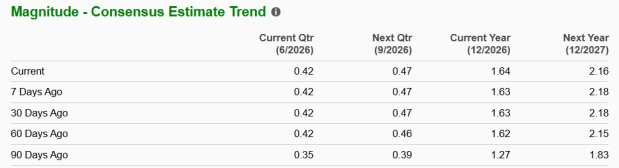
The Zacks Consensus Estimate for CVNA’s 2026 sales and EPS implies year-over-year growth of 39.2% and a decline of 3%, respectively. EPS estimates for 2026 have improved by a penny in the past seven days. EPS estimates for 2027 have declined 2 cents in the past seven days.
Image Source: Zacks Investment Research
The Case for SAH Stock
The buyout of RFJ Auto Partners, completed in 2021, expanded Sonic Automotive’s reach and helped it become one of the top five U.S. dealership groups. In the second quarter of 2025, Sonic acquired four Jaguar and Land Rover dealerships in California and became the largest U.S. retailer of these brands.
Moreover, the acquisition of five Harley-Davidson dealerships has strengthened its diversification strategy and expanded its exposure to the faster-growing powersports retail market. The deal lifts Sonic Powersports to 20 rooftops and 46 franchises, including nine full-service Harley-Davidson dealerships, positioning the unit among the top five U.S. powersports dealer groups. This comes after record 2025 company revenues of $15.2 billion and Powersports revenues of $202.9 million with $11.5 million in adjusted EBITDA, suggesting the segment is scaling from a stronger financial base. Broader brand coverage and entry into active riding markets should support incremental sales, service, parts and merchandise opportunities. The company expects 2026 Powersports adjusted EBITDA to be in the range of $14 to $17 million compared with $11.5 million in 2025.
Sonic’s EchoPark segment operates independently from the franchised dealerships business, sells used cars and light trucks and arranges Finance & Insurance product sales for customers in pre-owned vehicle specialty retail locations. In the first quarter of 2026, EchoPark revenues increased 4% year over year to $580.5 million and adjusted EBITDA reached $18.6 million. A gradual increase in used-vehicle supply and more normalized pricing should support demand and lift EchoPark’s retail unit volumes. Sonic is investing in EchoPark’s digital tools, including its app and broader digital retail platform, to support an omnichannel buying process. For 2026, the company expects high single-digit growth in used retail unit sales volume and total GPU of $3,400 to $3,600, and raised adjusted EBITDA guidance to $35 million to $40 million.
However, the company’s stretched balance sheet remains a concern. SAH ended the first quarter of 2026 with $1.5 billion in long-term debt and just $5.7 million. Long-term debt-to-capital is 0.66 versus the industry’s 0.26.
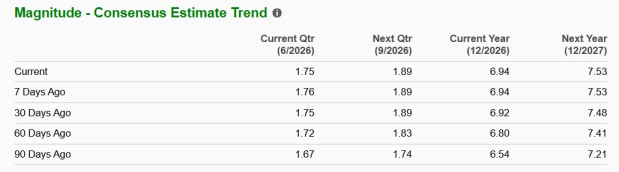
The Zacks Consensus Estimate for SAH’s 2026 sales and EPS implies year-over-year growth of 2.9% and 5.2%, respectively. EPS estimates for 2026 and 2027 have improved 2 cents and 5 cents, respectively, in the past 30 days.
Image Source: Zacks Investment Research
Price Performance of CVNA & SAH
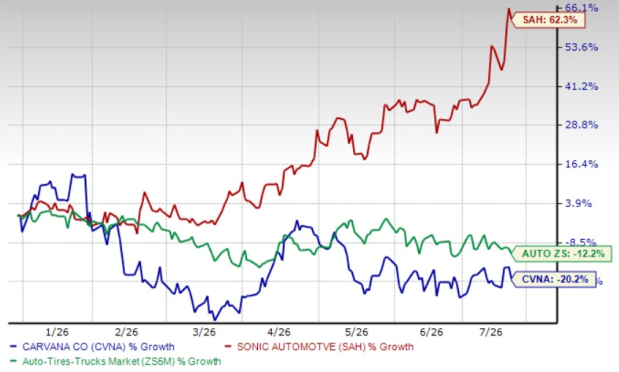
CVNA stock has declined 20.2% year to date, while shares of SAH have surged 62.3%. The auto sector has declined 12.2% in the same time frame.
Image Source: Zacks Investment Research
Conclusion
While Carvana offers stronger growth potential through its scalable e-commerce model, expanding ADESA network and robust retail volume growth, its high debt burden and elevated investments in technology, facilities and advertising could pressure profitability.
In contrast, Sonic benefits from a diversified business model spanning new and used vehicle sales, after-sales services and powersports, while EchoPark provides additional exposure to the growing used-car market. An improved 2026 earnings outlook and stronger EPS growth expectations also enhance prospects. Although Sonic's leverage remains high, its broader revenue base and diversification provide greater stability.
SAH carries a Zacks Rank #2 (Buy), while CVNA has a Zacks Rank #3 (Hold). Moreover, with shares already up sharply, the market appears to recognize Sonic's improving fundamentals, making it a more balanced investment option. You can see the complete list of today’s Zacks #1 Rank (Strong Buy) stocks here.
Radical New Technology Could Hand Investors Huge Gains
Quantum Computing is the next technological revolution, and it could be even more advanced than AI.
While some believed the technology was years away, it is already present and moving fast. Large hyperscalers, such as Microsoft, Google, Amazon, Oracle, and even Meta and Tesla, are scrambling to integrate quantum computing into their infrastructure.
Senior Stock Strategist Kevin Cook reveals 7 carefully selected stocks poised to dominate the quantum computing landscape in his report, Beyond AI: The Quantum Leap in Computing Power .
Kevin was among the early experts who recognized NVIDIA's enormous potential back in 2016. Now, he has keyed in on what could be "the next big thing" in quantum computing supremacy. Today, you have a rare chance to position your portfolio at the forefront of this opportunity.
See Top Quantum Stocks Now >>Want the latest recommendations from Zacks Investment Research? Today, you can download 7 Best Stocks for the Next 30 Days. Click to get this free report
Sonic Automotive, Inc. (SAH): Free Stock Analysis Report
Carvana Co. (CVNA): Free Stock Analysis Report
This article originally published on Zacks Investment Research (zacks.com).